A/C Performance Diagnosis
Testing may include vent temperature, ambient conditions, system pressures, compressor command and operation, cooling-fan performance, electrical data, and airflow. The exact checks depend on the vehicle and complaint.

Automotive Air Conditioning Service
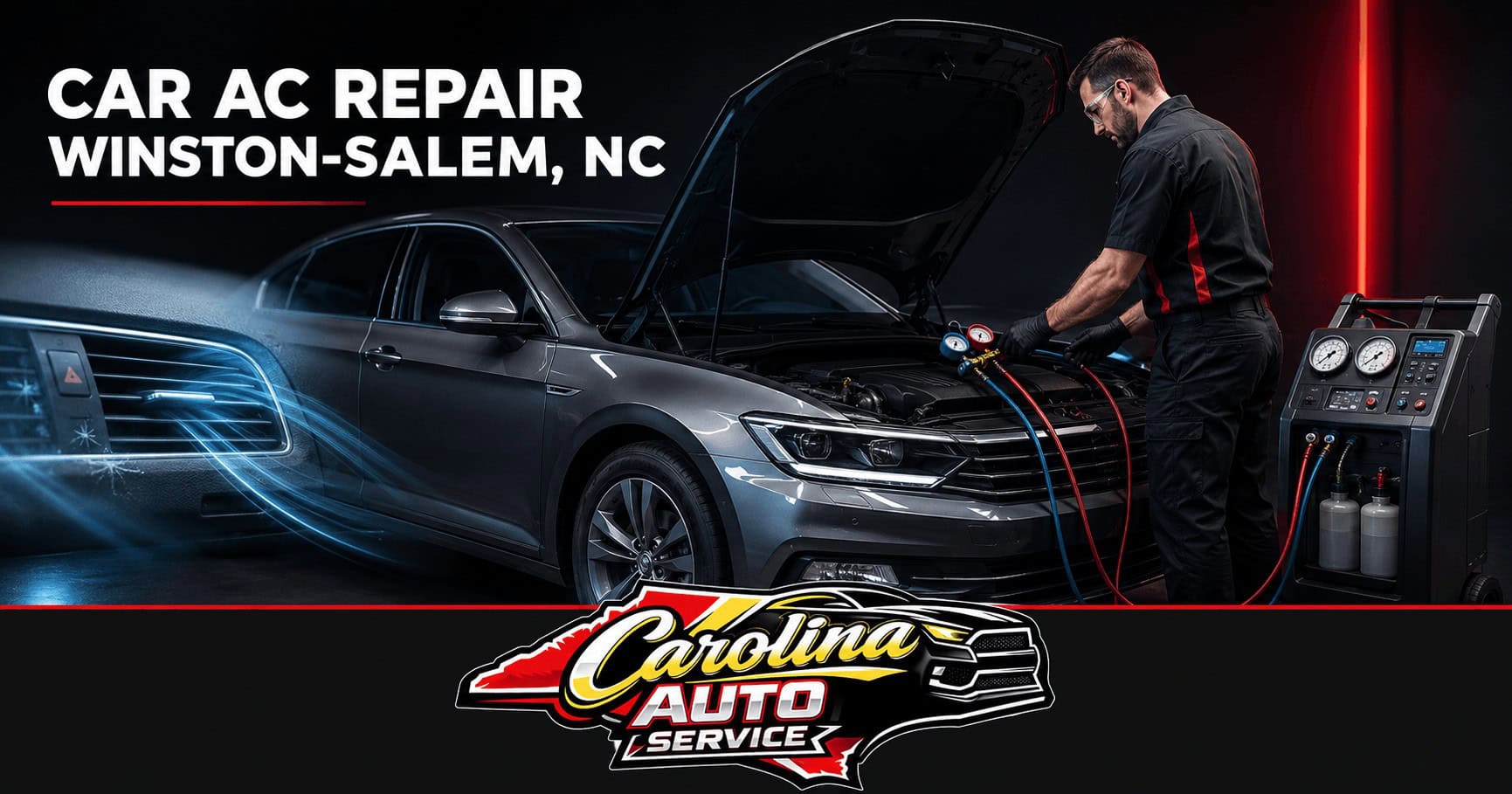
When your vehicle blows warm air, cools inconsistently, makes noise, or has weak airflow, Carolina Auto Service provides car AC repair in Winston-Salem based on proper testing—not guesswork or an automatic refrigerant top-off. Our team evaluates the complete climate-control system, explains what the findings mean, and recommends the repair that fits your vehicle and the confirmed cause.
Find the cause
Professional automotive air conditioning service is a diagnostic and repair process for the system that cools, dries, and distributes cabin air. Depending on the symptoms, that process may include temperature and pressure testing, refrigerant identification, visual inspection, electronic diagnosis, leak detection, airflow testing, evacuation and recharge, or repair of a failed component. The correct sequence matters because warm vent air can have several different causes.
An A/C system is closed by design. If refrigerant is low, there may be a leak that should be located rather than repeatedly covered up with another charge. If the refrigerant amount is correct, the problem may involve compressor control, a pressure sensor, a relay, a condenser fan, a temperature sensor, a blend door, the blower circuit, or another part of the climate-control system. Replacing the compressor simply because it is not operating can be expensive and ineffective if an electrical or control fault is preventing engagement.
Carolina Auto Service approaches car AC repair in Winston-Salem by separating the symptom from the underlying failure. The team considers what the system does at idle and while driving, whether cooling changes between vents, when the concern began, whether prior refrigerant or stop-leak products were added, and whether warning lights or electrical problems are present. That information helps define the testing path and reduces unnecessary parts replacement.
Complete climate-control care
Testing may include vent temperature, ambient conditions, system pressures, compressor command and operation, cooling-fan performance, electrical data, and airflow. The exact checks depend on the vehicle and complaint.
When indicated, the correct refrigerant is recovered with appropriate equipment, the system is evacuated, and the specified charge is installed by weight. Correct charge quantity is essential; both undercharging and overcharging can reduce performance.
Leak diagnosis can involve visual inspection, electronic detection, ultraviolet dye already compatible with the system, vacuum observations, or other approved methods. The goal is to identify the source and repairability before another loss of cooling.
A compressor concern may come from internal damage, a clutch or control-valve issue, improper system pressure, low-voltage supply, sensor data, wiring, or control commands. Testing distinguishes mechanical failure from an upstream problem.
The condenser releases heat at the front of the vehicle; the evaporator absorbs cabin heat inside the HVAC case. Damage, restriction, contamination, corrosion, or leakage can affect cooling and require component-specific repair.
Weak or missing airflow may involve a restricted cabin filter, blower motor, resistor or control module, wiring, ducts, mode doors, or an evaporator that is icing. Airflow testing prevents an A/C refrigeration problem from being misdiagnosed.
Modern climate control relies on switches, pressure sensors, temperature sensors, relays, modules, actuators, and network communication. Scan data and circuit testing can be as important as pressure readings.
A dirty filter can restrict airflow, while odors can come from moisture, debris, microbial growth near the evaporator, a clogged drain, or another cabin source. The remedy should match the actual source rather than merely masking it.
Some hybrids use high-voltage electric compressors and require vehicle-specific oils, equipment, and procedures. Visit our hybrid service page or call with the year and model so the shop can confirm the appropriate service.
Recognize the warning signs
Warm air is the most obvious sign of an A/C problem, but it does not identify a single failed part. A low refrigerant charge may prevent normal cooling, yet the original reason for that loss could be a seal, hose, service-port valve, condenser, evaporator, compressor, or another connection. A compressor may be mechanically capable of working but never receive the correct command because of pressure, temperature, electrical, or module inputs.
Cooling that improves on the highway but becomes warm in traffic can point the diagnostic process toward condenser airflow, cooling fans, pressure behavior, or compressor performance at lower speed. Cold air from one side and warm air from the other may involve a blend-door actuator, temperature sensor, low charge on certain designs, or a control issue. Air that starts cold and then becomes warm can relate to evaporator icing, compressor control, sensor readings, excessive pressure, or heat load. Each pattern is evidence, not a diagnosis by itself.
| What You Notice | Possible Areas to Test | Recommended Next Step |
|---|---|---|
| Warm air from every vent | Refrigerant charge, leaks, compressor operation, pressure sensors, controls, electrical supply | Schedule a complete A/C diagnosis before adding refrigerant or replacing parts. |
| Cold while driving, warmer at idle | Condenser airflow, cooling fans, charge level, compressor performance, engine temperature | Avoid assuming the compressor is bad; compare pressures and temperatures at different engine speeds. |
| Weak airflow at all fan speeds | Cabin filter, blower motor, duct restriction, evaporator icing, airflow doors | Request HVAC airflow and blower-circuit testing. |
| No air on some fan settings | Blower resistor/module, switch, connector, wiring, motor | Have the blower electrical circuit tested. |
| Different temperatures left to right | Dual-zone controls, blend doors, actuators, sensors, charge behavior | Scan the climate-control system and verify door operation. |
| Clicking behind the dashboard | Mode or temperature-door actuator, damaged door or linkage | Identify the exact actuator before disassembly. |
| Musty odor after startup | Cabin filter, evaporator moisture, drain, debris, cabin sources | Inspect the filter, drainage, and evaporator area; avoid relying only on fragrance products. |
| Water inside the passenger area | Blocked/disconnected evaporator drain or another water intrusion path | Address promptly to protect carpet, wiring, and interior materials. |
Some apparent A/C problems overlap with other vehicle systems. An overheating engine, inoperative radiator fan, weak battery, charging-system fault, or control-module issue can affect air conditioning operation. If the temperature gauge is rising or a warning message indicates overheating, stop driving when safe and address the cooling-system concern. Carolina Auto Service also provides radiator and cooling-system repair, check-engine-light diagnostics, and broader auto repair services.
Testing before parts
A useful diagnosis begins with the driver’s description. Tell the service team whether the concern is constant or intermittent, which vents are affected, whether it changes at idle, whether any noises occur, and whether work was recently performed. The vehicle’s year, make, model, engine or hybrid configuration, and prior repair history can change the testing requirements.
The technician operates the system under relevant conditions and records vent temperature, blower behavior, control response, noises, odors, or differences between zones. A problem that cannot be duplicated may require additional information or testing under specific conditions.
The refrigerant label, service information, compressor type, system capacity, and applicable procedures are verified. This step is especially important for newer vehicles and hybrids because incorrect refrigerant, oil, or equipment can contaminate or damage a system.
The team checks accessible components, belt condition where applicable, condenser condition, fan operation, electrical connections, airflow, and relevant temperatures and pressures. Scan-tool data or circuit testing may be used when the system is electronically controlled.
If charge loss is suspected, the diagnostic plan focuses on locating the leak. If charge is correct, testing shifts toward compressor performance, restrictions, actuators, sensors, controls, and airflow. Findings—not assumptions—determine the repair recommendation.
Before authorized work begins, the shop explains the diagnosed concern, relevant parts or services, and estimate. When more than one issue exists, the team can distinguish the repair needed to restore operation from maintenance or related items that may be considered separately.
After repair, system operation should be rechecked for appropriate cooling, airflow, pressure behavior, control response, and leakage as applicable. Final performance depends on ambient temperature, humidity, cabin heat load, vehicle design, and vent settings.
This process is more reliable than treating every warm-air complaint as “low Freon.” The term “Freon” is often used generically, but vehicles may use different refrigerants, and a pressure reading alone does not always reveal the refrigerant mass or the root cause. Proper service follows the specifications for the actual vehicle.
Correct refrigerant, correct procedure
Carolina Auto Service can service automotive systems using R-134a and R-1234yf. R-1234yf is used in many newer vehicles because it has a substantially lower global-warming impact than R-134a, but it is not a performance upgrade to be installed in any vehicle at will. The system label and manufacturer information identify the specified refrigerant, charge amount, oil requirements, and service procedure.
The distinction affects equipment, fittings, handling, leak detection, recovery, and contamination prevention. A shop should identify what is in the system before recovery or charging, particularly if the vehicle has an unknown service history. Mixing refrigerants or adding an unapproved substitute can impair performance, complicate future service, damage equipment, and create regulatory or safety problems.
Federal rules also prohibit knowingly releasing motor-vehicle refrigerants during service, maintenance, repair, or disposal. The U.S. Environmental Protection Agency requires technicians who service motor-vehicle air conditioners for compensation to be trained and certified under Clean Air Act Section 609. Refrigerant work therefore requires more than attaching a retail can and watching a low-side gauge.
Owners should be cautious with DIY recharge products, particularly sealers. A single gauge cannot evaluate every operating condition, and adding refrigerant without confirming the system type, existing charge, leak condition, and correct amount can overcharge the system or hide a larger problem. If another product has already been introduced, disclose that information when scheduling; it can affect testing and service decisions.
Component-specific repairs
The compressor circulates refrigerant and creates the pressure difference needed for heat transfer. Depending on vehicle design, it may be belt-driven, variable-displacement, clutchless, or electrically driven. Internal failure can release debris into the system, so a confirmed compressor failure may require more than replacing the compressor alone. The repair plan depends on contamination, component design, and manufacturer procedures.
The condenser releases absorbed heat to outside air. Road debris can damage it, while restricted fins or inoperative fans can reduce heat rejection. Fan problems often become more noticeable at low road speed or in traffic. Because fan operation may also protect engine cooling, related symptoms deserve prompt evaluation.
The evaporator cools and dehumidifies air inside the HVAC housing. Evaporator leaks can be difficult to see directly and may require targeted testing. Normal moisture should leave through the drain; a blocked drain may allow water into the passenger compartment. A small puddle of clear water beneath a parked vehicle after A/C use is usually normal condensation.
The metering device controls refrigerant flow into the evaporator. A restriction, contamination, or control problem can create abnormal pressures and temperatures. Diagnosis should distinguish a metering fault from incorrect charge, compressor weakness, moisture, or another restriction before parts are replaced.
Flexible hoses, O-rings, shaft seals, line connections, and service valves can lose refrigerant. Some leakage leaves visible oil or dye evidence; other leaks are small or occur only under certain temperature and pressure conditions. Locating the source helps determine whether a seal, line, component, or connection needs repair.
The refrigeration loop may be operating correctly while cooled air never reaches the cabin as intended. Blower motors, resistors or modules, cabin filters, mode doors, blend doors, actuators, control heads, wiring, and sensors all influence airflow and temperature. That is why vent behavior belongs in a complete diagnosis.
Newer vehicle systems
Many hybrid vehicles use electrically driven air-conditioning compressors so cabin cooling can continue when the gasoline engine is off. These compressors may operate at high voltage and can require a specific nonconductive lubricant. Cross-contamination with the wrong oil or service equipment can affect electrical insulation and compressor reliability. A/C service for a hybrid should therefore follow the exact vehicle procedure rather than a generic routine.
Climate control can also interact with battery thermal management on some electrified vehicles. A cabin-cooling complaint, warning message, or loss of A/C performance may involve controls beyond a conventional compressor clutch circuit. The shop must identify the architecture, review fault data, and confirm that the required equipment and procedure apply to that model.
Carolina Auto Service works on supported hybrid systems at its Winston-Salem facility. Because designs vary, provide the year, make, model, powertrain, warning message, and symptoms when arranging service. The team can confirm whether the requested A/C diagnosis or repair is supported before your visit. This avoids broad promises that ignore important differences among vehicles.
Clear expectations
The cost of automotive A/C repair depends on the confirmed failure, refrigerant type and capacity, vehicle design, access to the affected component, contamination, and whether additional parts are required by the repair procedure. A diagnostic evaluation or a correctly performed recharge is different from repairing a leaking evaporator, replacing a compressor after internal failure, correcting an electrical fault, or accessing an actuator deep inside the dashboard.
R-1234yf service commonly has different material and equipment considerations from R-134a service. Labor can also vary substantially. A condenser may be relatively accessible on one vehicle but require significant front-end disassembly on another. An evaporator or certain temperature-door repairs may require removal of substantial interior components. Hybrid compressor work adds vehicle-specific high-voltage and lubricant requirements.
| Cost Factor | Why It Matters |
|---|---|
| Diagnostic complexity | Intermittent, electrical, network, or concealed leaks may require more testing than an obvious visible failure. |
| Refrigerant type and amount | The specified refrigerant, system capacity, recovery needs, and contamination status affect service requirements. |
| Failed component | A seal or accessible line differs greatly from a compressor, evaporator, HVAC case, or control-module concern. |
| Labor access | Dashboard, bumper, cooling-module, or powertrain-area disassembly can increase time. |
| Contamination or debris | Internal compressor failure may require additional components and cleaning steps to protect the replacement. |
| Hybrid architecture | High-voltage safety, oil compatibility, and model-specific procedures may change the repair process. |
A trustworthy estimate follows diagnosis. Quoting a single price for “A/C repair” without knowing the refrigerant, system condition, and failed component can be misleading. Carolina Auto Service evaluates the concern and obtains authorization before performing the recommended repair. Call 336-765-8599 or request an appointment with the vehicle details and symptoms.
Comfort and visibility
North Carolina heat and humidity make cabin cooling important, but automotive air conditioning also helps remove moisture from air used for windshield defogging. A system that cannot dehumidify effectively may take longer to clear glass in damp conditions. Airflow failures, inoperative mode doors, and blower problems can also affect the driver’s ability to direct air toward the windshield.
Early evaluation can prevent a small concern from becoming more disruptive. A slow leak may eventually lower pressure enough that cooling stops. A noisy bearing or compressor can deteriorate. A blocked condensate drain can wet carpeting and nearby components. A failing blower may become intermittent before stopping. Prompt diagnosis does not guarantee a minor repair, but it provides information while the system may still be partly operational.
If the A/C fails suddenly with belt noise, smoke, an electrical smell, overheating, or another warning condition, turn the system off and stop driving when continued operation may be unsafe. A seized belt-driven component can affect the accessory belt on some vehicles. An overheating engine can suffer serious damage if driven. When unsure, call the shop for guidance and arrange safe transport rather than continuing to drive solely to preserve an appointment.
Local auto repair facility
Carolina Auto Service is a physical repair shop located at 160 Hanes Mall Circle, Winston-Salem, NC 27103. The current business is not a mobile repair operation. Customers bring their cars, SUVs, light-duty trucks, vans, and supported hybrids to the Winston-Salem facility for diagnosis, maintenance, and repair.
The page does not promise that every concern needs refrigerant or a compressor. Testing is used to narrow the cause before the repair recommendation.
Refrigerant, charge amount, oil, component design, and repair procedures are matched to the vehicle rather than treated as universal.
The shop is near Hanes Mall and serves drivers from Winston-Salem and surrounding communities during weekday business hours.
If the concern involves engine cooling, electrical diagnosis, maintenance, or another system, the broader auto-repair team can evaluate related needs.
R-134a and R-1234yf service enables the shop to address a broad range of older and newer vehicles without describing one refrigerant as a universal upgrade.
Providing symptoms and vehicle details in advance helps the team confirm service compatibility and plan the appropriate diagnostic path.
Carolina Auto Service is open Monday through Friday from 7:30 a.m. to 5:30 p.m. Service availability and completion time depend on diagnosis, parts, authorization, vehicle design, and shop workload. For broader information about the team and facility, visit the About Carolina Auto Service page.
Prepare for your visit
A detailed description can shorten the path to the right test. Share the vehicle’s year, make, model, engine or hybrid configuration, mileage, and whether the climate control is manual, automatic, or dual-zone. Describe whether air is warm, airflow is weak, the problem is intermittent, one side behaves differently, or the concern changes with vehicle speed.
Remove valuables and provide access to wheel-lock keys or other items the shop may need. If the concern occurs only under specific conditions, explain them on the appointment form. Do not intentionally reproduce a condition that creates smoke, overheating, severe noise, or an electrical-burning smell.
Get a vehicle-specific diagnosis for warm air, weak airflow, A/C leaks, compressor concerns, climate-control faults, or R-134a and R-1234yf service at Carolina Auto Service.
Car A/C questions
Warm air can result from low refrigerant caused by a leak, a compressor or compressor-control problem, an electrical fault, incorrect sensor information, a restriction, poor condenser airflow, or a temperature-door issue. Because several failures create the same symptom, the best first step is a complete diagnosis that considers vent temperature, system pressures, refrigerant specification, compressor operation, fans, scan data, and airflow. Adding refrigerant without confirming the cause may temporarily change performance while leaving the leak or control problem unresolved.
An automotive A/C system is sealed and does not consume refrigerant like fuel. A very small amount may escape over a long period through hoses and seals, but a noticeably low charge or repeated loss of cooling warrants leak evaluation. Common leak areas include service ports, O-rings, hoses, the condenser, compressor seals, and the evaporator. The correct response depends on how much refrigerant is present, the system’s history, whether a leak can be located, and whether another failure has affected pressure or cooling.
Carolina Auto Service supports automotive A/C systems using R-134a and R-1234yf. The refrigerants are not interchangeable, and R-1234yf is not a universal upgrade for an R-134a vehicle. The technician should verify the under-hood label and service information, identify the refrigerant in the system, use the correct equipment, and charge the manufacturer-specified amount by weight. Tell the shop if refrigerant, sealer, or another product has previously been added.
Testing is required to know. Low charge may indicate a leak, while warm air with a correct charge can point to a compressor, sensor, control, fan, restriction, blend-door, or airflow problem. A professional evaluation may include performance testing, pressure and temperature readings, visual inspection, leak detection, electrical checks, and scan-tool data. If a leak or failed component is confirmed, recharging alone will not resolve the underlying problem. The shop should explain the findings and obtain authorization before repair.
Timing depends on the diagnostic complexity, refrigerant type, failed component, access, parts availability, contamination, authorization, and current workload. A straightforward evaluation or service may require much less time than an intermittent electrical fault, concealed evaporator leak, dashboard-related repair, or compressor failure that released debris. Carolina Auto Service does not promise the same turnaround for every vehicle. When scheduling, provide the year, model, symptoms, prior repairs, and any deadline so the team can set realistic expectations.
This pattern may involve insufficient airflow across the condenser, a cooling-fan problem, incorrect refrigerant charge, pressure behavior, compressor performance at low speed, or high engine temperature. Road speed can move more air through the condenser, which may temporarily improve cooling and mask the underlying problem. A technician should compare system operation at idle and increased speed, verify fan commands and airflow, monitor pressures and temperatures, and inspect related cooling-system conditions before recommending a repair.
Weak airflow may be caused by a restricted cabin air filter, failing blower motor, blower-control problem, blocked duct, malfunctioning mode door, evaporator icing, or debris near the air intake. If some fan speeds work and others do not, the resistor or electronic blower-control circuit may be involved. Refrigerant service will not correct a basic airflow failure. The diagnostic process should confirm blower output, filter condition, air-door movement, duct delivery, and whether the evaporator is freezing.
A small amount of clear water beneath the vehicle after the air conditioner has been operating is generally normal. The evaporator removes moisture from cabin air, and condensation exits through a drain. Water inside the passenger compartment is not normal and may indicate a clogged or disconnected drain or another source of water intrusion. Have interior moisture addressed promptly because wet carpet can create odors and affect wiring, modules, insulation, or interior materials.
Carolina Auto Service evaluates supported hybrid A/C systems, but compatibility should be confirmed for the exact vehicle and repair. Many hybrids use high-voltage electric compressors and require model-specific oils, isolated equipment, safety procedures, and diagnostic steps. Using the wrong lubricant or contaminated service equipment can harm the compressor or electrical insulation. Provide the year, make, model, hybrid configuration, warning messages, and symptoms when requesting an appointment so the shop can confirm capability.
Call Carolina Auto Service at 336-765-8599 or use the online appointment form. The physical shop is located at 160 Hanes Mall Circle, Winston-Salem, NC 27103, and is open Monday through Friday from 7:30 a.m. to 5:30 p.m. Include the vehicle’s year, make, model, refrigerant type if known, symptoms, warning lights, prior A/C repairs, and any refrigerant or sealer previously added. Service time depends on diagnosis, authorization, parts, and shop workload.