
If your car stalls while driving, turn on the hazard lights, maintain control, and move out of traffic if you can do so safely. Steering and brake assist may feel different after the engine stops, so avoid abrupt inputs and do not repeatedly re-enter traffic just because the engine restarts.
Stalling can be caused by fuel delivery, ignition, electrical power, charging-system problems, engine-position signals, airflow control, sensors, vapor-control faults, or mechanical engine conditions. The pattern surrounding the stall is often as important as the stall itself.
A vehicle that shuts off unexpectedly can be both frustrating and dangerous, especially when the stall happens in traffic, at an intersection, while turning, or at higher road speeds.
The first step is to describe the symptom correctly.
Stalling means the engine stops running after it has already started. That is different from a no-crank condition, where the starter does not turn the engine, and different from a crank-no-start condition, where the engine turns over but never begins running.
That distinction matters because each symptom sends the diagnostic process in a different direction.
For an intermittent stall, one of the most valuable pieces of information is the pattern: whether the engine was hot or cold, whether the vehicle was moving or idling, whether you were braking or turning, whether the air conditioner was running, whether the fuel level was low, and what happened to the dashboard immediately before the engine stopped.
What Should You Do First if Your Car Stalls While Driving?
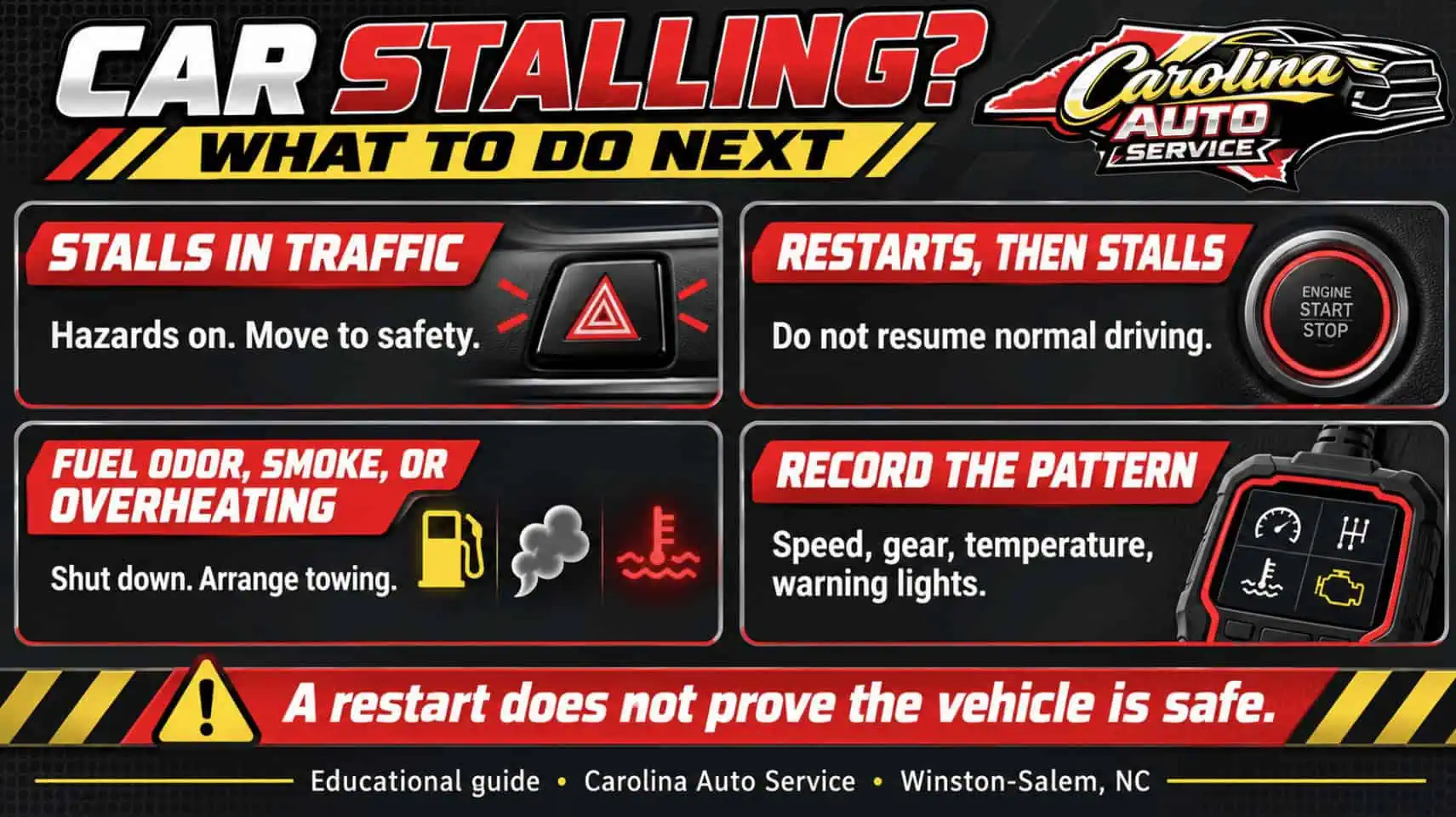
If the engine stops while the vehicle is moving, activate the hazard lights, maintain control, and move toward a safe location outside the active traffic lane if possible. Do not assume the problem is fixed because the vehicle restarts. A repeat stall may happen without warning.
| What You Notice | Recommended Next Step | Why It Matters |
|---|---|---|
| Engine stalls in moving traffic | Use hazards, maintain control, and move to safety if possible | Steering and brake assist may change, and another stall can expose occupants to traffic |
| Vehicle restarts but stalls again | Do not resume normal driving; arrange towing | A successful restart does not prove the underlying fault has disappeared |
| Stall with fuel odor, smoke, overheating, or oil warning | Shut the vehicle down and arrange towing or emergency help as appropriate | Fire, lubrication, or overheating damage may be developing |
| Single stall after obvious clutch error in a manual vehicle | Restart only when conditions are safe | A repeat stall or additional symptom still deserves evaluation |
| Stalls only at stoplights or while idling | Record the pattern and schedule diagnosis | Idle-load, airflow, fuel, electrical, or control problems may appear only at low engine speed |
What Does “Stalling” Actually Mean?
Drivers sometimes use the word “stalling” for several different vehicle problems. Separating them helps prevent misdiagnosis.
Engine Stalls
The engine was running and then stopped. It may restart immediately, restart later, or refuse to restart after the event.
Engine Will Not Start
The engine never begins running. The starter may crank normally, crank slowly, or not crank at all. This follows a different diagnostic path.
Vehicle Loses Power
The engine continues running but the vehicle cannot accelerate normally. This may feel similar to a stall but is diagnostically different.
Carolina Auto Service also provides check-engine light diagnosis when a stall occurs with warning lights or stored diagnostic information.
Why Can a Car Stall While Driving or Idling?
1. Electrical Power Interruption
Modern engines depend on continuous electrical power for the engine-control module, fuel system, ignition system, sensors, actuators, and other electronic components.
A power interruption can result from issues involving:
- Loose battery connections
- Damaged wiring
- Poor grounds
- Relays
- Ignition-switch circuits
- Power-distribution connections
- Charging-system faults
- Module power or communication loss
Diagnostic clue: Tell the shop whether the dashboard, radio, gauges, or other electronics also lost power when the engine stalled. A complete electrical shutdown suggests a different test path than an engine that stops while the rest of the vehicle remains powered.
2. Crankshaft or Camshaft Position Signal Loss
The engine-control system uses crankshaft and camshaft position information to determine engine speed and position so it can control ignition and fuel injection.
A sensor, damaged wire, connector problem, reluctor issue, timing problem, or heat-related electrical failure can interrupt those signals.
Diagnostic clue: Some position-signal failures store diagnostic trouble codes. Others may need live-data monitoring or waveform testing while the problem is actually occurring.
3. Fuel Delivery Problem
An engine needs an adequate amount of correctly delivered fuel to keep running.
Possible areas that may require testing include:
- Fuel-pump operation
- Pump electrical supply
- Fuel pressure
- Pressure regulation
- Fuel quality or contamination
- Restrictions
- Injector control
- Fuel-system wiring
Diagnostic clue: A stall that occurs under acceleration, climbing a grade, with a low fuel level, or after sustained driving can help shape the fuel-system test plan, but those patterns do not prove the fuel pump has failed.
4. Airflow or Idle-Control Problem
When the accelerator is released, the engine-control system has to maintain enough airflow and fueling to keep the engine running at idle.
Problems involving throttle control, airflow measurement, vacuum leaks, carbon buildup, learned idle values, or other airflow-related conditions may become more noticeable when engine speed drops.
This is why some vehicles drive normally at road speed but stall:
- At stoplights
- While parking
- When shifting into gear
- With the air conditioner running
- During low-speed turns
5. EVAP Purge or Vapor-Control Problem
The evaporative-emissions system controls how fuel vapors are stored and introduced into the engine.
A purge-control problem can sometimes disturb the air-fuel mixture enough to create rough running or stalling under certain conditions.
If the stall tends to happen shortly after refueling, tell the technician. That timing may be useful when evaluating vapor-control operation.
6. Charging-System Problem
Once the engine is running, the charging system supplies electrical energy to the vehicle and maintains the battery.
A failing alternator, belt problem, damaged connection, poor ground, or charging-control fault can eventually reduce available system voltage enough to affect engine operation.
A battery warning light does not automatically mean the battery itself is bad. The battery, alternator, belt, wiring, grounds, charging voltage, and vehicle control strategy may all need to be evaluated together.
7. Ignition-System Problem
Gasoline engines require reliable ignition to keep operating.
Ignition coils, wiring, control circuits, power supply, spark plugs, or related components can potentially contribute to severe misfire or engine shutdown depending on the vehicle and failure mode.
A stall accompanied by heavy misfiring or rough running provides different information than an engine that shuts off instantly and cleanly.
8. Mechanical or Temperature-Related Condition
Mechanical engine problems can also prevent an engine from remaining running.
Depending on the symptoms, technicians may need to evaluate:
- Compression
- Valve timing
- Timing-chain or timing-belt operation
- Overheating
- Exhaust restriction
- Persistent misfire
- Other internal engine conditions
Noise, overheating, severe power loss, persistent misfire, or unusual mechanical sounds make this part of the diagnosis more important.
Why Does My Car Stall Only at Stoplights or While Idling?
If the engine runs normally at higher RPM but stalls when you come to a stop, the problem may be most noticeable when the engine is trying to maintain idle speed.
Possible areas to evaluate can include:
- Electronic throttle operation
- Airflow measurement
- Vacuum leaks
- Idle adaptation
- EVAP purge flow
- Fuel mixture
- Accessory load compensation
- Electrical-system voltage
- Mechanical engine condition
A technician may also want to know whether the vehicle stalls:
Those differences can substantially narrow the diagnostic path.
Why Does My Car Stall While Driving at Higher Speed?
A stall while cruising or accelerating generally deserves more caution because the vehicle may lose predictable engine power while surrounded by moving traffic.
Potential diagnostic areas include:
- Electrical power interruption
- Crank or cam signal loss
- Fuel pressure loss
- Charging-system failure
- Ignition failure
- Control-module power or communication problems
- Serious mechanical or temperature-related conditions
If the vehicle restarts, do not assume the fault has repaired itself.
An intermittent electrical, sensor, fuel, or heat-related failure may disappear temporarily after the engine stops. The vehicle can restart normally and still stall again minutes later.
Why Does the Car Restart After It Cools Down?
Heat changes the behavior of electrical and mechanical components.
A component that operates normally when cold may fail after warming, then begin working again after cooling.
Possible heat-sensitive areas can include:
- Electrical sensors
- Ignition components
- Relays
- Wiring or connections
- Fuel-pump operation
- Electronic modules
- Mechanical clearances
The hot-versus-cold pattern is valuable evidence, but it does not identify one guaranteed failed part.
This is one reason intermittent stalling can require data logging or testing during a heat-soak condition rather than only inspecting the vehicle after it has cooled.
Can a Bad Battery or Alternator Cause a Car to Stall?
Electrical supply problems can contribute to stalling, but the battery and alternator should not be diagnosed independently from the rest of the charging system.
A technician may evaluate:
- Battery condition
- Charging voltage
- Alternator output
- Drive-belt condition
- Battery terminals
- Ground connections
- Voltage drop
- Charging-system control
If multiple electrical systems behave strangely just before the stall—such as flickering lights, warning messages, gauge changes, or radio interruption—tell the repair shop.
What Does the Stall Pattern Tell the Technician?
The pattern can be more useful than simply saying “my car stalled.”
| Stall Pattern | Areas That May Need Investigation | Why the Pattern Matters |
|---|---|---|
| Stalls only when hot | Sensors, wiring, fuel delivery, ignition, modules, mechanical conditions | Heat-sensitive failures may disappear after cooling |
| Stalls at stoplights | Idle airflow, throttle, vacuum, fuel mixture, purge, electrical load | The fault may appear only as engine speed drops |
| Stalls over bumps | Connections, wiring, grounds, relays, power distribution | Movement may interrupt an already weak connection |
| Stalls after refueling | EVAP purge, fuel mixture, vapor controls | Refueling changes vapor-system conditions |
| Stalls under acceleration | Fuel delivery, ignition, electrical supply, engine load | Higher load can expose marginal system performance |
| Dash also loses power | Main electrical supply, connections, ignition circuits, grounds | Suggests a broader power interruption may have occurred |
When Should a Car That Stalls Not Be Driven?
A vehicle that stalls unpredictably can become unsafe even if it restarts.
- The engine has stalled more than once
- The stall happened while moving in traffic
- The vehicle will not remain running
- The stall occurs with fuel odor or smoke
- The temperature warning indicates overheating
- An oil-pressure warning remains on
- Electrical power is repeatedly cutting out
- You cannot predict whether the engine will remain running
If the engine stops, power-assisted steering or braking may feel different depending on the vehicle. Maintain control and move only as far as needed to reach a safer location.
Do not intentionally test an intermittent stall in heavy traffic.
If the vehicle is disabled in a dangerous traffic lane and cannot be moved safely, protect yourself and contact emergency assistance.
Why Might There Be No Check-Engine Light?
A stalled engine does not always produce an illuminated check-engine light.
A fault may:
- Occur too briefly
- Not meet the criteria required to illuminate the warning lamp
- Create pending rather than confirmed codes
- Be recorded in another control module
- Cause data changes without storing an obvious code
This is why professional diagnosis often includes more than reading engine codes.
How Does a Professional Shop Diagnose Intermittent Stalling?
Intermittent stalling can be difficult because the vehicle may operate normally by the time it reaches the shop.
The diagnosis therefore combines the driver's history with testing and stored data.
The technician determines whether the vehicle truly stalled, lost power, misfired heavily, or experienced a broader electrical shutdown.
Stored, pending, history, and manufacturer-specific diagnostic information can provide clues even when no warning light remains on.
When available, recorded engine speed, load, temperature, voltage, and other data may reveal what was happening when a fault was detected.
Electrical supply needs to remain stable for the engine-management system to operate correctly.
Position signals may need to be observed in live data or with appropriate test equipment, especially during intermittent failures.
Pressure, supply voltage, pump behavior, injector control, and other vehicle-specific tests may be appropriate.
Throttle control, vacuum conditions, airflow measurement, purge operation, and idle adaptation may be tested when the pattern points in that direction.
Compression, timing, cooling, exhaust restriction, or other mechanical tests may be necessary when the symptoms justify them.
Why Can Intermittent Stalling Take Time to Diagnose?
Intermittent problems are often the most difficult because the failed component or circuit may work normally during inspection.
A technician may need to reproduce:
- Heat
- Cold start
- Idle load
- Road vibration
- Low fuel level
- Extended driving
- Accessory load
- Post-refueling conditions
Depending on the symptom, diagnosis can involve data logging, heat-soak testing, vibration checks, circuit monitoring, or repeated controlled operation.
This is not the same as guessing until the vehicle stops stalling.
The objective is to capture evidence that connects the symptom to a specific system or component.
What Repair Might Be Needed After Testing?
The correct repair depends on what diagnosis confirms.
Possible repair paths can include:
- Repairing a verified power or ground problem
- Repairing damaged wiring or connectors
- Replacing a failed relay when testing proves it
- Replacing a failed crank or cam sensor
- Correcting fuel-pressure or pump problems
- Repairing throttle or airflow-control faults
- Correcting EVAP purge-related problems
- Repairing charging-system faults
- Addressing ignition faults
- Repairing confirmed mechanical or timing problems
The exact repair scope depends on the year, make, model, engine, access, diagnostic results, part availability, programming requirements, and whether one failure caused another problem.
There is no single universal “car stalling repair.”
Why Replacing the Fuel Pump First Can Be a Mistake
Fuel pumps are commonly associated with stalling, so they are often blamed before the fuel system has actually been tested.
But a vehicle can stall because of:
- Loss of electrical power
- Position-sensor signal loss
- Charging problems
- Ignition problems
- Airflow problems
- Purge-control faults
- Mechanical conditions
Fuel pressure, electrical supply, and the conditions surrounding the stall should support the diagnosis before an expensive fuel-system component is replaced.
How Should You Evaluate a Stalling Repair Recommendation?
A professional repair recommendation should connect the proposed repair to evidence.
Ask the technician:
- Was the stall reproduced?
- Were diagnostic codes stored?
- Was freeze-frame or event data available?
- Was electrical power lost?
- Was fuel pressure measured?
- Were crank or cam signals tested?
- What specific test identified the failed component?
- Could another condition produce the same symptom?
- How will the repair be verified?
The Federal Trade Commission's Auto Repair Basics guidance recommends understanding the repair being proposed and obtaining written information about anticipated parts and labor.
A trouble code by itself does not always prove that the component named in the code description is defective.
Common Mistakes That Make Stalling Harder to Diagnose
- Assuming every stall is a failed fuel pump. Several systems can stop an engine.
- Clearing codes before recording them. Freeze-frame and history data can be valuable.
- Disconnecting the battery before diagnosis. This may erase adaptive or diagnostic information.
- Assuming a successful restart means the vehicle is repaired. Intermittent faults can return without warning.
- Testing the problem in traffic. Diagnosis should not create another safety risk.
- Replacing the component mentioned by a code without testing. A circuit, connector, wiring, or control problem may produce the same code.
What Should You Tell the Repair Shop?
The circumstances surrounding the stall are extremely valuable.
Tell the technician:
- Whether the engine was hot or cold
- Approximate fuel level
- Vehicle speed
- Whether you were accelerating, braking, or coasting
- Whether the vehicle was turning
- Whether it stalled in Park, Neutral, or Drive
- Whether the air conditioner was running
- Whether the dashboard stayed powered
- Whether the radio stayed on
- Whether any warning lights appeared
- How quickly the engine restarted
- Whether it cranked normally after the stall
- Whether the problem happened over bumps
- Whether the vehicle had recently been refueled
- Whether recent battery, engine, fuel, or electrical work was performed
Also provide the year, make, model, mileage, and recent service history.
If you can safely photograph the dashboard after the vehicle is stopped, that image may help preserve warning information. Never attempt to take a photo or video while actively driving.
Car Stalling in Winston-Salem, NC?
A stall on I-40, Silas Creek Parkway, or a busy Winston-Salem intersection can become a traffic hazard quickly.
If the engine stops while you are moving, focus first on getting yourself and the vehicle out of active traffic when that can be done safely.
Carolina Auto Service provides engine diagnostics and repair services for drivability problems at its Winston-Salem facility.
If a warning light accompanies the stall, the shop also provides check-engine light and scan-data diagnosis.
Carolina Auto Service is an in-shop repair facility. Vehicles are serviced at the Winston-Salem shop rather than through mobile roadside repair.
Schedule In-Shop Stalling Diagnosis
If your vehicle stalls while driving, idling, or coming to a stop, Carolina Auto Service can evaluate the engine, electrical, fuel, ignition, charging, and control systems indicated by the symptoms and test results.
If the vehicle stalls repeatedly or cannot be driven predictably, arrange towing instead of driving it to the shop.
Call 336-765-8599 Request an AppointmentFrequently Asked Questions About a Car That Stalls
Why does my car stall only at stoplights?
Stalling at stoplights can become more noticeable when engine speed drops to idle. Airflow, throttle control, vacuum leaks, purge flow, fuel mixture, ignition, electrical voltage, accessory load, or mechanical engine conditions may be involved. The exact pattern needs testing rather than assuming one idle-control component is responsible.
Can a bad battery make a running car stall?
A battery, poor battery connection, charging-system problem, wiring fault, or ground problem can contribute to loss of electrical power. Once the engine is running, the charging system normally supplies electrical energy, so the battery, alternator, belt, connections, voltage, and system controls should be evaluated together.
Why does my car restart after cooling down?
Heat can change electrical resistance, sensor behavior, fuel-pump operation, relay performance, electronic-module behavior, and mechanical clearances. A vehicle that restarts after cooling may have a heat-sensitive fault, but that pattern does not identify one specific failed component without testing.
Will a stalled engine always turn on the check-engine light?
No. Some faults are too brief to illuminate the warning light, may create only pending or history codes, may be recorded in another module, or may not meet the conditions required to turn the light on. Scan data can still be useful even when the dashboard appears normal.
Is stalling the same as a no-start?
No. A stall occurs after the engine has already been running. A no-crank condition means the starter does not turn the engine, while a crank-no-start condition means the engine turns but does not begin running. Some causes can overlap, but the diagnostic starting point is different.
Can low fuel cause a car to stall even if the gauge is not empty?
It is possible if the fuel-level reading is inaccurate, the fuel moves away from the pickup under certain conditions, or fuel delivery is already weak. However, low indicated fuel should not automatically be blamed without confirming fuel pressure, delivery, gauge accuracy, and the conditions surrounding the stall.
Should I keep driving after the car restarts?
Not when the stall happened while moving, has occurred more than once, or was accompanied by fuel odor, overheating, oil-pressure warnings, electrical problems, or other safety concerns. A restart only proves the engine is running at that moment; it does not prove the fault will not happen again.
Where can I get a stalling problem diagnosed in Winston-Salem?
Carolina Auto Service provides in-shop diagnosis for stalling, check-engine light, engine, electrical, fuel, and related drivability concerns in Winston-Salem. Call 336-765-8599 or request an appointment online. If the vehicle cannot be driven predictably, arrange towing.
Sources & Consumer Resources
For vehicle-specific warning lights, operating procedures, towing guidance, and engine-management information, consult the owner's manual or manufacturer service information for the exact year, make, model, and engine.