Service Vans
Maintenance and repairs for vans used by HVAC, plumbing, electrical, property-service, installation, repair, and other field-service teams.

Commercial Vehicle Service for Local Businesses
Carolina Auto Service provides preventive fleet maintenance, diagnostics, and commercial vehicle repair for Winston-Salem businesses that depend on company cars, service vans, SUVs, and light-duty trucks. We help fleet owners and managers plan maintenance, respond to driver-reported problems, document completed work, and keep vehicles available for daily operations.
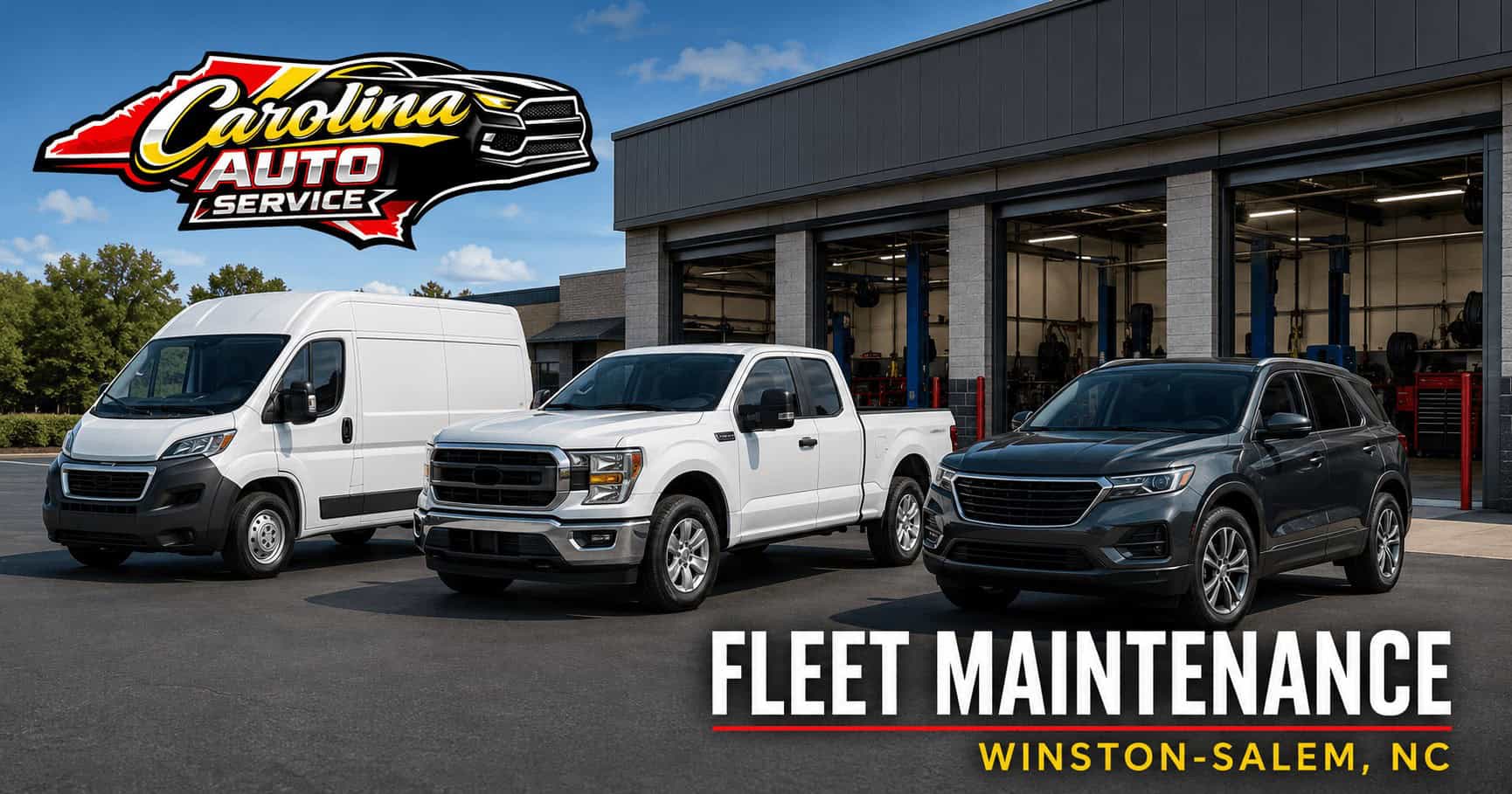
Fleet Uptime Starts With a Plan
Fleet maintenance is the organized process of servicing business vehicles before predictable wear, overdue maintenance, or a developing fault interrupts work. The right plan is not simply a calendar of oil changes. It considers each vehicle’s manufacturer schedule, mileage, age, service history, operating conditions, load, idle time, trip length, and driver feedback.
That distinction matters because fleet vehicles rarely experience the same duty cycle as a personal car. A service van may idle at job sites, make repeated short trips, carry tools, and operate throughout the hottest part of the day. A sales vehicle may accumulate highway mileage quickly. A company truck may carry heavier loads that affect brakes, tires, steering, suspension, cooling, and fluid condition.
Carolina Auto Service helps businesses establish a practical maintenance rhythm for each vehicle rather than applying one generic interval to the entire fleet. Our in-shop team can perform routine service, investigate warning lights and drivability complaints, recommend repairs based on verified findings, and provide documentation for business records.
Vehicles We Service
Carolina Auto Service supports local organizations whose work depends on road-ready light-duty vehicles. Service availability depends on the vehicle, configuration, condition, and repair required. Call with the year, make, model, engine, mileage, and concern so the team can confirm that the shop is equipped for the work.
Maintenance and repairs for vans used by HVAC, plumbing, electrical, property-service, installation, repair, and other field-service teams.
Support for sales, management, healthcare support, real estate, inspection, and other employee-driven vehicles.
Service for supported pickups used by contractors, landscapers, maintenance companies, and businesses carrying tools or equipment.
Maintenance and diagnostics for eligible light-duty vehicles used for local deliveries, scheduled routes, and customer service.
One local shop for supported domestic and import vehicles can simplify maintenance records and repair communication.
Maintenance and diagnostic support for eligible hybrid vehicles with conventional and high-voltage systems.
Preventive Maintenance
A useful fleet program turns maintenance from a series of isolated appointments into a repeatable operating process. Instead of waiting for a dashboard light, breakdown, or driver complaint to force an urgent decision, the business reviews each vehicle at appropriate intervals and acts on documented findings.
Oil-change intervals and other service timing should follow the correct information for the exact vehicle and operating pattern. Severe-duty conditions—such as frequent idling, stop-and-go routes, short trips, dust, heat, towing, or regular loads—may affect the appropriate schedule. Carolina Auto Service reviews the available service history and vehicle requirements rather than promising one interval for every fleet unit. Learn more about our oil-change service and complete auto repair capabilities.
Commercial Vehicle Repair
Preventive maintenance cannot eliminate every failure. Components wear, electrical faults develop, warning lights appear, and operating conditions expose problems that were not evident during the previous visit. When a fleet vehicle develops a symptom, diagnosis should identify the cause before parts are authorized.
Scan data and trouble codes identify systems that require further testing; they do not automatically prove which part failed. Testing may involve visual checks, electrical measurements, mechanical evaluation, live data, and a road test. Review our check engine light diagnostics.
Grinding, squealing, pulsation, pulling, warning lights, a soft pedal, or longer stopping distance requires attention. Inspection may include pads, rotors, calipers, hydraulic components, fluid, and ABS-related faults. Explore brake service.
Overheating, misfires, oil or coolant leaks, loss of power, abnormal noise, hard starting, and stalling can affect uptime and may worsen if ignored. The appropriate repair depends on confirmed findings. See engine repair.
Delayed engagement, slipping, harsh shifting, vibration, fluid leaks, clunks, or power-delivery problems may originate in the transmission, axles, joints, mounts, or related control systems. Review transmission repair and drivetrain service.
No-starts, slow cranking, intermittent power, charging warnings, lighting problems, blown fuses, and battery drain require testing of the affected circuit and related components—not automatic battery replacement.
Cabin climate control affects driver comfort, defrosting, and productivity. Diagnosis can distinguish refrigerant, airflow, electrical, control, compressor, or cooling-system concerns. Visit our automotive air-conditioning service page.
Control Downtime
A disabled commercial vehicle can affect more than transportation. It may remove an employee from a route, delay customer appointments, require tools or inventory to be transferred, create rental or rescheduling costs, and reduce the number of jobs the company can complete. That is why a fleet program should address maintenance timing, driver communication, authorization, records, and repair follow-through.
| Fleet Risk | Operational Response | How Service Records Help |
|---|---|---|
| Maintenance becomes overdue because vehicles are always working | Plan service around mileage, time, and operating demands before the due point | Shows what was completed and what is approaching |
| Drivers report symptoms inconsistently | Use a standard reporting process for warning lights, noise, leaks, handling, and performance | Connects the complaint with inspection and repair findings |
| Repairs are approved without clear priorities | Separate immediate safety or drivability needs from maintenance and monitor items | Creates a decision trail for the fleet owner or manager |
| Different vehicles receive inconsistent service | Maintain a vehicle-specific schedule rather than one fleetwide generic interval | Reduces uncertainty about the history of each unit |
| A recurring problem is treated as a new complaint each time | Review prior findings, repairs, mileage, and operating context | Helps technicians and managers recognize patterns |
Documentation does not prevent every breakdown, but it improves the information available when the business must decide whether to maintain, repair, monitor, replace, or retire a vehicle. It can also help with budgeting, resale records, warranty questions, and internal accountability.
Fleet Onboarding
Contact the shop with the number and types of vehicles, common makes and models, approximate mileage, how the vehicles are used, and the person authorized to approve work. This initial conversation helps determine service compatibility.
Provide recent invoices, maintenance history, manufacturer schedules, unresolved recommendations, recurring driver complaints, and applicable fleet instructions. Incomplete records do not prevent service, but available history helps establish a more informed baseline.
Schedule maintenance or an initial inspection based on each unit’s mileage, due services, symptoms, and work schedule. A vehicle with a warning light or safety complaint requires a different starting point from one that is simply approaching routine service.
Identify the fleet contact, preferred method of communication, information needed before approval, and any documentation requirements. The person making the decision should receive clear findings and an estimate before authorized work begins.
Use vehicle requirements, service history, usage, and inspection findings to plan upcoming visits. Staggering vehicles can help a business avoid taking multiple units out of operation at the same time.
As mileage, routes, loads, vehicle condition, or fleet composition changes, revisit the plan. Maintenance should adapt to the vehicles the business operates now—not remain fixed around assumptions that no longer apply.
Driver Reporting
Drivers are often the first people to notice a change. A simple reporting system helps the fleet manager act before a vehicle becomes harder to schedule or unsafe to operate.
Do not continue driving a vehicle that appears unsafe, is overheating, has lost oil or coolant, has severely reduced braking or steering control, or displays a flashing warning accompanied by poor operation. Arrange appropriate assistance and contact the shop.
Local Fleet Support
Carolina Auto Service operates from a physical repair facility at 160 Hanes Mall Circle in Winston-Salem, near Hanes Mall, Stratford Road, Silas Creek Parkway, and major routes used by local businesses. The shop serves Winston-Salem and surrounding communities such as Clemmons, Lewisville, Kernersville, Pfafftown, Walkertown, and other parts of Forsyth County.
A nearby fleet repair relationship can simplify vehicle drop-off, manager communication, follow-up service, and access to records. Carolina Auto Service is open Monday through Friday from 7:30 a.m. to 5:30 p.m., offers 24/7 vehicle drop-off, and has local shuttle availability. Qualifying repairs may include warranty and roadside-assistance benefits; terms, exclusions, mileage, time, and vehicle eligibility apply. Review the current roadside-assistance information or ask the team what applies to a specific repair.
Our ASE-certified technicians service many supported domestic, Asian, European, and hybrid vehicles. Learn more about Carolina Auto Service, the shop’s diagnostic approach, and its in-person repair facility.
Fleet Maintenance FAQs
Fleet maintenance can include manufacturer-scheduled service, oil and filter changes, fluid checks, brake and tire inspections, battery and charging-system checks, belts, hoses, filters, cooling-system service, steering and suspension evaluation, warning-light diagnostics, and repairs identified through inspection or driver reports. The exact plan should be vehicle-specific. Mileage, age, engine, service history, route type, idle time, loads, and operating conditions all influence what a vehicle needs and when it needs it.
There is no responsible universal interval for every commercial vehicle. Start with the manufacturer’s maintenance schedule for the exact year, make, model, engine, and drivetrain, then consider whether the vehicle operates under severe-duty conditions. Frequent idling, repeated short trips, stop-and-go routes, heavy loads, heat, dust, and high annual mileage can change service needs. Carolina Auto Service can review available records and current usage to help establish an appropriate schedule for each unit.
Yes. Carolina Auto Service provides maintenance and repair support for local businesses operating one or multiple eligible company cars, SUVs, service vans, and light-duty trucks. The shop does not publish a minimum fleet size on this page. Contact the team with your vehicle list, operating needs, and approval process so service compatibility and scheduling can be discussed without assumptions.
Carolina Auto Service works on many supported domestic, Asian, European, and hybrid vehicles, making the shop a potential fit for mixed light-duty fleets. Service depends on the specific vehicle and required procedure. Provide the year, make, model, engine, mileage, and concern in advance—especially for specialized, modified, unusually equipped, or heavier commercial vehicles—so the team can confirm capability before the appointment.
Preventive maintenance creates scheduled opportunities to address due services and identify visible wear, leaks, fluid concerns, warning lights, or driver-reported symptoms before they force an unscheduled stop. It cannot prevent every breakdown, and no shop should promise that it will. Its operational value comes from replacing some emergency decisions with planned service, better records, clearer priorities, and earlier investigation of developing problems.
Keep the VIN or internal unit number, year, make, model, engine, current mileage, purchase or in-service date, maintenance schedule, service invoices, inspection findings, repairs, declined or deferred recommendations, warranty information, recurring driver complaints, and dates when warning lights or symptoms appeared. Vehicle-specific records help the business avoid relying on memory and give technicians more context when diagnosing repeat or intermittent concerns.
The driver should bring the keys, current mileage, vehicle or unit number, fleet card or service instructions when applicable, and the name and contact information of the person authorized to approve work. Provide a detailed description of any symptom, including when it happens and whether a warning light, noise, smell, leak, vibration, starting problem, handling change, or loss of performance is involved. Prior service records are also useful when available.
Some employer, leasing, and third-party fleet programs require pre-authorization, specific maintenance codes, an estimate, a service card, photographs, or communication with a fleet administrator. Requirements vary by program and vehicle. Drivers should bring their instructions and fleet contact details. Carolina Auto Service can supply findings and service documentation, but authorization, coverage, payment, and policy decisions remain with the vehicle owner or program administrator.
No. This page is focused on in-shop maintenance and repair for eligible cars, SUVs, service vans, hybrid vehicles, and light-duty trucks. It does not represent Carolina Auto Service as a heavy-duty truck, tractor-trailer, trailer, mobile mechanic, towing, emergency roadside-repair, or DOT inspection provider. Call before scheduling a specialized commercial vehicle so the shop can verify that the vehicle and requested work fit its equipment and service capabilities.
Call Carolina Auto Service at 336-765-8599 or use the website contact page. Be ready to describe the number and types of vehicles, common makes and models, approximate mileage, business use, current maintenance needs, known symptoms, and the person who approves service. The shop is located at 160 Hanes Mall Circle in Winston-Salem and is open Monday through Friday from 7:30 a.m. to 5:30 p.m., with 24/7 vehicle drop-off available.
Tell Carolina Auto Service what your business drives, how the vehicles are used, and what is due or causing concern. Our team can help you determine the right starting point for preventive maintenance, diagnostics, or commercial vehicle repair.
Carolina Auto Service · 160 Hanes Mall Circle, Winston-Salem, NC 27103 · Monday–Friday, 7:30 a.m.–5:30 p.m.