
If your car battery keeps dying overnight, the battery itself may not be the only problem. A weak battery, undercharging, excessive resistance at the cables or grounds, a light or accessory staying on, a control module that does not go to sleep, aftermarket electronics, or another key-off electrical draw can all produce similar symptoms.
Replacing the battery repeatedly without testing its actual condition, charging-system performance, electrical connections, and key-off current can leave the real cause unresolved.
A vehicle that starts normally after a jump but is dead again the next morning has a different diagnostic pattern from a car that gradually cranks slower over several weeks.
The timing matters.
If the battery loses enough charge to prevent starting after only one night, technicians need to determine whether the battery lacks usable capacity, whether the charging system failed to restore the battery, or whether something continued consuming electrical current after the vehicle was shut off.
Modern vehicles complicate this diagnosis because many electronic systems remain awake for a period after the key is removed. Security systems, telematics, keyless-entry systems, body-control modules, infotainment systems, and other electronics may continue operating before the vehicle enters its normal sleep state.
That means a proper parasitic-draw test is not simply:
The vehicle has to be tested in a way that does not repeatedly wake the modules and distort the measurements.
What Should You Do First if Your Battery Keeps Dying Overnight?
If the battery repeatedly goes dead after sitting, avoid replacing parts based only on the symptom. The battery should be properly charged and tested first, followed by the charging system, cable and ground condition, and key-off electrical draw when appropriate. A new battery can also be drained if the underlying electrical problem remains.
| What You Notice | Recommended Next Step | Why It Matters |
|---|---|---|
| Battery is swollen, hot, leaking, frozen, or smells strongly like sulfur | Do not jump-start it; keep ignition sources away and seek professional help | A damaged battery can create chemical, electrical, and explosion hazards |
| Vehicle loses power while driving and the charging warning is on | Move to safety and arrange diagnosis or towing | A charging-system failure can eventually shut the vehicle down again |
| Battery is dead after one night but vehicle otherwise seems normal | Properly charge and test the battery; investigate key-off draw if the problem repeats | Weak battery capacity or an abnormal electrical load may become apparent only after sitting |
| A recently installed battery also goes dead | Test the complete charging, connection, and key-off electrical system | A new battery cannot correct an external drain, charging fault, or cable problem |
| Slow cranking after repeated short trips | Check battery state of charge and charging performance | Driving pattern may be leaving the battery undercharged |
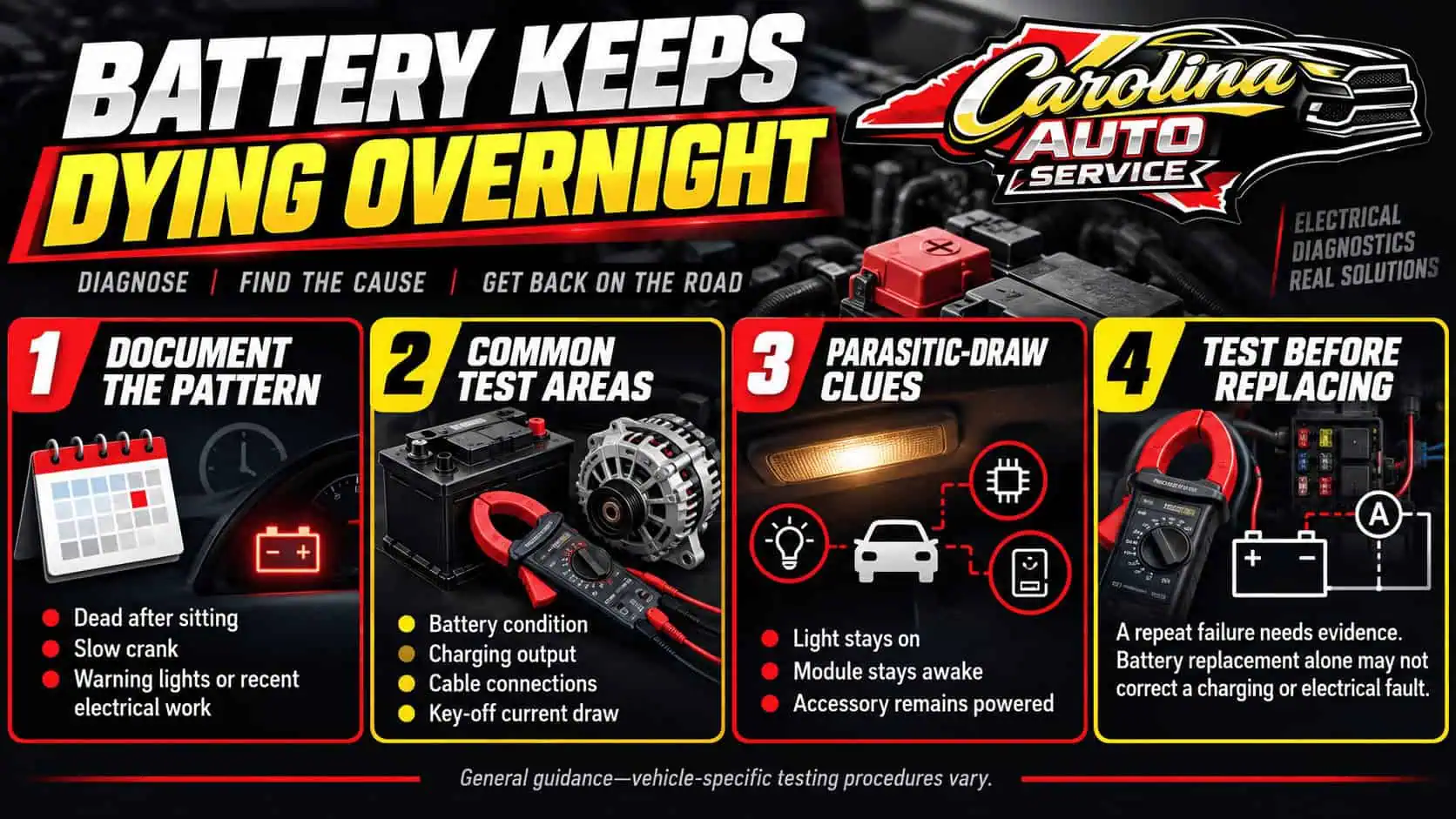
Why Does a Car Battery Keep Dying Overnight?
The symptom usually falls into one or more of three broad categories:
Battery Problem
The battery may not be able to store enough usable energy even after charging. Age, heat, repeated deep discharge, internal damage, or chronic undercharging can reduce capacity.
Charging Problem
The battery may be capable of storing energy, but the vehicle may not be restoring enough of the energy used during starting and normal operation.
Key-Off Electrical Draw
Something may remain powered after the vehicle should be asleep, slowly consuming enough energy to leave the battery discharged by morning.
There can also be overlap. For example, an electrical draw can repeatedly deep-discharge a battery until the battery itself becomes damaged.
1. The Battery Has Lost Usable Capacity
A battery can show voltage and still fail to deliver the amount of current required to start the engine.
That distinction is important because simply measuring approximately 12 volts at the battery terminals does not prove the battery is healthy.
Battery performance can be affected by:
- Age
- Heat exposure
- Repeated deep discharge
- Internal plate damage
- Sulfation
- Chronic undercharging
- Manufacturing defects
- Long storage periods
Diagnostic clue: A discharged battery should generally be charged appropriately before its capacity is judged. Testing a deeply discharged battery without restoring its state of charge can lead to misleading results.
2. The Charging System Is Not Replacing Enough Energy
Starting the engine removes energy from the battery. Once the vehicle is running, the charging system has to support the vehicle's electrical loads and restore energy to the battery.
Possible charging-system concerns can involve:
- Alternator output
- Drive belt condition or tension
- Battery cables
- Ground circuits
- Fuse and power-distribution connections
- Battery-current sensors
- Charging-system controls
- Vehicle-specific energy-management strategies
On many modern vehicles, charging voltage is actively controlled rather than remaining at one fixed value under every condition.
Diagnostic clue: A single voltage reading may not tell the whole story. Depending on the vehicle, technicians may need to evaluate charging output under load, voltage drop, current flow, commanded charging behavior, and battery state.
3. Something Is Draining the Battery After the Car Is Shut Off
An abnormal key-off electrical load is often called a parasitic draw or parasitic battery drain.
Some electrical current after shutdown is normal because certain modules need to maintain memory, security functions, communications, and other low-current functions.
The problem occurs when electrical consumption remains higher than expected after the vehicle should have entered its normal sleep state.
Possible causes can include:
- Interior light staying on
- Glove-box or trunk light
- Relay remaining energized
- Module failing to sleep
- Door or hood switch reporting the wrong state
- Telematics system activity
- Aftermarket alarm
- Dash camera
- Phone charger or USB device
- Aftermarket audio equipment
- Tracker or remote-start system
- Wiring fault
Because every vehicle can have a different shutdown strategy, the acceptable sleep time and key-off current are vehicle-specific.
Why Can a New Battery Still Die Overnight?
A new battery only solves a failed battery. It does not correct a charging problem, abnormal key-off electrical draw, loose connection, excessive cable resistance, malfunctioning module, or accessory that continues consuming current after shutdown.
If a new battery becomes discharged again within days or weeks, that is valuable diagnostic information.
The shop should evaluate whether:
- The replacement battery is correctly specified
- The new battery is fully charged
- The charging system is functioning correctly
- Battery terminals and cables have excessive resistance
- An abnormal key-off draw exists
- The vehicle requires a battery registration or reset procedure where applicable
- Driving habits are leaving the battery chronically undercharged
Repeatedly installing batteries without testing the system can turn an electrical diagnosis into an expensive parts-replacement cycle.
4. Battery Cables, Terminals, or Grounds Have Excessive Resistance
A battery and alternator can both test well individually while the vehicle still has starting or charging problems because electrical current also has to travel through cables and connections.
Problems can occur at:
- Battery terminals
- Ground connections
- Engine grounds
- Body grounds
- Starter cables
- Alternator output cables
- Fuse or power-distribution connections
Corrosion is one possible sign, but a connection can have excessive resistance even when it looks acceptable from the outside.
Diagnostic clue: Voltage-drop testing under load can reveal resistance that a simple visual inspection or unloaded voltage check may miss.
5. Short Trips May Leave the Battery Undercharged
Frequent short trips can contribute to low battery state of charge, particularly when the vehicle also uses substantial electrical power for climate control, heated accessories, lighting, infotainment, or other loads.
Starting the engine uses a significant burst of battery energy. A very short drive may not always restore everything that was consumed during the start.
This does not mean every overnight battery failure is caused by short trips.
But driving pattern is worth documenting because:
6. Aftermarket Electronics Can Change Key-Off Current
Aftermarket accessories are important diagnostic information because they may be powered differently from factory equipment.
Examples include:
- Dash cameras
- Vehicle trackers
- Remote-start systems
- Audio amplifiers
- Alarm systems
- USB power adapters
- Lighting accessories
- Radar detectors
An accessory does not have to be defective to affect battery state. Some devices are intentionally designed to remain powered while the vehicle is parked.
Tell the shop about any accessory installation, even if it was added months before the battery problem became obvious.
7. A Vehicle Module May Not Be Going to Sleep
Modern vehicles contain multiple electronic modules that communicate over vehicle networks.
After shutdown, many of those modules remain active temporarily before entering lower-power sleep modes.
A door switch, keyless-entry event, module fault, network communication issue, telematics activity, or other input may keep part of the vehicle awake longer than expected.
This is why parasitic-draw diagnosis on a modern vehicle may involve:
- Monitoring key-off current
- Waiting for the normal sleep period
- Using scan-tool information
- Checking module status
- Monitoring circuit activity
- Isolating circuits without unnecessarily waking the network
Can a Key Fob Cause the Battery to Drain?
On some proximity-key vehicles, key location can affect vehicle behavior.
If a key is stored very close to the parked vehicle, certain systems may respond differently than when the key is farther away.
However, this is highly vehicle-specific.
The correct approach is not to assume the key fob is responsible, but to tell the technician:
- Where the keys are normally stored
- Whether the issue changes with a spare key
- Whether door handles or locks behave unusually
- Whether the vehicle seems to wake repeatedly while parked
Then measure the actual key-off current.
Can an Alternator Drain a Battery While the Car Is Off?
It is possible for certain alternator or charging-system faults to contribute to battery discharge after shutdown, but that should be demonstrated with testing rather than assumed.
A professional diagnosis can compare:
- Charging performance while running
- Key-off current
- Circuit behavior
- Battery state of charge
- Cable and connection condition
If the alternator is recommended for replacement, ask what measurement or test supports that recommendation.
Will Driving Recharge a Completely Dead Battery?
A brief drive is not always the best way to recover a deeply discharged battery.
A battery that has been significantly discharged may need controlled external charging before accurate testing can be performed.
Relying entirely on the vehicle's charging system to recover a deeply discharged battery can also place a substantial load on the charging system.
If the vehicle required a jump because the battery was deeply discharged, the important question is not simply whether it starts again. The battery still needs enough state of charge and usable capacity to be properly evaluated.
How Long Should a Car Be Able to Sit Without the Battery Dying?
There is no universal number of days that applies to every vehicle.
Parking duration depends on:
- Battery capacity
- Battery condition
- State of charge
- Temperature
- Normal key-off electrical load
- Vehicle electronics
- Aftermarket equipment
- How often the vehicle is driven
However, a battery that repeatedly becomes unable to start the vehicle after one normal overnight parking period warrants diagnosis.
When Should You Avoid Jump-Starting the Battery?
A battery that is swollen, cracked, leaking, extremely hot, frozen, or producing a strong sulfur-like odor should be treated cautiously. Keep sparks, flames, and smoking materials away and seek professional assistance.
For a normal jump-start situation, use the exact procedures and designated connection points specified in the owner's manual.
Modern vehicles may have remote jump terminals or manufacturer-specific instructions.
How Does a Professional Shop Diagnose an Overnight Battery Drain?
A good electrical diagnosis follows a sequence rather than immediately searching for a “bad fuse.”
The technician confirms battery type, size, installation condition, terminal condition, visible damage, and replacement history.
A significantly discharged battery may need to be properly charged before meaningful battery and system testing continues.
Appropriate battery testing helps determine whether the battery can supply the required current rather than relying on voltage alone.
Battery cables, terminals, grounds, and starter circuits can be evaluated under load for excessive resistance.
Alternator performance, electrical load, voltage, current, wiring, grounds, and control strategy are considered as appropriate for the vehicle.
Doors, locks, key proximity, modules, and timed functions may need to be managed so the vehicle can shut down normally before key-off current is judged.
The actual current draw is compared with vehicle-specific expectations after the required sleep period.
Technicians may use circuit measurements, scan data, fuse voltage-drop methods, controlled disconnection, or other diagnostic techniques depending on the vehicle.
The exact acceptable current draw is not universal.
Different vehicles have different electronics, shutdown strategies, and manufacturer specifications.
Why Pulling Fuses Randomly Can Make the Diagnosis Harder
On older vehicles, fuse-pulling was often a straightforward way to narrow an electrical draw.
On a modern networked vehicle, opening a door, unlocking the vehicle, removing a fuse, reconnecting a circuit, or using certain accessories can wake control modules.
That can suddenly increase current and make the technician think the circuit is the source when the vehicle has simply been awakened.
What Does the Failure Pattern Tell the Technician?
| Pattern | Areas to Investigate | Why It Matters |
|---|---|---|
| Dead every morning | Battery capacity, charging, key-off draw | Short repeat interval makes abnormal discharge more likely |
| Slowly gets weaker over several weeks | Battery age, undercharging, driving pattern, connections | Gradual loss differs from a sudden overnight drain |
| Only happens after several days parked | Normal vs. abnormal key-off draw, battery capacity | Time-to-failure can help estimate the severity of discharge |
| Started after accessory installation | Accessory wiring and key-off operation | Recent changes can provide a direct diagnostic lead |
| Battery warning appears while driving | Charging system, belt, cables, grounds | The battery may not be receiving adequate charge while the engine runs |
| New battery also dies | Full system diagnosis | Battery replacement did not correct the underlying condition |
What Repairs Might Be Needed After Testing?
The correct repair should follow the measured cause.
Possible repair paths can include:
- Replacing a battery that fails appropriate testing after being properly charged
- Cleaning or repairing battery connections
- Repairing a high-resistance cable or ground
- Correcting an alternator or charging-system problem
- Repairing a belt or charging-drive issue
- Repairing a light, switch, or relay that remains powered
- Repairing wiring causing an unintended load
- Correcting an aftermarket accessory installation
- Repairing a module or network condition that prevents normal sleep
- Applying manufacturer-supported software or configuration corrections when appropriate
There is no universal “battery drain repair” because the same dead-battery symptom can originate from several very different systems.
Why Replacing the Battery Again Can Be a Mistake
If a battery has actually failed a proper capacity test, replacement may be appropriate.
But a battery should not become the automatic diagnosis simply because the vehicle will not start in the morning.
A repeat battery failure should prompt questions such as:
- Was the old battery actually tested?
- Was the replacement battery fully charged?
- Was charging output tested?
- Were the battery cables voltage-drop tested?
- Was key-off current measured?
- Were aftermarket accessories considered?
- Was the vehicle allowed to reach normal sleep state?
How Should You Evaluate the Repair Recommendation?
Ask the technician to connect the proposed repair to the test results.
Useful questions include:
- What was the battery's state of charge?
- Did the battery pass or fail capacity testing?
- What was the charging-system result?
- Was excessive voltage drop found?
- What key-off current was measured?
- Was the vehicle fully asleep during the test?
- Which circuit caused the abnormal draw?
- Which specific device or component on that circuit was confirmed?
- How will the repair be verified afterward?
The Federal Trade Commission's Auto Repair Basics guidance recommends understanding the condition being repaired and obtaining a written estimate that identifies anticipated parts and labor.
A recommendation such as “replace the alternator” or “replace the battery” is much stronger when it is connected to actual measurements.
Common Mistakes That Make Battery-Drain Diagnosis Harder
- Installing multiple batteries without testing the charging system.
- Assuming approximately 12 volts proves the battery is healthy.
- Testing parasitic draw before the vehicle reaches sleep mode.
- Opening doors or repeatedly unlocking the vehicle during the test.
- Pulling random fuses without considering module wake-up behavior.
- Forgetting to mention aftermarket accessories.
- Ignoring short-trip driving and long parking periods.
- Disconnecting the battery before recording diagnostic information.
What Should You Tell the Repair Shop?
The time pattern and recent vehicle history can help focus the diagnosis.
Tell the shop:
- How long the vehicle sits before the battery becomes too weak to start
- Battery age
- Whether the battery was recently replaced
- Whether the vehicle starts normally after a jump
- Whether it remains running after the jump
- Whether the battery warning light has appeared
- Whether any lights stay on
- Whether doors or locks behave unusually
- Where the key fob is stored
- Whether a dash camera, tracker, alarm, audio system, or charger is installed
- Whether electrical work was recently performed
- Whether the vehicle is usually driven on short trips
- Whether the problem changes after the vehicle sits several days
Also provide the year, make, model, mileage, and recent service history.
Battery and Electrical Diagnosis in Winston-Salem, NC
Heat can accelerate battery aging, and frequent short trips can leave a battery below full state of charge. Neither condition, however, proves why a specific vehicle is repeatedly dead in the morning.
Carolina Auto Service provides battery, starting, charging, and electrical diagnosis at its Winston-Salem repair facility.
The diagnostic approach can include the battery, charging system, cables, grounds, starting circuit, and key-off electrical load as supported by the symptoms and test results.
Carolina Auto Service is an in-shop repair facility. Vehicles are serviced at the Winston-Salem shop rather than through mobile roadside repair.
Battery Keeps Dying? Schedule Electrical Diagnosis
If your battery repeatedly dies overnight, Carolina Auto Service can test the battery, charging system, electrical connections, and key-off draw to determine what the evidence supports.
If the battery is swollen, leaking, extremely hot, frozen, or otherwise appears unsafe, do not attempt a routine jump-start. Arrange appropriate assistance.
Call 336-765-8599 Request an AppointmentFrequently Asked Questions About a Battery That Keeps Dying
Why does a new battery keep dying overnight?
A new battery can still be discharged by an abnormal key-off electrical load, undercharging, high-resistance cables or grounds, an accessory that remains powered, or another electrical fault. The replacement battery should also be properly charged and tested rather than assuming its age proves its condition.
What is a parasitic battery drain?
A parasitic drain is electrical current consumed after the vehicle should have entered its normal key-off sleep state. Some current use is normal for memory and security functions. The acceptable amount and the time required for the vehicle to sleep vary by vehicle.
Can an alternator drain a battery when the car is off?
Certain alternator or charging-system faults can contribute to battery discharge in some cases, but the condition should be confirmed by measuring charging performance and key-off current rather than assuming the alternator is responsible.
How long should a car sit before the battery dies?
There is no universal parking time because battery capacity, state of charge, temperature, normal electrical load, vehicle electronics, and accessories all matter. A healthy vehicle should generally tolerate normal overnight parking, so repeated overnight failure is enough reason to have the system tested.
Can a key fob cause battery drain?
Key proximity can affect certain vehicle systems depending on model and design, but it should not be assumed to be the cause. Tell the shop where the keys are normally stored and have the actual key-off current measured under controlled conditions.
Will driving recharge a dead battery?
A short drive may not fully recharge a deeply discharged battery. Proper external charging may be needed before battery capacity and charging-system performance can be evaluated accurately. A deeply discharged battery can also place substantial demand on the charging system.
Can I test parasitic draw by pulling fuses?
Fuse isolation can be part of professional diagnosis, but randomly pulling fuses can wake modules and change the electrical state being measured. Modern vehicles often need to reach their normal sleep state before current draw is judged and circuits are isolated.
Does Carolina Auto Service provide mobile battery service?
No. Carolina Auto Service is an in-shop repair facility in Winston-Salem. Call 336-765-8599 or request an appointment online. If the vehicle will not start, arrange appropriate transportation to the shop.
Sources & Consumer Resources
For vehicle-specific battery type, jump-starting instructions, charging-system behavior, battery registration procedures, warning indicators, and electrical specifications, consult the owner's manual or manufacturer service information for the exact year, make, and model.