
The color of a puddle under your car can help narrow the possibilities, but color alone cannot identify the leaking fluid. Automotive fluids change color with age, contamination, lighting, dirt, and manufacturer formulation. The location of the puddle, amount, texture, odor, warning lights, and whether a fluid level is dropping are often more useful than color by itself.
Stop driving when a suspected leak involves fuel, brake-fluid loss, major coolant loss with overheating, an oil-pressure warning, heavy transmission-fluid loss, or any condition that affects braking, steering, visibility, engine lubrication, cooling, or predictable vehicle control.
Finding a puddle beneath your vehicle can immediately raise two questions:
What is leaking?
and:
Can I still drive the car?
A fluid color guide can help organize those questions, but it should not be treated as a final diagnosis.
Engine oil becomes darker with use. Coolant can be green, orange, pink, yellow, blue, red, or another manufacturer-specific color. Some transmission fluids are red, while others are amber or nearly clear. Brake fluid is commonly clear to amber. Washer fluid may be blue, but not always.
Fluids can also run along shields, crossmembers, hoses, covers, or body panels before reaching the ground.
What Should You Do First if You Find Fluid Under Your Car?
Do not identify the leak by color alone. First look for warning lights, overheating, brake-pedal changes, steering changes, fuel odor, smoke, or rapidly increasing fluid loss. If none of those are present, safely document where the puddle appears, how much fluid is present, its general color, and whether the same spot returns after the vehicle is parked again.
| What You Notice | Recommended Next Step | Why It Matters |
|---|---|---|
| Fuel odor or thin fuel-like liquid | Shut the vehicle off, avoid ignition sources, and arrange towing | Fuel vapor and liquid can create fire and exposure hazards |
| Brake warning, soft pedal, or suspected brake-fluid leak near a wheel | Do not drive | Hydraulic fluid loss can reduce predictable braking ability |
| Coolant loss, steam, or rising engine temperature | Stop safely and do not open the cooling system while hot | Overheating can damage the engine, and pressurized hot coolant can cause burns |
| Oil-pressure warning with an engine-oil leak | Shut the engine off and arrange assistance | Low oil pressure can threaten engine lubrication |
| Small clear-water drip after air-conditioner use | Monitor if there is no odor, oily feel, color, or warning symptom | Air-conditioning evaporator condensation is commonly normal |
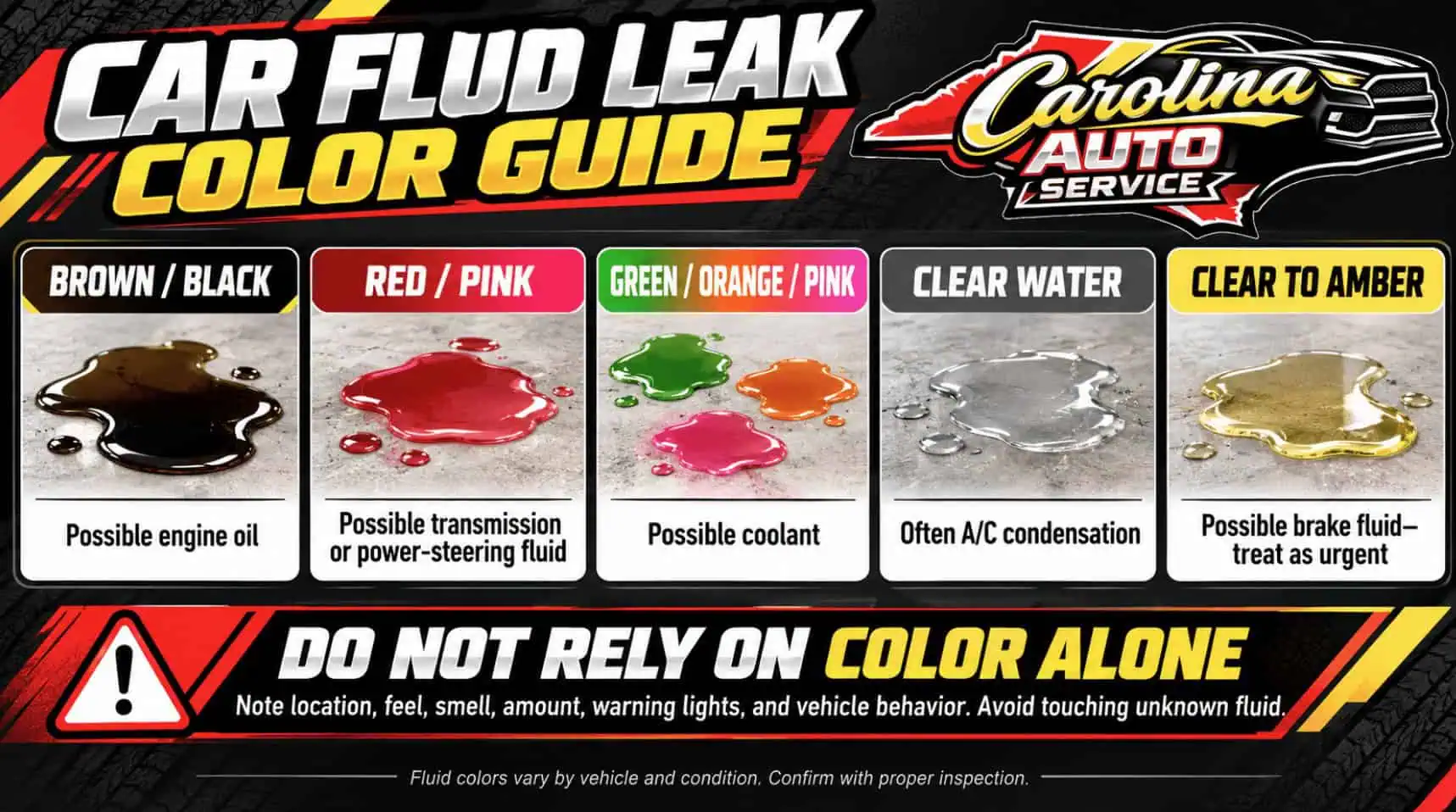
Car Fluid Leak Color Guide: What Might the Puddle Be?
Use this table as a starting point—not a final diagnosis.
| Possible Fluid | Common Appearance | Other Useful Clues | Typical Urgency |
|---|---|---|---|
| Engine oil | Amber, brown, or dark brown/black | Oily feel; commonly appears under engine area | Depends on leak rate, level, and oil-pressure warning |
| Coolant | Green, orange, pink, yellow, blue, red, or other colors | Often slippery; may have a sweet odor; temperature may rise | Urgent if level is falling, steam appears, or engine overheats |
| Transmission fluid | Red, amber, brown, blue, green, or nearly clear depending on system | May appear near transmission area; shifting symptoms may occur | Depends on amount and transmission behavior |
| Brake fluid | Clear to amber; may darken with age | Slippery; may appear near wheel, line, master cylinder, or hydraulic unit | Do not drive if hydraulic leakage is suspected |
| Power-steering fluid | Can be red, amber, clear, or manufacturer-specific | Steering noise or change in assist may accompany leak | Depends on steering behavior and fluid loss |
| Washer fluid | Often blue, but can vary | Watery; commonly associated with reservoir, hose, or washer use | Usually not a drivability emergency |
| Air-conditioner condensation | Clear water | Odorless, watery, commonly after AC operation | Usually normal |
| Fuel | Clear to pale amber depending on fuel | Strong fuel odor; thin liquid; evaporates quickly | Stop driving and avoid ignition sources |
1. Engine Oil Leak
Fresh engine oil may appear light amber or brown. As it accumulates combustion byproducts and contaminants through normal use, it becomes darker.
Oil leaks may originate from areas such as:
- Valve-cover sealing surfaces
- Oil-pan area
- Oil-filter housing or filter seal
- Drain plug
- Front or rear engine sealing areas
- Timing-cover areas
- Oil cooler or related lines where equipped
However, the spot on the ground may not be directly below the source.
Diagnostic clue: Oil can travel along the engine, subframe, splash shields, and underbody before it drips. Technicians often trace the highest active wet point rather than replacing the component directly above the puddle.
If the engine-oil pressure warning appears, the situation becomes much more urgent than the size or color of the puddle alone suggests.
2. Coolant Leak
Coolant is one of the easiest fluids to misidentify by color because manufacturers use many different formulations and dyes.
It may appear:
- Green
- Orange
- Pink
- Yellow
- Blue
- Red
- Another manufacturer-specific shade
Possible external leak areas include:
- Radiator
- Upper or lower hoses
- Reservoir
- Water pump
- Thermostat housing
- Heater hoses
- Cooling-system connections and seals
If the temperature rises, steam appears, or significant coolant has been lost, stop the vehicle safely and allow the system to cool. Opening a hot, pressurized cooling system can release hot coolant and steam.
Carolina Auto Service provides cooling-system and radiator inspection for supported coolant-loss and overheating concerns.
3. Transmission or Powertrain Fluid Leak
Many drivers assume red fluid automatically means transmission fluid.
That is not reliable.
Some transmission fluids begin red, while others may be amber, blue, green, or nearly clear. Fluid also changes appearance with age and heat.
Useful diagnostic clues include:
- Location beneath the vehicle
- Whether the puddle appeared after driving
- Whether shifting changed
- Whether the transmission warning appeared
- Whether the leak rate is increasing
- The fluid specification used by that exact vehicle
Diagnostic clue: Fluid color should never be used as the only basis for adding transmission fluid. Using the wrong specification can create additional problems.
Carolina Auto Service provides transmission diagnosis and repair for supported transmission leaks and operating concerns.
4. Brake Fluid Leak
Brake fluid is commonly clear to amber when relatively fresh and can darken with age or contamination.
A leak may appear around:
- Brake calipers
- Wheel cylinders
- Flexible brake hoses
- Hard brake lines
- Master cylinder
- Hydraulic control components
- Connections and fittings
The most important clues are not simply color.
Pay attention to:
- Soft or sinking brake pedal
- Brake warning light
- Longer stopping distance
- Fluid level change
- Wetness around a wheel or brake component
If the brake pedal has changed or hydraulic leakage is suspected, do not continue driving to see whether the symptom improves. Arrange appropriate transport for the vehicle.
Carolina Auto Service provides brake inspection and repair in Winston-Salem.
5. Power-Steering or Hydraulic Fluid
Not every vehicle uses hydraulic power steering, and fluid color varies widely among systems.
Where hydraulic power steering is used, the approved fluid may be:
- Red
- Amber
- Clear
- Green
- Another manufacturer-specified color
Symptoms accompanying a leak can include steering noise, changes in assist, or fluid loss from lines, hoses, pumps, reservoirs, racks, or related components.
Do not add a generic “power steering fluid” without confirming the exact specification required by the vehicle.
6. Clear Water Under the Car
A small amount of clear, odorless water under the passenger-side area after using the air conditioner is commonly normal condensation. The air-conditioning evaporator removes moisture from cabin air, and that water normally drains beneath the vehicle.
Clear water becomes more suspicious when:
- It has an odor
- It feels oily
- It has visible color
- The amount is unusually large
- It is accompanied by a fluid warning
- A reservoir level is dropping
The simplest useful question is:
7. Washer Fluid
Windshield-washer fluid is often blue, but color depends on the product.
A leak may come from:
- Washer reservoir
- Pump seal
- Washer hose
- Connector
- Damaged reservoir
This is generally much less urgent than a brake-fluid, fuel, oil-pressure, or overheating-related leak, but it should still be repaired if the washer system cannot provide adequate visibility when needed.
8. Fuel Leak
Fuel can be difficult to identify visually because it is relatively thin and evaporates quickly.
A strong gasoline odor is a more important warning sign than its precise color.
If you see liquid fuel or smell a strong persistent fuel odor:
- Shut the vehicle off in a safe location
- Keep smoking materials, flames, and sparks away
- Do not crawl underneath an actively leaking vehicle
- Do not continue driving simply to reach the repair shop
- Arrange towing or appropriate assistance
A fuel leak should not be treated like an ordinary fluid stain.
Why Is the Puddle Sometimes Far From the Actual Leak?
This is one of the most useful concepts in leak diagnosis.
Fluid does not necessarily drip straight down from the failed component.
It can travel across:
- Engine covers
- Splash shields
- Crossmembers
- Subframes
- Transmission housings
- Hoses
- Underbody panels
Airflow while driving can move the fluid even farther rearward.
Diagnostic clue: The puddle identifies where the fluid finally reached the ground. It does not necessarily identify where the leak began.
Does the Location of the Puddle Help?
Yes, but location should be combined with the vehicle's layout.
| General Location | Areas That May Need Inspection | Important Limitation |
|---|---|---|
| Front-center | Engine, radiator, cooling system, engine oil, accessories | Fluid can travel rearward or sideways before dripping |
| Front near a wheel | Brake components, steering components, washer system, suspension-area leaks | Exact vehicle layout matters |
| Center of vehicle | Transmission, powertrain, exhaust condensation, underbody lines | A leak from farther forward can migrate rearward |
| Rear-center | Fuel tank area, differential on applicable vehicles, rear drivetrain components | Fuel odor changes urgency immediately |
| Passenger-side water drip | Air-conditioning condensate drain | Only reassuring when fluid is clear, odorless, and watery |
How Can You Safely Document a Leak Before the Appointment?
If there is no fuel odor, no active traffic danger, no need to crawl under the vehicle, and no other immediate safety concern, a few observations can help the technician.
Note which end of the vehicle was above the puddle and whether the ground was level.
A light background can make the general color and size of the leak easier to document without touching the fluid.
Photograph the puddle and its location relative to the vehicle when this can be done safely.
A few drops, a palm-sized spot, and a rapidly expanding puddle represent very different leak rates.
Use only the owner's-manual procedure. Some fluid levels are not designed for simple owner inspection.
Overheating, soft brakes, shifting problems, steering changes, smoke, or unusual noise can be more important than the puddle color itself.
When Should a Fluid Leak Be Considered Urgent?
- Fuel is leaking or a strong fuel odor is present
- Brake-fluid loss is suspected
- The brake pedal becomes soft or sinks
- The engine is overheating or producing steam
- The oil-pressure warning appears
- A leak is rapidly increasing
- Transmission operation changes along with substantial fluid loss
- Steering assist or control changes
- Smoke appears from fluid contacting a hot component
- You are uncertain whether the vehicle can be operated safely
Do not rely on puddle size alone. A small visible leak in a safety-critical hydraulic system may be more important than a larger amount of normal AC condensation.
Should You Top Off the Fluid Before Diagnosis?
Sometimes maintaining an approved fluid level is part of a service procedure, but blindly adding fluid can create problems.
Before adding anything, you need to know:
- Which system is actually low
- The exact fluid specification
- Whether the system is designed for owner-level inspection
- Whether the leak makes driving unsafe
- Whether opening the system creates a burn or contamination risk
Do not use color alone to choose a replacement fluid.
Should You Use a Stop-Leak Product?
A universal stop-leak product should not be treated as the default response to an unidentified leak.
Depending on the system and product, sealants can potentially complicate later diagnosis or repair, contaminate components, or restrict passages.
A better process is:
If a manufacturer-approved additive or procedure applies to a particular vehicle, that should be determined from vehicle-specific service information rather than a generic leak chart.
How Does a Professional Shop Find the Actual Leak?
Professional leak diagnosis is more than looking at the puddle.
The technician considers color, viscosity, location, odor from an appropriate distance, fluid levels, and the systems installed on the vehicle.
Proper lift access can reveal wet components, lines, housings, shields, and the path the fluid followed.
Existing grime and old leakage can make it difficult to distinguish an active leak from a stain left by a previous repair.
Warning lights, temperature, pressure, transmission behavior, braking, and other system information help establish urgency.
Pressure testing, UV dye where appropriate, hydraulic inspection, level checks, operating tests, or manufacturer-specific procedures may be used.
The objective is to repair the component that is actually leaking rather than the component nearest the puddle.
Residual fluid should be distinguished from new leakage so the original concern can be accurately rechecked.
What Repairs Might Be Needed?
The repair depends entirely on the confirmed fluid and source.
Possible repairs can include:
- Replacing a failed hose
- Repairing a leaking seal or gasket
- Repairing a damaged fluid line
- Replacing a leaking radiator or cooling component
- Repairing a water-pump leak
- Repairing an engine-oil leak
- Repairing a transmission-fluid leak
- Repairing a brake-hydraulic leak
- Repairing a fuel-system leak
- Repairing a washer reservoir or hose
- Correcting a power-steering or hydraulic leak where applicable
The system then needs to be filled or serviced with the correct manufacturer-specified fluid and procedure.
Repair cost cannot be estimated accurately from puddle color because replacing a hose, radiator, seal, hydraulic line, transmission component, or engine gasket involves very different labor and parts.
How Should You Evaluate a Leak-Repair Recommendation?
Ask the technician to connect the proposed repair to evidence.
Useful questions include:
- What fluid was identified?
- Where is the highest confirmed active leak?
- Was the system level low?
- Was a pressure or operating test performed?
- Is the leak currently active or only old residue?
- Did the leak damage another component?
- Does the leak make the vehicle unsafe to drive?
- Which exact fluid specification will be used after repair?
- How will the repair be verified afterward?
The Federal Trade Commission's Auto Repair Basics guidance recommends understanding the condition being repaired and obtaining written information about anticipated parts and labor.
A recommendation is stronger when the technician can show where the leak is coming from rather than identifying it from puddle color alone.
Common Mistakes That Make Leak Diagnosis Harder
- Identifying fluid by color alone. Several automotive fluids overlap in color.
- Adding fluid before confirming the specification. Similar-looking fluids may not be interchangeable.
- Assuming the puddle is directly below the source. Fluid can travel a considerable distance before dripping.
- Using universal stop-leak products before diagnosis. This can complicate the eventual repair.
- Cleaning away all evidence before taking a photo. The original location and amount may help diagnosis.
- Ignoring warning lights because the puddle is small. Warning information can be more important than leak size.
- Crawling under a vehicle supported only by a jack. Leak identification is not worth creating a serious safety risk.
What Should You Tell the Repair Shop?
The more detail you provide, the easier it is for the technician to begin in the correct system.
Tell the shop:
- General fluid color on clean cardboard or a light surface
- Front, center, or rear location
- Driver or passenger side
- Whether the fluid appeared after driving or while parked
- Whether the air conditioner was running
- Whether the leak is a few drops or a growing puddle
- Whether a fluid level has changed
- Any warning lights
- Any overheating
- Any brake-pedal change
- Any steering change
- Any shifting problem
- Whether the vehicle recently had related service
Also provide the year, make, model, mileage, and recent repair history.
Photographs of the puddle and dashboard warnings can be useful when captured safely.
Car Fluid Leak Diagnosis in Winston-Salem, NC
If you find fluid beneath your vehicle in Winston-Salem, the most useful first step is to determine whether the leak affects vehicle safety before deciding whether to drive it to a shop.
Carolina Auto Service provides supported fluid-leak diagnosis at its Winston-Salem repair facility, including engine, cooling-system, transmission, brake, and related mechanical concerns.
Relevant service resources include:
- Engine repair and engine leak diagnosis
- Cooling-system and radiator inspection
- Transmission diagnosis and repair
- Brake inspection and repair
Carolina Auto Service is an in-shop repair facility. Vehicles are serviced at the Winston-Salem shop rather than through mobile roadside repair.
Not Sure What Is Leaking? Schedule an Inspection
If you see an unexplained puddle beneath your vehicle, Carolina Auto Service can identify the fluid, trace the active source, explain the findings, and recommend the repair supported by the inspection.
If the leak may involve fuel, brake fluid, major coolant loss with overheating, or engine oil with an oil-pressure warning, do not drive the vehicle to the shop—arrange towing or appropriate assistance.
Call 336-765-8599 Request an AppointmentFrequently Asked Questions About Car Fluid Leaks
Is clear water under my car normal?
A small amount of clear, odorless water beneath the passenger-side area after air-conditioner use is often normal evaporator condensation. Have it inspected if the liquid has color, odor, an oily feel, unusually large volume, or appears with warning lights or falling fluid levels.
What color is engine coolant?
Coolant can be green, orange, pink, yellow, blue, red, or another manufacturer-specific color. Color alone cannot confirm the coolant type or specification. Location, odor, reservoir level, vehicle temperature, and the correct manufacturer specification are more useful clues.
Is red fluid under a car always transmission fluid?
No. Some transmission fluids are red, but power-steering fluids and some coolants can also appear red. Some transmissions use fluids that are amber, blue, green, or nearly clear. The fluid source and vehicle specification should be confirmed before adding anything.
Can I drive with an engine-oil leak?
It depends on the leak rate, oil level, leak location, and warning indicators. Shut the engine off if the oil-pressure warning appears, oil is rapidly escaping, smoke develops from oil reaching hot components, or the engine begins making abnormal mechanical noise.
What does brake fluid look like?
Brake fluid is commonly clear to amber and can darken with age or contamination. Appearance alone is not enough to identify it. A soft or sinking pedal, brake warning light, falling reservoir level, or suspected hydraulic leak means the vehicle should not be driven.
Why is the puddle far from where the leak started?
Automotive fluids can travel along shields, frames, engine covers, hoses, housings, subframes, and underbody panels before reaching the ground. Airflow while driving can move the fluid farther rearward, so the puddle location is only one diagnostic clue.
Should I use a stop-leak product?
Do not add a universal sealant simply because a leak is visible. The fluid and source should be identified first. Some sealants can complicate later diagnosis or repair, and manufacturer-specific procedures should take priority when applicable.
How does a shop find where the fluid is leaking from?
The technician identifies the fluid, checks system levels and warning symptoms, inspects the vehicle from above and below, cleans old residue when necessary, and may use pressure testing, approved dye, hydraulic checks, or other system-specific procedures to locate the highest active leak point.
Where can I get a fluid leak diagnosed in Winston-Salem?
Carolina Auto Service provides in-shop diagnosis for supported engine, cooling-system, transmission, brake, and other mechanical leaks in Winston-Salem. Call 336-765-8599 or request an appointment online. If the leak makes the vehicle unsafe to drive, arrange towing.
Sources & Consumer Resources
For vehicle-specific fluid specifications, level-check procedures, warning lights, cooling-system precautions, brake-fluid requirements, and transmission service information, consult the owner's manual or manufacturer service information for the exact year, make, model, and powertrain.