
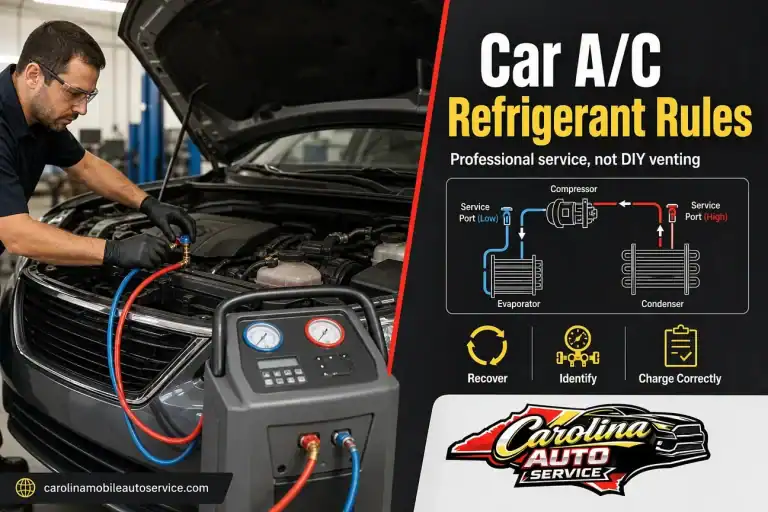
Car ac refrigerant Service Rules for Safe A/C Work
Quick Answer: Before any car ac refrigerant service, drivers should know that vehicle A/C refrigerant is regulated, intentional venting is prohibited, and paid service work must be handled by properly trained and certified technicians using approved equipment. If your A/C is weak, warm, or intermittent, the right next step is diagnosis, not guessing with a can. A low charge can be a clue, but leaks, electrical faults, airflow problems, compressor-control issues, or an incorrect charge can all feel similar from the driver’s seat.
The most important point is simple: refrigerant is not just “cold gas.” It is a controlled chemical used inside a sealed system. The EPA motor vehicle air conditioning program explains why motor vehicle A/C service has specific rules for technician certification, recovery equipment, and refrigerant choices. Those rules affect what a repair shop must do, what a driver should ask, and why DIY top-offs can create more confusion than answers.
Why car ac refrigerant Rules Start With the Law
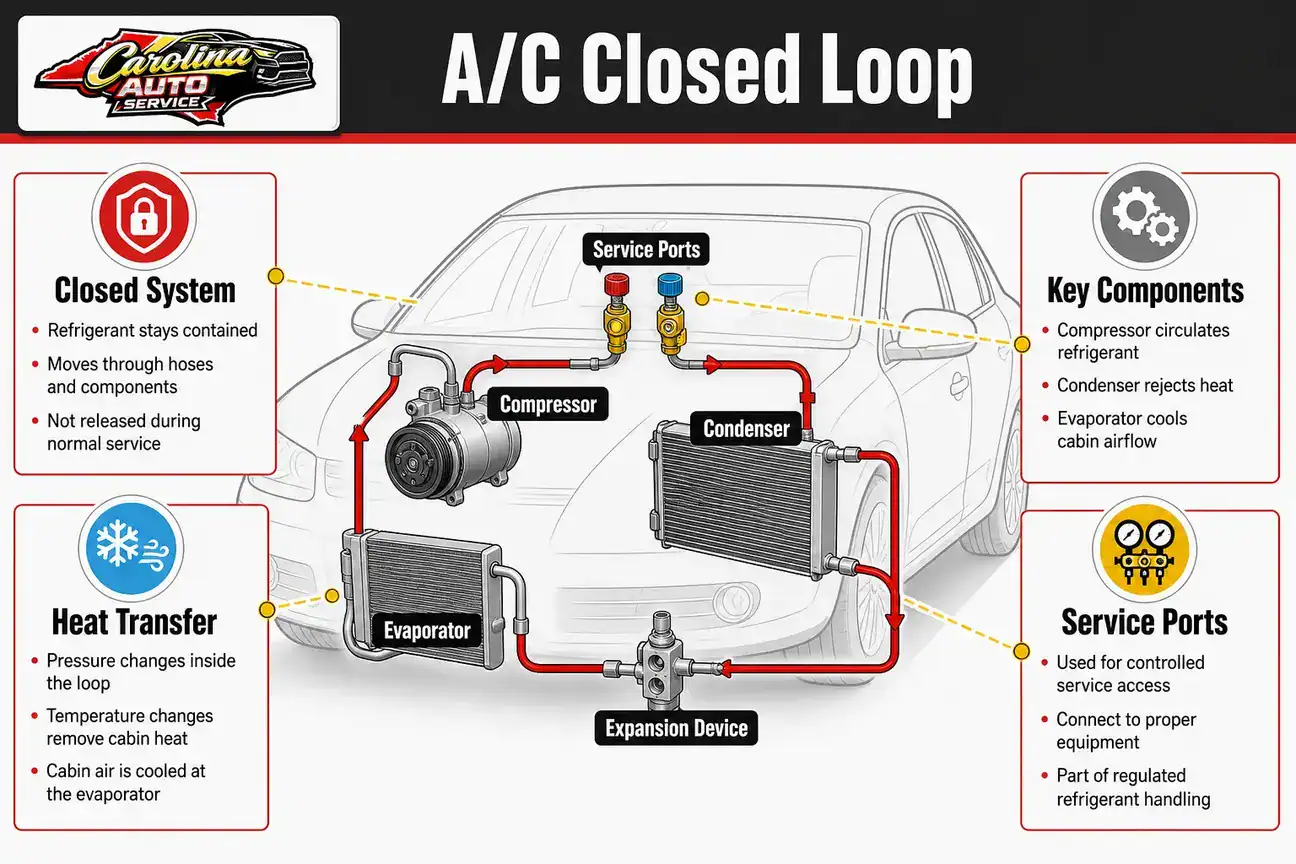
Modern vehicle air conditioning systems are designed to keep refrigerant contained, moving through the compressor, condenser, expansion device, evaporator, and hoses as a closed loop. When the system is working correctly, refrigerant changes pressure and temperature inside that loop to remove heat from the cabin. It is not supposed to be released as part of normal service.
Because refrigerant can affect the atmosphere and because different refrigerants have different safety and environmental profiles, federal rules control how it is recovered, recycled, and charged during service. That is why refrigerant handling is treated differently from topping off washer fluid or checking engine oil. The technician is not just adding a product; the technician is opening and servicing a regulated system.
For drivers, the practical takeaway is that an A/C visit should not begin with a blind A/C recharge. It should begin with a complaint, a visual inspection, system checks, and a plan for handling refrigerant properly if the system needs to be opened or charged. A weak vent temperature is a symptom. A symptom or code is a clue, not a diagnosis.
Federal A/C rules also help explain why a shop may ask what refrigerant your vehicle uses, whether another product has been added, and whether the system has been serviced before. Those questions are not busywork. They can affect equipment choice, recovery procedure, and the next diagnostic step.
Refrigerant handling Is Regulated for Environmental and Safety Reasons
The core rule for drivers is that refrigerant handling is not casual work. EPA rules for motor vehicle A/C service explain that anyone who repairs or services a motor vehicle air conditioner for payment must be properly certified, and the EPA regulatory requirements for MVAC system servicing explain recovery, equipment, and venting rules.
Certification matters because A/C service involves more than connecting gauges. The person doing the work needs to understand recovery, recycling, equipment requirements, refrigerant identification, system contamination concerns, and safe service practices. Section 609 is a technician certification rule specific to motor vehicle air conditioning work. It is not the same thing as a shop’s general repair experience, and it is not a substitute for proper diagnosis.
Drivers do not need to memorize the entire rulebook, but they should know enough to recognize a careful process. If a service involves opening the refrigerant circuit, removing refrigerant, replacing an A/C component, or charging the system, the shop should be following the applicable recovery and service rules. Refrigerant handling also means the system should be treated as a controlled system, not as a place to keep adding refrigerant until the air feels cooler.
That distinction is important with older or high-mileage vehicles. If refrigerant is low, it may indicate a leak, a prior service issue, or another system condition that has not yet been confirmed. Adding refrigerant without finding out why the level is low can mask the real problem for a short time. It can also make later diagnosis harder if the wrong product, the wrong amount, or sealer has been introduced.
Why No venting Is More Than a Shop Preference
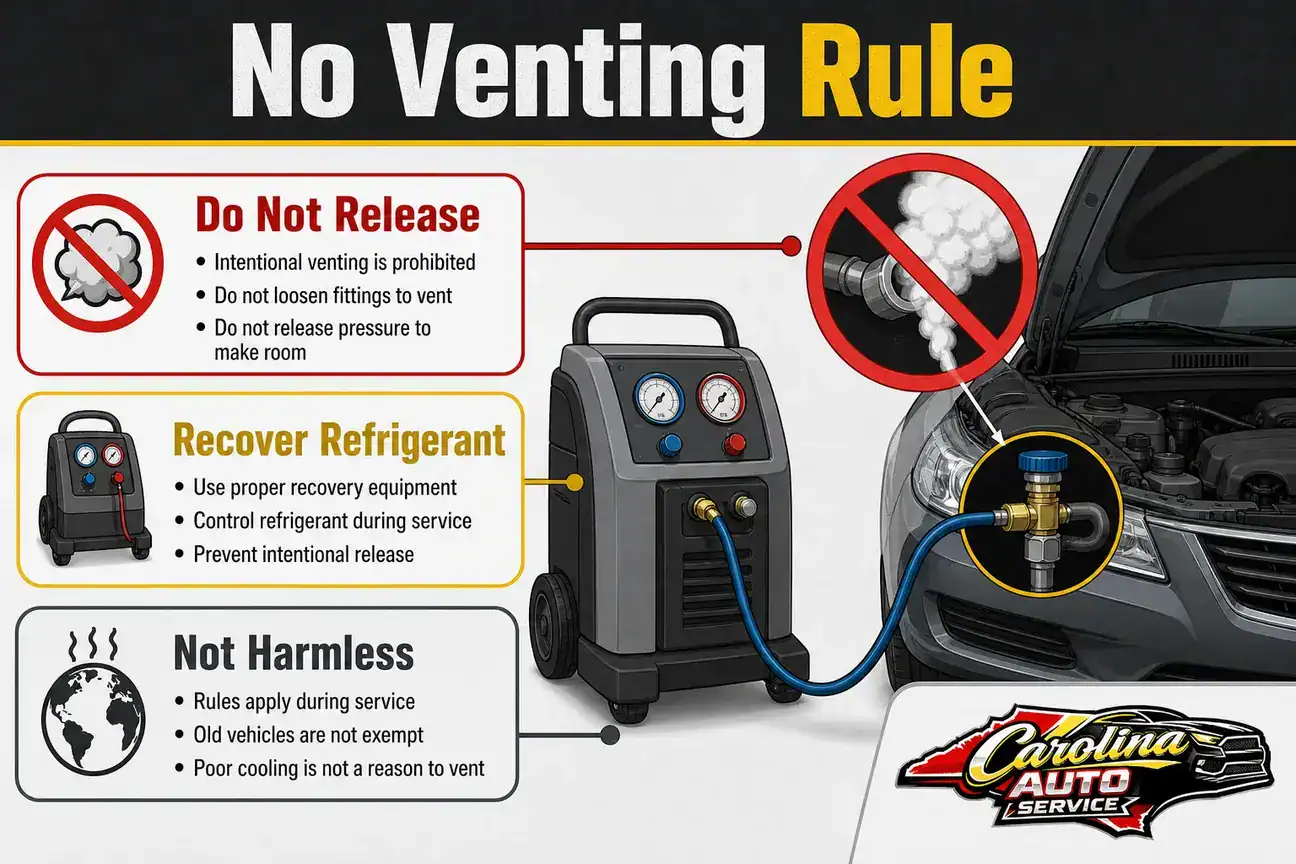
The phrase no venting is not just a best practice. EPA rules prohibit intentional release of refrigerant during service, maintenance, repair, or disposal. EPA guidance states that Section 608 “prohibits the intentional release (venting)” of refrigerant, and that rule applies when refrigerant is being handled during service.
That means refrigerant should be recovered with proper equipment when service requires removing it from the vehicle. It should not be loosened at a fitting and allowed to escape. It should not be released to “make room” for a different charge. It should not be treated as harmless because the vehicle is old or because the A/C is already not cooling well.
No venting also protects the diagnostic process. If refrigerant escapes uncontrolled, the technician loses useful information about how much was actually in the system. Recovering refrigerant with the correct equipment helps measure what came out, compare that amount with the vehicle specification, and decide what to inspect next. That does not diagnose the whole problem by itself, but it gives better evidence than guessing.
Drivers sometimes hear a hiss when a fitting, hose, or component is damaged. That situation is different from intentionally venting during service, but it still means the system needs professional attention. If you suspect a leak, avoid trying to tighten A/C fittings or attach a can as a test. Refrigerant can cause injury if mishandled, and no venting rules exist for a reason.
Section 609 Certification and Equipment Requirements
Section 609 is the federal technician certification program for people who service motor vehicle A/C systems for payment. In plain English, paid A/C refrigerant work requires properly trained and certified handling. EPA also says technicians must use refrigerant recovery equipment or approved refrigerant handling equipment when servicing MVAC systems. The rule is about controlling refrigerant, protecting the system, and preventing intentional release.
That requirement affects several parts of an A/C visit. If refrigerant must be removed, the technician should recover it. If a component must be replaced, the system should be handled in a way that controls refrigerant and contamination. If the system is charged, the charge amount should be based on vehicle specifications and testing, not feel alone.
Section 609 does not mean every A/C complaint automatically needs refrigerant. It means that when refrigerant is part of the service, there are legal and procedural requirements for handling it. Many weak-cooling complaints start with checks that do not require opening the refrigerant circuit: vent temperature, blower operation, cabin airflow, visible signs of oil residue, compressor command, cooling fan operation, and electronic control inputs.
Refrigerant handling also includes avoiding cross-contamination. Different refrigerants and oils may not be interchangeable. Some vehicles use refrigerants that require specific fittings, equipment, or service practices. If someone has added an unknown product, a sealer, or an incorrect refrigerant, the service path can change. That is another reason a professional diagnosis is better than repeated top-offs.
For drivers, a reasonable question is not “Can you just add a can?” A better question is “What will you check before charging the system?” A careful shop should be able to explain the inspection, testing, estimate, and approval process before authorized repairs begin.
What a Compliant A/C Service Process Should Protect
A proper A/C visit protects three things: the environment, the vehicle, and the customer’s decision-making. The environmental side is the no venting rule and the requirement to recover refrigerant. The vehicle side is making sure refrigerant type, amount, oil balance, airflow, pressure behavior, and controls are evaluated before a repair is recommended. The customer side is clear communication before work is approved.
EPA rules also include recordkeeping requirements. EPA says shops must maintain on-site records showing that technicians are properly certified and records related to recovered refrigerant sent off site. That kind of rule is another reminder that A/C service is regulated work, not a casual top-off.
From the customer side, records matter too. The FTC auto repair basics guidance tells consumers to “Document all transactions.” For an A/C concern, that means keeping your estimate, approval, repair order, notes about the symptom, and any warranty information you receive. Good records help if the symptom returns or if another related issue appears later.
At Carolina Auto Service, A/C concerns are handled as in-shop diagnosis and repair. The shop’s automotive air-conditioning service page is the right place to start if your vents are not cooling, the system cycles oddly, or you suspect the A/C needs attention. ASE-certified technicians inspect, explain findings, and provide clear repair recommendations and an estimate before authorized work is approved.
Why an A/C recharge Should Not Be the First Guess
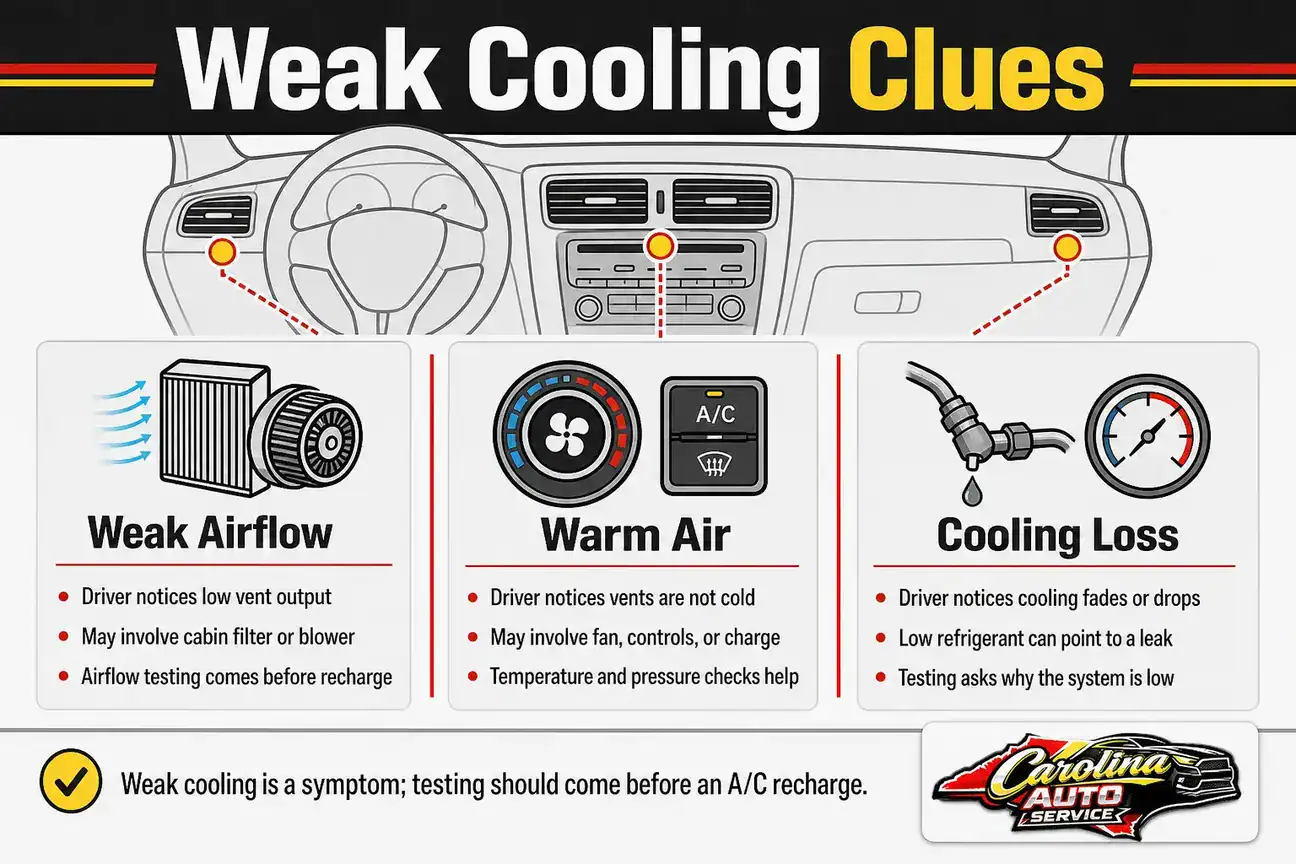
An A/C recharge can sound simple: add refrigerant and make the vents cold again. Sometimes an A/C system is low on refrigerant, but the real question is why. A sealed system should not need refrigerant added as routine maintenance. Low refrigerant can be associated with a leak, prior service loss, component damage, or another condition that testing must confirm.
Weak cooling can also come from causes that are not solved by adding refrigerant. A restricted cabin air filter, weak blower output, cooling fan issue, blend door problem, sensor input fault, compressor-control issue, wiring concern, or incorrect refrigerant charge can all affect comfort. Some of those conditions may feel the same to the driver: warm air at idle, cooling only while moving, one side colder than the other, or cold air that fades after a few minutes.
That is why professional A/C diagnosis looks for patterns. Does the air start cold and then warm up? Is the complaint worse at idle in traffic? Does the compressor engage? Do the cooling fans operate when commanded? Are pressures consistent with the temperature and vehicle condition? Is there visible dye or oil residue near a fitting or hose? The answers help narrow the problem without pretending one symptom proves one failed part.
A blind A/C recharge can cause new problems if the system is already full, if the wrong refrigerant is used, if air or moisture enters the system, or if a sealer contaminates service equipment. More refrigerant does not automatically mean colder air. The correct charge amount matters, and that amount varies by vehicle. Your owner’s manual, under-hood label, and manufacturer service information are the right references for the vehicle’s refrigerant type and amount.
Common Weak-Cooling Clues and What They May Indicate
The table below is not a diagnosis. It is a way to organize what you notice before calling a shop. A/C symptoms are clues that need testing, especially before any A/C recharge or refrigerant handling decision.
| What you notice | What it may be associated with | Why testing matters |
|---|---|---|
| Air is cool at highway speed but warm at idle | Airflow across the condenser, cooling fan operation, charge level, or compressor-control concerns | Pressure and fan checks help separate airflow problems from refrigerant charge issues. |
| Air starts cold, then gets warm | Control issues, freezing at the evaporator, sensor inputs, compressor cycling, or restriction concerns | The timing of the change helps guide electrical, airflow, and pressure testing. |
| One vent area feels cooler than another | Air distribution, blend door operation, cabin airflow, or refrigerant distribution concerns in some systems | Cabin control checks may be needed before assuming the system is low. |
| A/C stopped after prior service or a DIY can | Incorrect charge amount, added sealer, contamination, leak, or another unresolved condition | Knowing what was added helps protect equipment and choose the next diagnostic step. |
| Hissing, oily residue, or visible damage near A/C parts | Possible leak or component damage | Leak confirmation and proper recovery are needed before parts are replaced or refrigerant is added. |
These patterns are useful because they help the technician reproduce the complaint. They also help avoid unnecessary assumptions. If the symptom only appears on very hot days, after a long drive, or in stop-and-go traffic, that detail matters. If the blower speed changes, the vents switch unexpectedly, or a warning light appears, that matters too.
Why Refrigerant Type Matters Before Service
Refrigerant type is not a preference item. Vehicles are designed for specific refrigerants, oils, fittings, service procedures, and charge amounts. EPA motor vehicle air conditioning information explains why refrigerant choice, recovery, and servicing practices are regulated rather than left to guesswork.
Using the wrong refrigerant can affect performance, safety, service equipment, and future repairs. Mixing refrigerants can also complicate recovery and recycling. That is why shops may use identifiers, check labels, and ask about previous service. If a vehicle has been charged with an unknown product, the shop may need to slow down and confirm what is in the system before continuing.
Drivers should be cautious with products advertised as universal fixes. A can that promises colder air may contain refrigerant, oil, dye, sealant, or additives. The label may not tell the whole story for your vehicle’s situation. Even if a product fits the low-side port, that does not prove it is the right product, the right amount, or the right repair.
Refrigerant handling is also different on some hybrids and newer vehicles because the A/C system may interact with high-voltage components, battery cooling, or electric compressors. Hybrid owners should not attempt refrigerant work or high-voltage-related A/C diagnosis. If a hybrid warning appears, treat it as a warning that needs proper inspection, not a DIY project.
What Certified Technicians Check Before Charging a System
Before charging a system, technicians typically need to understand both the customer complaint and the system condition. The exact process depends on the vehicle, but a careful diagnostic path often starts with basics: verifying the symptom, checking cabin airflow, confirming control settings, looking for obvious leaks or damage, and checking whether the compressor and cooling fans are being commanded properly.
If refrigerant recovery is needed, the recovered amount can be compared with the expected charge amount. That information may help indicate whether the system was low, overcharged, or affected by prior service. Pressure readings, temperature measurements, and control data can then be interpreted together. No single gauge reading should be treated as a full diagnosis by itself.
Leak checks may be part of the process when the system appears low or when visual clues suggest leakage. Depending on the vehicle and situation, a shop may use dye already present in the system, electronic leak detection, nitrogen pressure testing, or other approved methods. The point is not just to find a low charge; it is to understand whether the system can hold the correct charge.
When a repair is recommended, the estimate should explain what was found and why the repair is being proposed. For North Carolina drivers, it is also reasonable to keep documentation of the estimate, approval, and repair order. Carolina Auto Service provides inspection findings and repair recommendations before authorized work begins, and qualifying repairs may carry a nationwide limited 24-month/24,000-mile parts and labor warranty. Ask about terms, and review warranty on qualifying repairs information when coverage is part of the discussion.
What to Write Down Before Scheduling A/C Service
Good notes help a shop reproduce the concern. You do not need technical language. Just write what you notice in normal driver terms. The goal is to describe the symptom, not diagnose it.
- When the A/C problem happens: start-up, idle, highway speed, after sitting in the sun, or after a long drive.
- Whether the air is warm all the time, only on one side, or cold at first and then warm.
- Any noises, odors, moisture, smoke, warning lights, or changes in blower speed.
- Whether the vehicle has had recent A/C work, collision damage, front-end repairs, or a DIY product added.
- What refrigerant or additive was used, if you know. Bring the container or a photo of the label if available.
- Whether the concern changes with outside temperature, rain, humidity, or traffic conditions.
These notes also support the FTC’s advice to document transactions. Keep your estimate, approvals, and final paperwork with your vehicle records. If the A/C concern returns, those records help the next inspection start with better information.
If your vehicle’s A/C is weak or inconsistent, you can request an appointment with Carolina Auto Service or call 336-765-8599. Describe when the symptom happens, whether any products were added, and whether any warning lights or unusual noises are present. Appointment requests are confirmed by the shop.
When to Stop Troubleshooting and Avoid DIY Refrigerant Work
Stop troubleshooting if you see smoke, smell burning electrical odors, hear an unusual grinding noise from the A/C area, see signs of overheating, or get a hybrid high-voltage warning. Stop in a safe place and arrange towing or roadside assistance when a serious warning suggests overheating, electrical trouble, smoke, or unsafe operation. Do not keep driving just to reach a shop if a serious warning is present.
For refrigerant specifically, stop if you see a damaged A/C line, suspect a leak, or do not know what refrigerant is in the system. Do not loosen fittings, depress service ports, or try to release pressure. No venting rules apply, and refrigerant can cause injury if mishandled. There is no safe DIY shortcut for refrigerant handling.
Also stop if a store-bought gauge shows a reading you do not understand. Low-side pressure alone can be misleading because pressure changes with temperature, compressor command, airflow, and system condition. A gauge on a can does not tell the whole story, and it does not confirm whether the charge amount is correct.
If the A/C issue is not an immediate safety concern, it can usually be scheduled as an in-shop diagnostic visit. If roadside assistance may apply after qualifying service, Carolina Auto Service provides information about a roadside assistance program and warranty-related terms separately. That program is a qualifying-service benefit, not a shop-operated towing or roadside repair service.
Local Heat Can Make Weak A/C Show Up Sooner
Hot, humid weather around Winston-Salem can make a marginal A/C system feel much worse. Stop-and-go traffic near Hanes Mall and I-40 can also reduce airflow across the condenser compared with steady road speed, so a problem that feels minor in spring may become obvious in summer. That does not prove the vehicle needs an A/C recharge; it means the system is being tested under harder conditions.
Forsyth County drivers often notice A/C issues first after the vehicle sits in the sun, during slow traffic, or after several short trips. Those conditions can expose airflow, fan, control, or charge-related problems. The right response is still diagnosis before assumptions. A/C performance depends on refrigerant charge, heat exchange, cabin airflow, electrical controls, and the condition of multiple components.
Carolina Auto Service is an in-shop repair facility at 160 Hanes Mall Circle in Winston-Salem, NC 27103. You can find shop details through shop hours and directions, and you can learn more about Carolina Auto Service if you are comparing local repair options. The shop is open Monday-Friday 7:30 a.m.-5:30 p.m.; vehicle drop-off outside business hours is available, and the shop confirms appointment times.
How to Make a Smart Decision Before Any Refrigerant Service
Drivers do not need to become A/C technicians to make a good decision. You only need to know the guardrails. Refrigerant work is regulated. Section 609 matters for paid service. No venting is the rule. The correct refrigerant and charge amount matter. Weak cooling is a symptom, not proof that the system only needs a top-off.
The safest, most practical approach is to describe the concern clearly, avoid DIY refrigerant handling, and ask what testing will be done before any A/C recharge. If a leak, control issue, or component concern is found, review the estimate and ask what is being repaired and why. A clear explanation should connect the recommended repair to the test results, not just to a guess.
For business vehicles and daily commuters, this matters even more because downtime and repeat visits are frustrating. A proper diagnosis may take more thought up front, but it helps prevent the cycle of adding refrigerant every time the air gets warm. It also protects the system from incorrect refrigerant, contamination, or overcharge.
The bottom line: car ac refrigerant service is not a casual top-off. It is regulated work that should protect the environment, the vehicle, and your repair decision. General educational information, not a diagnosis. Only an in-person inspection can confirm what a vehicle needs.
Frequently Asked Questions
Is it illegal to release car A/C refrigerant into the air?
Yes. Intentional venting of refrigerant during service, maintenance, repair, or disposal is prohibited. If refrigerant must be removed from the system, it should be recovered with proper equipment rather than released into the air.
Do I need a certified technician for A/C refrigerant service?
For paid motor vehicle A/C service involving refrigerant, the person servicing the system must be properly certified under Section 609. That is one reason professional A/C service is different from ordinary fluid checks.
Can a weak A/C system just need a top-off?
It can be low on refrigerant, but low refrigerant is usually a clue that needs diagnosis. A leak, airflow problem, control issue, electrical concern, or incorrect prior charge can all cause weak cooling, so testing should come before adding refrigerant.
What should a shop check before recharging the system?
A careful shop should verify the symptom, check airflow and controls, look for visible leaks or damage, confirm compressor and fan operation when appropriate, and use proper recovery and charging procedures if refrigerant service is needed.
What should I tell the technician before the appointment?
Tell the shop when the A/C problem happens, whether the air is warm all the time or intermittent, whether any noises or warning lights appeared, and whether anyone added refrigerant, dye, sealer, or another product before the visit.
Why does refrigerant type matter?
Vehicles are built for specific refrigerants, oils, fittings, charge amounts, and service procedures. The wrong refrigerant or an unknown mix can affect performance, safety, service equipment, and future repair decisions.
How do I know whether my A/C problem is a refrigerant issue or something else?
You usually cannot confirm that from the driver’s seat. Warm air, intermittent cooling, and poor cooling at idle can be related to refrigerant charge, leaks, airflow, fans, controls, sensors, or electrical issues. Inspection and testing are needed to narrow it down.