
Why Is My Car Heater Blowing Cold Air? 7 Causes & Fixes
Is your vehicle blowing cold air even with the temperature turned all the way up? Learn why coolant problems, faulty thermostats, restricted heater cores, and climate-control failures can affect cabin heat—and when cold air signals a serious engine problem.
When you turn on your vehicle's heater, warm air should begin arriving after the engine reaches an appropriate operating temperature. If the air remains cold, however, the problem may involve more than cabin comfort. Vehicle heating systems depend on coolant circulation, temperature regulation, airflow, and electronic controls. A failure in any of these areas can prevent the system from delivering heat.
Some heater problems are relatively straightforward to diagnose. Others can be early indications of coolant loss, overheating, or cooling-system damage. Understanding the difference helps you recognize warning signs and avoid replacing components without identifying the actual cause.
This guide from Carolina Auto Service explains seven common reasons car heaters blow cold air, what different symptoms mean, which checks are safe for drivers, and when professional diagnosis is recommended.
Why Is My Car Heater Blowing Cold Air?
A car heater commonly blows cold air because the heater core is not receiving enough hot coolant or the HVAC system is not directing air through it correctly. Possible causes include low coolant, a thermostat stuck open, a clogged heater core, faulty blend doors, heater control valve problems, cooling-system circulation faults, or electronic climate-control failures.
If cold air is accompanied by overheating, steam, substantial coolant loss, or an engine-temperature warning, stop driving safely and arrange assistance. The underlying cooling-system problem may damage the engine.
In This Guide
How Does a Car Heater Produce Warm Air?
Most conventional gasoline and diesel vehicles use heat generated by the engine to warm the passenger cabin. Coolant absorbs engine heat and circulates through the cooling system. Some of this heated coolant flows through a small heat exchanger called the heater core, usually located within the dashboard.
The blower fan moves cabin air across the heater core. As that air passes over its heated surfaces, it warms before flowing into the passenger compartment. Temperature-control doors regulate how much air passes through or around the heater core.
Engine Heat
The engine produces heat, which is absorbed and transported by coolant.
Heater Core
Hot coolant transfers heat through a compact heat exchanger.
Air Distribution
The blower and air doors distribute heated air throughout the cabin.
For the system to work effectively, the engine must reach an appropriate operating temperature, enough hot coolant must reach the heater core, and air must be directed across it. A problem in any of these processes can create weak or cold heating.
Hybrid and electric vehicles may use electric heating elements, heat pumps, or additional heating circuits. Their diagnostic procedures differ from those of conventional engine-based heating systems.
7 Common Reasons Your Car Heater Blows Cold Air
The causes below can produce similar symptoms, but the correct repair depends on the vehicle and what testing reveals.
Low Engine Coolant
Low coolant is one of the first possibilities to investigate when a heater stops producing warm air. If the coolant level drops too far, the heater core may not receive adequate hot coolant. Air can also become trapped in the cooling system, disrupting circulation and heat transfer.
Coolant loss can result from leaking hoses, radiator problems, loose connections, a damaged reservoir, a water pump leak, or an internal engine problem. Some vehicles lose cabin heat before displaying more obvious overheating symptoms.
Adding coolant may temporarily restore heat when low coolant is responsible, but it does not repair the source of a leak. Repeated coolant loss requires inspection.
A Thermostat Stuck Open
The thermostat helps the engine reach and maintain its intended operating temperature by regulating coolant flow through the radiator.
When a thermostat sticks open, coolant may circulate through the radiator before the engine has warmed sufficiently. The engine can take longer than expected to warm up, particularly during cold weather or highway driving.
Because the heater depends on engine heat, a cooler-than-normal engine may produce lukewarm or cold cabin air. A thermostat-related diagnostic trouble code, such as P0128 on certain vehicles, may accompany the symptom.
A thermostat stuck closed presents a different concern because it may cause overheating. Thermostat operation should be tested before replacement.
A Clogged or Leaking Heater Core
The heater core is similar to a small radiator. Its narrow passages allow heated coolant to transfer warmth to air entering the cabin.
Over time, corrosion, sediment, contaminated coolant, and deposits can restrict circulation through those passages. Even if the engine reaches its normal operating temperature, a restricted heater core may not transfer enough heat to warm the passenger compartment.
A leaking heater core can produce different warning signs, including a sweet coolant odor, damp carpeting, unexplained coolant loss, or persistent windshield fogging.
Professional testing may include checking heater-core inlet and outlet temperatures, coolant condition, and circulation. Flushing may help some restrictions, while severe clogging or leaks may require replacement.
A Faulty Blend Door or Actuator
When the engine is warm but the vents remain cold, the problem may be inside the dashboard. A blend door controls whether air passes through or around the heater core.
Many vehicles use electric actuators to move these doors. A damaged gear, failing motor, stuck door, or control issue may prevent the system from responding correctly when the temperature setting changes.
On vehicles with dual-zone climate control, separate doors may regulate the driver and passenger sides. This can explain why one side blows warm air while the other remains cold.
Clicking or tapping behind the dashboard may indicate an actuator problem, although other HVAC components can produce similar noises.
A Heater Control Valve Problem
Some vehicles use a heater control valve to regulate coolant flow through the heater core. Other vehicles circulate hot coolant continuously and regulate cabin temperature entirely through airflow doors.
On vehicles equipped with a heater valve, a valve stuck closed or partially closed may prevent enough hot coolant from reaching the heater core.
Depending on the design, heater valves can use electrical, mechanical, or vacuum controls. A damaged vacuum hose or incorrect control signal can sometimes mimic a defective valve.
Because not every vehicle has this component, the actual heating-system configuration should be confirmed before replacement.
Cooling-System Circulation Problems
The water pump, radiator, cooling fan, hoses, and coolant passages help maintain proper engine temperature. A problem with this system can affect cabin heating.
A failing water pump may reduce coolant circulation. Trapped air after cooling-system service can also interfere with heater-core flow.
Radiator and cooling-fan failures are more commonly associated with overheating than with low engine temperature, although abnormal fan control can contribute to temperature problems in certain vehicles.
Our radiator repair and water pump replacement pages provide additional information about these cooling-system components.
HVAC Sensors, Controls, or Electrical Failures
Modern climate-control systems may use cabin temperature sensors, electronic modules, blower controllers, wiring, and multiple air-door actuators.
If a control module receives incorrect sensor information or cannot position an air door properly, the system may deliver a different temperature from the one selected.
A blower motor or speed-controller failure can also reduce airflow. However, weak airflow and cold airflow are different problems. A clogged cabin air filter generally restricts airflow rather than directly preventing otherwise strong air from warming.
Professional diagnosis can include reading HVAC module data, testing actuators, inspecting wiring, and checking relevant electrical circuits.
What Your Car Heater Symptoms May Be Telling You
How and when the heater fails can help identify the systems that deserve attention first.
| Symptom | Possible Cause | Recommended Action |
|---|---|---|
| Cold at idle, warmer while driving | Low coolant, air pockets, or reduced circulation | Check coolant when cool and arrange cooling-system testing. |
| Engine temperature stays unusually low | Thermostat stuck open or temperature-sensor issue | Verify actual coolant temperature. |
| One side hot, the other cold | Blend door, actuator, or uneven heater-core flow | Inspect HVAC controls and heat transfer. |
| Sweet smell and foggy windows | Possible heater-core leak | Check coolant loss and inspect the heater core. |
| Cold air after coolant replacement | Trapped air or incomplete bleeding | Recheck the cooling-system refill procedure. |
| Cold heater and overheating engine | Serious coolant loss or circulation failure | Stop driving safely and arrange assistance. |
| Little airflow from any vent | Blower, filter, duct, or electrical problem | Diagnose airflow separately from temperature. |
These are possible explanations rather than confirmed diagnoses. The same symptom can result from multiple faults, depending on the vehicle.
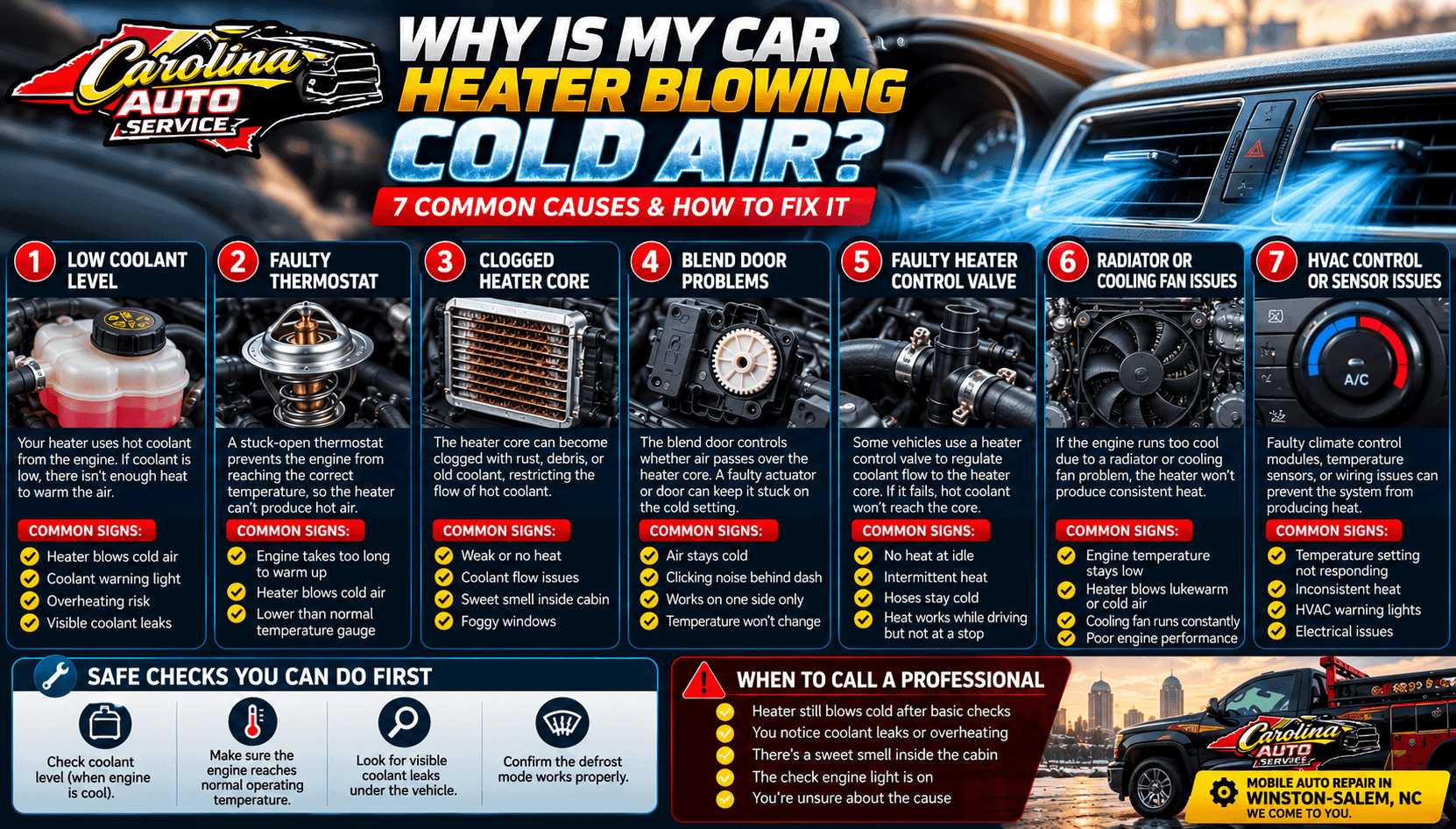
Car Heater Blowing Cold Air: 7 Causes at a Glance
The infographic below summarizes the main heating-system components, common symptoms, and useful first checks. It complements the diagnostic explanations above.
What Should You Check First When Your Car Heater Blows Cold?
Several basic checks can help you describe the problem accurately before scheduling an inspection. They should not require opening a hot cooling system or removing dashboard components.
Allow the Engine to Reach Operating Temperature
Cold air shortly after starting a conventional gasoline vehicle may be normal. Observe whether the heater begins warming during ordinary driving. Never warm a running vehicle inside an enclosed garage.
Confirm the Heater Settings
Select a warm temperature and test the different vent settings. On dual-zone systems, verify that both sides have appropriate temperature settings.
Observe the Temperature Gauge
An unusually low reading can indicate insufficient engine warm-up. A rapidly rising reading or overheating warning requires immediate attention.
Inspect Coolant Only When the Engine Is Fully Cool
Compare the coolant reservoir level against its marked cold range if accessible. Follow the owner's manual, and never remove a pressurized cap while the engine is hot.
Look for Visible Leaks
Inspect the ground beneath the parked vehicle and note visible coolant residue. Do not reach near moving belts, fans, or hot engine components.
Record Unusual Symptoms
Note any clicking noises, coolant odors, uneven heating, weak defrosting, or changes in heater temperature while idling versus driving.
Never remove a radiator cap or pressurized coolant-reservoir cap while the engine is hot. Hot coolant and steam can cause severe burns. If your vehicle overheats, produces steam, or displays a critical temperature warning, stop safely, shut off the engine, and arrange assistance.
Why Does My Car Heater Work Sometimes but Not Others?
Why Is My Heater Cold at Idle but Warm While Driving?
Heat that improves as engine speed increases can indicate insufficient coolant circulation at idle. Possible causes include low coolant, trapped air, restricted heater-core passages, or water-pump-related circulation problems.
Engine load also affects heat production and coolant-flow conditions, so the symptom alone does not establish which component has failed.
Why Does My Heater Blow Cold Air on the Highway?
Cold or lukewarm heat while driving at highway speeds may indicate that the engine is running below its intended operating temperature. A thermostat stuck open is one possibility, especially if engine warm-up takes longer than normal.
Testing actual coolant temperature helps determine whether the engine is too cool or whether the HVAC system is responsible.
Why Is One Side of My Car Heater Cold?
Many dual-zone climate-control systems use separate blend doors. If one door or actuator fails, one side of the cabin may remain cold while the other produces heat.
In some designs, an unevenly restricted heater core can create a similar temperature difference. Both air-door operation and coolant heat transfer should be considered.
Why Is My Heater Cold After a Coolant Flush?
Trapped air is one possible cause of heating problems immediately following cooling-system service. Some vehicles require specialized filling or bleeding procedures to remove air from the heater circuit.
If the issue begins after a coolant replacement, the refill procedure, coolant level, and circulation should be checked before recommending additional parts.
Why Is My Heater Cold Even Though the Engine Is Hot?
When engine temperature is normal but the cabin does not warm, possible causes include inadequate heater-core flow, a restricted heater core, a closed heater control valve, or an incorrectly positioned blend door.
Determining whether hot coolant is reaching the heater core can help distinguish a cooling-system concern from an HVAC airflow-control fault.
How Does a Mechanic Diagnose a Heater That Blows Cold Air?
A professional diagnosis should identify the root cause before components are replaced. Depending on the vehicle and symptoms, testing may include:
- Cooling-system inspection: Checking coolant level, hoses, reservoirs, connections, and evidence of leakage.
- Pressure testing: Evaluating whether the system loses pressure and identifying possible leak locations.
- Temperature verification: Comparing engine coolant temperature readings against the manufacturer's specifications.
- Heater-core testing: Evaluating coolant flow and inlet and outlet temperature differences.
- HVAC actuator testing: Confirming proper movement of temperature-control doors.
- Electrical diagnosis: Checking relevant sensors, wiring, blower controls, and electronic module data.
- Post-repair verification: Confirming normal engine temperature, heater output, and windshield defrosting.
How Much Does It Cost to Fix a Car Heater Blowing Cold Air?
The cost depends on what has failed. Replacing a thermostat, repairing a coolant leak, replacing a blend door actuator, and replacing a heater core involve different parts and labor requirements.
| Repair Type | Typical Complexity | Main Cost Consideration |
|---|---|---|
| Coolant leak diagnosis and repair | Varies widely | Location and severity of the leak |
| Thermostat replacement | Low to high | Engine design and component access |
| Blend door actuator replacement | Low to high | Dashboard accessibility |
| Heater core replacement | Often high | HVAC housing and dashboard removal |
| Water pump replacement | Moderate to high | Engine layout and associated components |
| Electrical or HVAC control repair | Varies widely | Testing requirements and failed components |
These are general complexity classifications, not repair-price quotes. The actual estimate depends on the vehicle, diagnostic findings, labor requirements, and parts availability.
Is It Safe to Drive When Your Car Heater Blows Cold Air?
A car heater blowing cold air does not automatically mean the vehicle is unsafe to drive. However, the underlying cause matters.
If the engine reaches normal temperature, there are no coolant warnings, and the windshield remains clear, the problem may be less urgent. Nevertheless, it should be investigated before colder weather or extended driving.
Stop Driving and Seek Assistance If:
- The engine temperature enters the overheating range.
- A critical coolant-temperature warning appears.
- Steam escapes from the engine compartment.
- The vehicle is losing coolant rapidly.
- The windshield cannot be kept sufficiently clear.
Continuing to drive an overheating engine can cause severe mechanical damage. Arrange appropriate assistance rather than attempting to drive the vehicle to a repair facility.
Can the Defroster Work Without Cabin Heat?
A defroster may continue blowing air even when the heating system is unable to warm it. However, warm and appropriately dehumidified air is especially useful for clearing condensation from the windshield.
Some vehicles use air conditioning during defrost operation to remove moisture. A heating or airflow failure can therefore reduce visibility under certain conditions. Do not drive when the windshield cannot be kept clear.
How Can You Prevent Car Heater Problems?
Not every heater failure can be prevented, especially electronic actuator and sensor faults. However, maintaining the cooling system and addressing developing symptoms can reduce the risk of coolant-related heating problems.
Maintain Coolant
Use the manufacturer-approved coolant specification and follow recommended service intervals.
Repair Leaks Early
Investigate recurring coolant loss rather than repeatedly topping off the reservoir.
Test Before Winter
Check heater output, blower speeds, temperature controls, and windshield defrosting before colder weather arrives.
Drivers in Winston-Salem can benefit from checking cabin heat during the fall, before lower temperatures make poor heating and windshield defogging more inconvenient.
Car Heater Blowing Cold Air: FAQs
1. Why is my car heater blowing cold air even when the engine is warm?
If the engine reaches normal operating temperature but the heater remains cold, hot coolant may not be flowing adequately through the heater core, or the HVAC system may not be directing air across it correctly. Possible causes include a restricted heater core, low coolant, a closed heater valve, or a blend door malfunction. Testing can distinguish coolant-flow concerns from air-control problems.
2. Can low coolant cause the heater to blow cold air?
Yes. Low coolant can interrupt circulation through the heater core, preventing sufficient heat transfer. Air may also enter the cooling system and create inconsistent heating. Coolant loss can result from leaks, damaged hoses, water pump problems, or internal engine faults. Check the reservoir only when the engine is fully cooled and investigate unexplained or repeated coolant loss.
3. Why does my car heater only work when I accelerate?
Heat that improves with engine speed can indicate inadequate coolant circulation at idle. Possible causes include low coolant, trapped air, restricted heater-core passages, or water-pump-related circulation problems. Engine speed also affects heat production and coolant movement, so this symptom alone cannot identify the failed part. Cooling-system temperature and circulation testing can help narrow the diagnosis.
4. Can a faulty thermostat make a car heater blow cold air?
Yes. A thermostat stuck open may prevent the engine from reaching its intended operating temperature, reducing the heat available to warm the cabin. Drivers may notice slow engine warm-up or weak heat during highway driving. A thermostat stuck closed may instead cause overheating. Actual coolant temperature should be verified before thermostat replacement is recommended.
5. What are the symptoms of a clogged heater core?
A restricted heater core may produce weak or inconsistent heat despite normal engine temperature. Symptoms can include poor heating at idle or uneven vent temperatures in some vehicles. A leaking heater core may also cause a sweet coolant smell, persistent interior fogging, damp carpet, or coolant loss. Diagnosis typically involves checking coolant condition, circulation, and heater-core temperature differences.
6. Why does my heater blow cold air on the passenger side?
Cold air on only one side commonly suggests a blend door or actuator problem in a dual-zone climate-control system. The affected door may not respond to temperature commands. However, restricted heater-core flow can produce similar uneven heating on some vehicles. Testing should evaluate air-door operation and heater-core performance before replacing components.
7. Will adding coolant fix a car heater that blows cold air?
Adding the correct coolant may restore heat if low coolant caused the problem, but it will not fix a leak, stuck thermostat, restricted heater core, or failed blend door. Coolant must be added according to manufacturer instructions and only when the system is safe to open. If coolant levels continue dropping, the underlying problem requires diagnosis.
8. Is it safe to drive with a car heater blowing cold air?
Driving may be possible when engine temperature remains normal, coolant warnings are absent, and windshield visibility is adequate. However, cold heat accompanied by overheating, steam, coolant loss, or poor defrosting can indicate a serious concern. Stop safely if overheating occurs, and arrange professional assessment rather than risking engine damage or unsafe visibility.
9. Why is my heater blowing cold air after a coolant flush?
Air trapped in the cooling system is one possible reason a heater stops working properly after coolant service. Some vehicles require special bleeding procedures or vacuum filling to remove trapped air. Incorrect coolant level, a remaining restriction, or another fault may also contribute. Have the refill and bleeding procedure checked rather than assuming the new coolant caused the problem.
10. Can a failing water pump cause no heat inside the car?
Yes. The water pump circulates coolant through the engine cooling system, and inadequate circulation can reduce heater-core performance. Depending on the failure, a water pump may also leak, make noise, or contribute to overheating. Cold air alone does not confirm water pump failure. A technician should verify circulation and related cooling-system conditions before recommending replacement.
11. How long should a car take to start blowing warm air?
There is no universal warm-up time. Heating performance depends on outside temperature, engine design, operating conditions, and climate-control settings. Conventional engines may need several minutes to produce noticeable cabin warmth, especially in cold weather. If heating remains absent once normal engine temperature is reached, the system should be evaluated. Hybrid and electric vehicles may use different heating methods.
12. Can Carolina Auto Service diagnose car heater problems in Winston-Salem?
Carolina Auto Service provides automotive diagnostics and repairs at its Winston-Salem facility, including engine and cooling-system concerns that can affect cabin heating. Technicians can assess reported symptoms and recommend appropriate testing based on the vehicle. For an appointment, call 336-765-8599 or contact the shop through its website.
Still Getting Cold Air From Your Car Heater?
Carolina Auto Service helps Winston-Salem drivers diagnose vehicle heating, cooling, and engine-temperature concerns. Accurate testing helps determine whether your car needs coolant-system repairs, thermostat service, HVAC diagnosis, or another solution.
Visit our repair facility at 160 Hanes Mall Circle, Winston-Salem, NC 27103. Contact the team to discuss your symptoms and schedule an appointment.
Business hours: Monday–Friday, 7:30 a.m.–5:30 p.m. Confirm availability before visiting. Never drive an overheating vehicle to the shop.
Automotive References & Further Reading
These resources provide additional background on vehicle heating problems and automotive troubleshooting.
- Cars.com — Why Does My Car Heater Blow Cold Air?
- NAPA Know How — Is Your Car Heater Blowing Cold Air?
- NAPA Know How — Troubleshooting a Car Heater Blowing Cold Air
- ALLDATA — Remedying Lack of Cabin Heat
Editorial note: This article provides general automotive education. Individual vehicles may require manufacturer-specific diagnostic and repair procedures.