
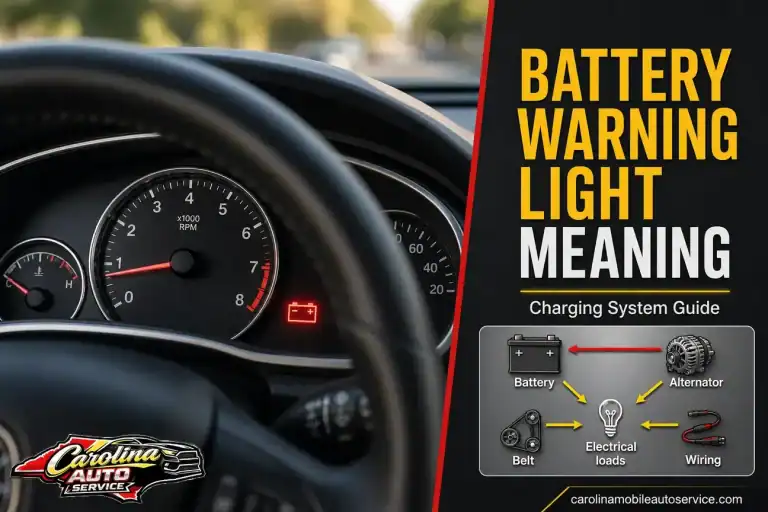
What Does the Battery Warning Light Mean? 7 Safe Answers
Quick Answer: The battery warning light usually points to a charging-system problem, not automatic proof that the battery itself has failed. Possible causes can include charging output, voltage control, wiring, cable connections, a belt-related issue, or a battery that cannot accept or hold a charge. If the light appears with dimming lights, loss of electrical power, stalling, smoke, a burning smell, or severe belt-area noise, stop in a safe place and arrange towing or roadside assistance instead of trying to keep driving.
A battery-shaped dashboard light can be confusing because the engine may still run, the radio may still play, and the vehicle may feel normal for a short time. That does not mean the charging system is keeping up. The vehicle may be using stored battery power while the underlying fault remains active. These seven safe answers explain what the light can mean, what to do right away, what symptoms matter most, and how an in-shop diagnosis confirms the real cause.
Answer 1: What does the battery warning light mean?
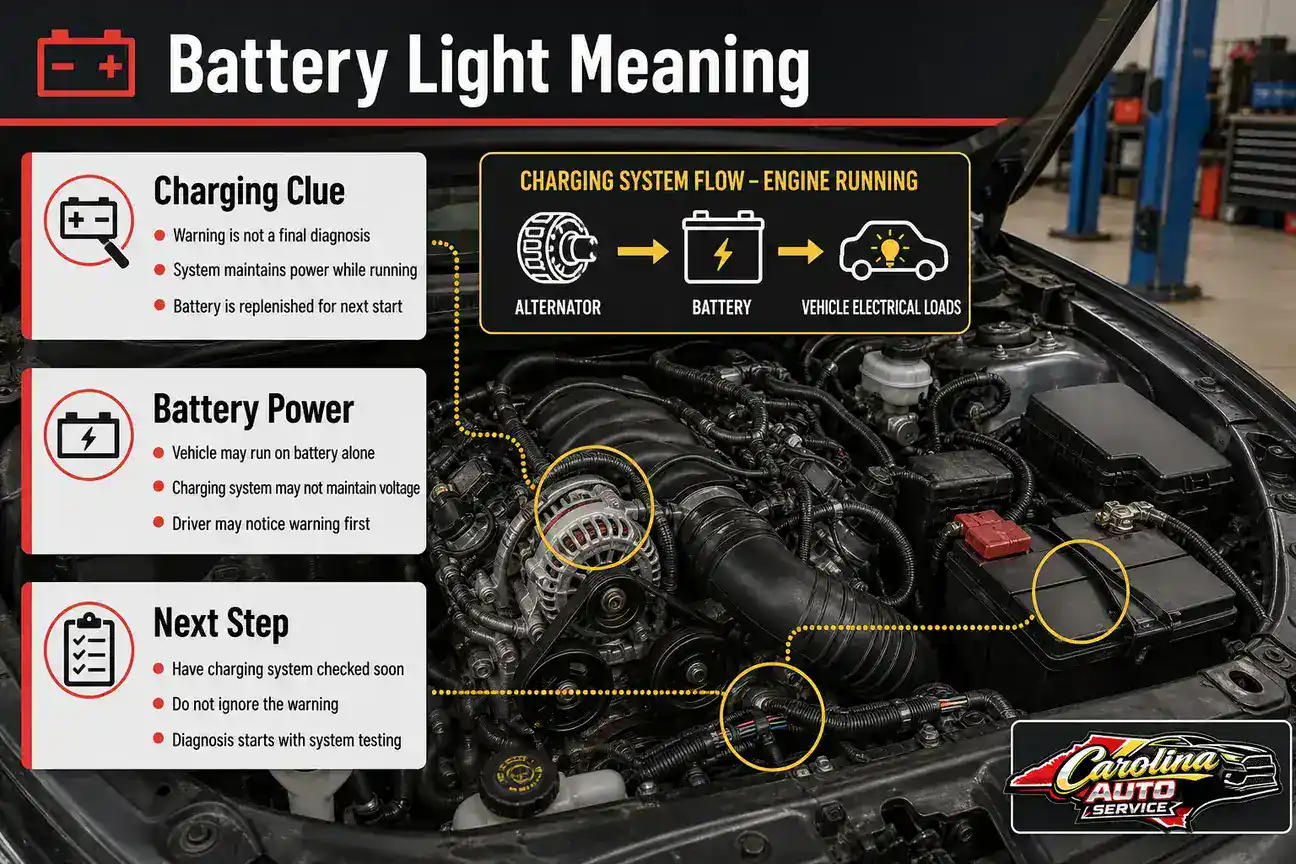
The battery-shaped warning is a charging clue, not a final diagnosis. The charging system’s job is to maintain electrical power while the engine is running and keep the battery replenished for the next start. If that system is not working as expected, the vehicle may alert you before the problem becomes obvious from the driver’s seat.
AAA’s battery-light guidance explains that this warning is tied to the charging system and that a vehicle may be running on battery power alone if the charging system is not maintaining voltage. In the supplied AAA recommendation-strength wording, AAA says drivers should have the charging system checked “as soon as possible” and should not ignore the warning because the vehicle can lose electrical power. See AAA’s 2024 battery-light guidance, pages 1-2, for that charging-system context.
The important point is that the dashboard icon does not always mean “buy a battery.” A weak battery is possible, but so are poor cable connections, wiring concerns, belt operation issues, voltage regulation problems, and vehicle-specific charging controls. Testing has to confirm what is happening before any repair is recommended.
When the engine keeps running with the light on, the vehicle may still have enough stored electrical energy to operate temporarily. That can change quickly. Electrical systems such as ignition, fuel control, lighting, power steering assist on some vehicles, cooling fans, and vehicle computers rely on stable voltage. If voltage drops far enough, drivability and safety can change without much warning.
The dashboard symbol is best treated as an early warning to reduce risk and plan a proper inspection. A symptom or code is a clue, not a diagnosis. That is especially true with electrical concerns because one poor connection can imitate a larger component failure, and one charging-control problem can create several different warning messages.
Answer 2: Is the car battery light always about the battery?
No. The phrase car battery light is common because the dashboard icon often looks like a little battery, but the meaning is broader. A car battery light can appear when the vehicle sees a charging-system condition outside the normal range. The battery may be involved, but it may also be the part receiving less charge because of another problem.
A battery-related cause may include a discharged battery, an internal battery condition, a battery that cannot accept charge properly, or a connection problem at the terminals. Corrosion, looseness, damaged cable ends, and poor grounds can all affect how electrical power moves through the vehicle. Those conditions can create symptoms that look similar from the driver’s seat.
An alternator or voltage-regulation issue is another possibility. The alternator is commonly responsible for generating electrical power while the engine runs on many gasoline-powered vehicles, and voltage control helps keep that power within a usable range. Still, an alternator label can be misleading because the light does not prove the alternator has failed. Testing has to confirm whether output, control, connections, or another factor is involved.
Belt-related issues can matter too. On vehicles with a belt-driven alternator, a loose, worn, slipping, damaged, or misaligned belt can affect charging. A tensioner or pulley concern may also change belt operation. If the light follows a squeal, chirp, whine, or visible belt problem, that timing is useful information, but it still does not identify one failed part by itself.
Some newer vehicles control charging in more complex ways, and hybrids may use different charging strategies than a conventional alternator setup. Hybrid warnings and high-voltage systems require vehicle-specific procedures. Drivers should not attempt high-voltage diagnosis or repair. The NHTSA electric and hybrid vehicle safety information explains that these vehicles can include high-voltage battery systems, which is why warning messages should be handled with the right equipment and procedures.
Answer 3: When does a charging system light mean stop driving?
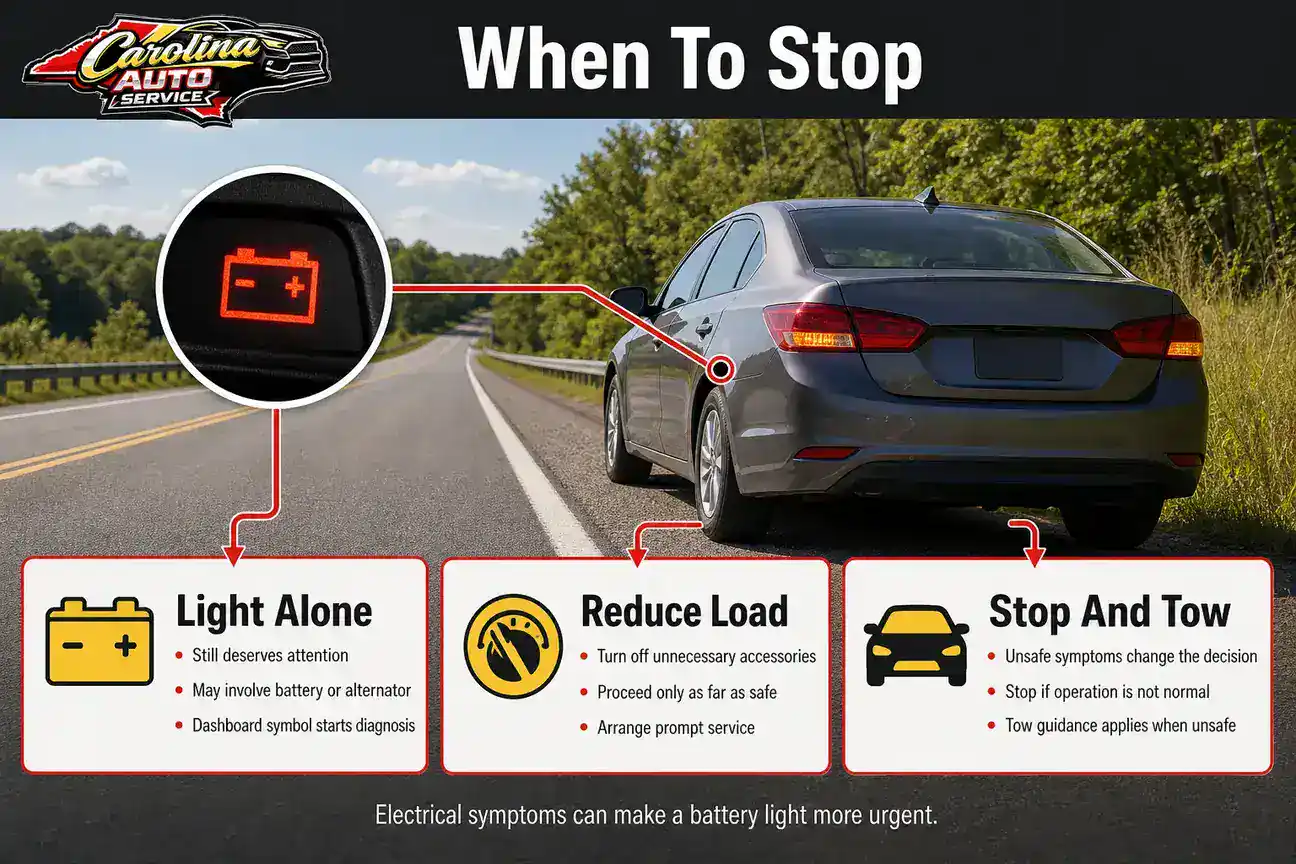
A charging system light deserves attention even when the vehicle seems normal. It becomes more urgent when other electrical symptoms appear at the same time. The light may be associated with the battery, alternator, wiring, charging controls, or another electrical concern. The dashboard symbol is the beginning of the diagnostic process, not the end.
AAA’s supplied safe-driving guidance for this warning says to turn off unnecessary electrical accessories and proceed only as far as is safe while arranging prompt service. AAA also gives stronger stop-and-tow guidance when the vehicle shows unsafe symptoms or can no longer be operated normally. In that context, AAA’s 2024 battery-light guidance, pages 1-2, supports treating a charging warning as time-sensitive rather than as a light to postpone indefinitely.
If the charging system light is the only symptom and the vehicle is already parked somewhere safe, do not ignore it. Avoid repeated starts and unnecessary electrical use until the vehicle can be evaluated. If the light comes on while driving, your first task is not to diagnose the vehicle from the seat; it is to manage risk and reach a safe stopping place.
Stop in a safe place and arrange towing or roadside assistance if you notice any of these serious symptoms:
- Loss of engine power, stalling, or repeated stumbling
- Headlights or dashboard lights that are fading quickly
- Smoke, burning smell, or visible belt damage
- Severe squealing, chirping, grinding, or belt-area noise
- Multiple warning lights appearing together
- Electrical accessories shutting off, resetting, or acting erratically
- A hybrid warning message or high-voltage-related warning
Do not open hot engine components, reach near moving belts, disconnect electrical parts, or attempt roadside repairs. If the vehicle is in traffic or creating a hazard, prioritize personal safety and roadside assistance. Carolina Auto Service performs in-shop diagnostics and repair; it is not a towing or roadside-repair provider.
A roadside assistance program may apply to qualifying service in some situations. Because that program is a third-party benefit with terms and conditions, review the details and ask Carolina Auto Service what applies before relying on coverage.
| What you notice | What it may indicate | What to do |
|---|---|---|
| Dimming or flickering headlights | Charging output, connection, or electrical fault | Move toward a safe stopping place; arrange assistance if symptoms worsen |
| Accessories slow down or behave differently | Reduced available electrical power or unstable voltage | Treat as an urgent electrical clue, especially if several accessories change together |
| Squeal, chirp, or whine near the belt area | Belt, pulley, tensioning, or charging-system concern | Stop if the noise is severe, paired with smoke, or paired with power loss |
| Stalling or loss of power | The vehicle may no longer maintain electrical operation | Stop safely and arrange towing or roadside assistance |
| Battery-shaped light plus other warning lights | Multiple systems may be affected or voltage may be unstable | Record every light and request diagnosis when the vehicle is safely parked |
Answer 4: Why do dimming headlights and weak accessories matter?
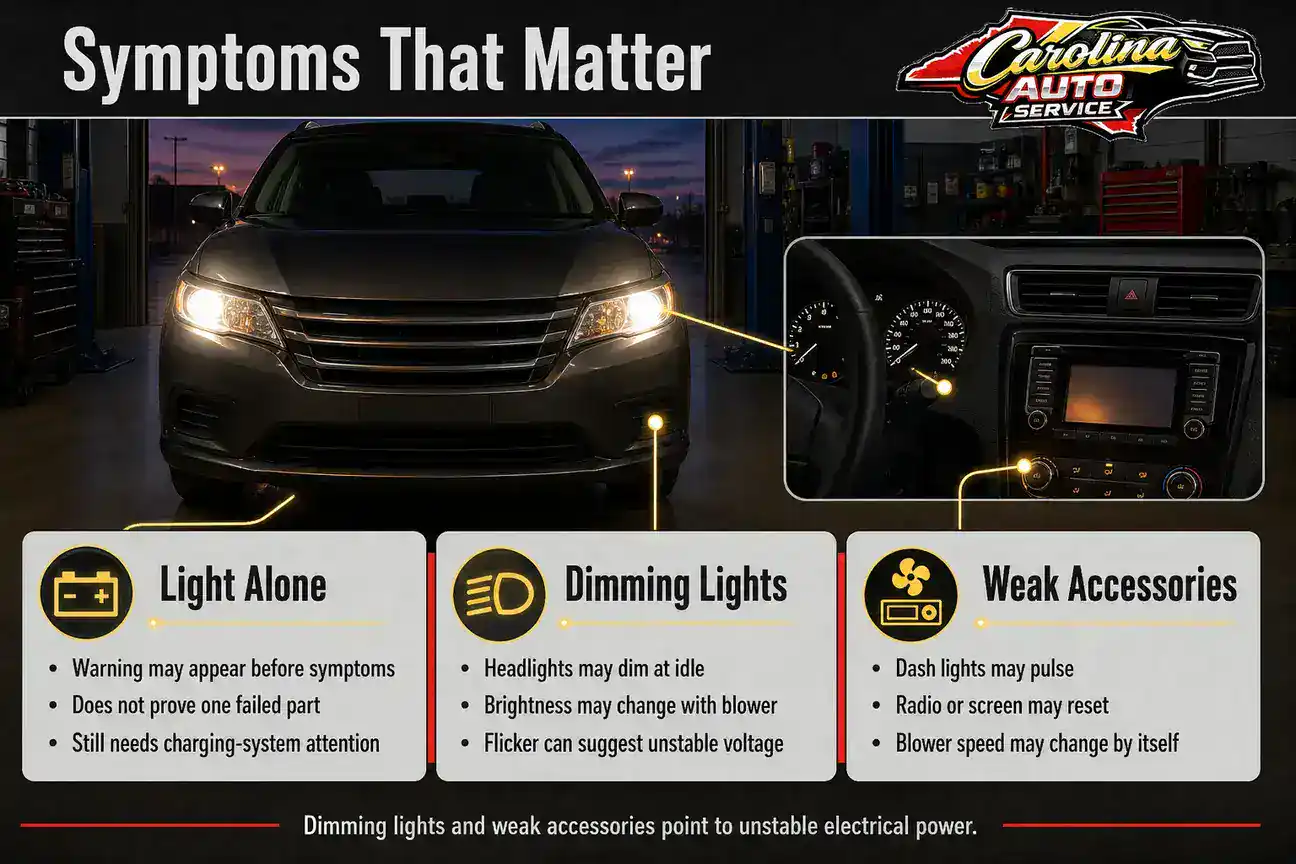
Dimming headlights are one of the easiest symptoms for a driver to notice. Headlights may dim at idle, flicker during acceleration, change brightness when the blower motor turns on, or seem unusually bright and then fade. Dimming headlights do not prove a single component has failed, but they do suggest that voltage or electrical supply may not be steady.
Interior lights and dashboard illumination can provide the same kind of clue. If the dash lights pulse, the radio resets, the infotainment screen flickers, or the blower motor changes speed without you changing the setting, the vehicle may not be maintaining stable electrical power. Those changes are especially important when they happen at the same time as a charging system light.
Power windows, seat motors, rear defrosters, heated seats, wipers, and climate-control systems all add electrical load. When several accessories act differently at once, the problem may become more urgent because the system is struggling under demand. A driver might notice the car battery light during a rainy evening drive with headlights, wipers, defroster, and blower operating together.
Do not use accessory behavior as a home diagnosis. Dimming headlights can be associated with charging output, cable condition, grounds, wiring, belt drive, or the battery itself. The pattern helps guide testing, but it does not replace inspection. If dimming headlights are getting worse while you drive, focus on finding a safe stopping place rather than trying to make it to a shop.
Timing helps too. If the charging warning appears mostly at idle, the symptom may be more noticeable when engine speed is low and electrical load is high. A driver may see the car battery light at a stoplight with the headlights, blower, rear defroster, and wipers operating. That pattern is useful because the shop can evaluate charging performance under conditions similar to when the symptom occurs.
If symptoms show up after rain, after a jump-start, after recent repair work, or after the vehicle sat unused, mention that. Moisture, disturbed connections, battery state of charge, and recent service history can all affect the diagnostic path. The more exact the history, the less time is spent chasing unrelated possibilities.
Answer 5: Why can an alternator warning light label be misleading?
Some drivers call the dashboard symbol an alternator warning light because the alternator is a common charging-system part. That wording is understandable, but it can lead to an expensive assumption if testing is skipped. The alternator may be part of the concern, or it may be responding to a belt, wiring, battery, control, or connection issue.
For example, an alternator warning light that appears after a belt squeal could be related to belt drive operation. An alternator warning light that appears with corrosion at the battery terminals could be related to connection quality. An alternator warning light that appears on a vehicle with several communication codes may involve a more complex electrical-control concern.
The same caution applies to dashboard messages that say “service charging system” or “check charging system.” They are helpful alerts, but they do not tell the whole story. The technician still needs to test the battery, charging output, wiring, grounds, belt condition, and any related diagnostic information before recommending a repair.
If the light appears after a squeal, chirp, or whine, the belt drive and related components become important inspection points. A belt noise that changes with engine speed may be connected to belt tension, pulley operation, or accessory load. Still, a noise and a charging warning together do not prove which part is responsible.
If a warning appears after a recall notice, or if you are unsure whether a safety recall may apply to your vehicle, you can use the NHTSA recalls lookup as one source of information. A recall lookup does not diagnose a current charging concern, but it can help identify manufacturer safety recall information tied to a specific vehicle.
Local driving patterns can make electrical symptoms more noticeable. In Winston-Salem, stop-and-go traffic near Hanes Mall and I-40 can mean long idle periods with the blower, lights, phone charger, and other accessories operating. That combination can make a marginal charging concern show itself sooner than a short daytime drive with few accessories on.
Seasonal conditions can matter too. North Carolina heat encourages heavy A/C use, while cold snaps can make starting demand more noticeable. Rainy evening drives add headlights, wipers, defroster, and blower load at the same time. None of those conditions diagnose the vehicle, but they explain why a charging problem may appear under one set of conditions and not another.
Answer 6: How does a shop diagnose a charging system light?
A good diagnosis starts by confirming the concern. That may include verifying the warning light, noting whether other dashboard lights are present, checking the vehicle’s voltage behavior, and reviewing the driver’s description. At Carolina Auto Service, diagnosis before assumptions matters because a warning light is a clue, not a parts list.
For a warning-light concern, check-engine-light diagnostics and related dashboard-light testing may include retrieving relevant diagnostic information and looking at the systems involved. Even when the dashboard symbol is not the check engine light, scan data and stored codes can help identify voltage-related clues, communication faults, or vehicle-specific charging-control issues.
Testing may include checking battery condition, state of charge, and whether the battery can accept and hold charge. The shop may also evaluate charging output under appropriate conditions, inspect visible belt operation, and look for signs of looseness, wear, damage, or abnormal movement. Battery terminals, cables, grounds, connectors, and visible wiring are common inspection areas because poor connections can mimic larger failures.
Electrical load matters too. If the light appears with the A/C, blower motor, lights, or defroster on, the technician may reproduce similar conditions during testing when appropriate. If the engine runs poorly, stalls, or loses power, engine diagnostics may also be relevant because low or unstable voltage can overlap with drivability symptoms.
The goal is not to replace the most familiar part first. The goal is to test the charging system, identify the confirmed cause, explain the findings, and provide an estimate before authorized repairs begin. The FTC auto repair basics recommend understanding the shop’s policies, estimates, and warranty details before authorizing repair work. North Carolina also has a statute addressing written motor vehicle repair estimates, so asking clear questions before work begins is a practical step.
ASE-certified technicians at Carolina Auto Service diagnose and repair vehicles in the shop. Qualifying repairs may carry a nationwide limited 24-month/24,000-mile parts and labor warranty on qualifying repairs. Ask about terms before approving work.
If your vehicle is parked safely and you are ready to have the warning checked, you can request an appointment or call 336-765-8599. Describe when the light appears, whether it is steady or intermittent, and whether dimming headlights, noise, stalling, or other warning lights are present. The shop confirms the appointment time.
Answer 7: What should you record before service?
Good notes can make a charging complaint easier to reproduce. Before requesting service, write down the exact warning symbol or message. The battery light may look slightly different by make and model, and some vehicles display text such as “charging system” or “battery.” Note the color of the warning, whether it flashes or stays steady, and whether it disappears after a restart.
Record when the light appears. Does it come on during startup, at idle, while accelerating, while braking, while turning, or during steady highway driving? Does the alternator warning light appear only with the A/C on or only at night with headlights operating? Those details help connect the symptom to electrical load, belt operation, or operating conditions.
Also record any sound, smell, or behavior change. A squeal, chirp, whine, grinding noise, burning smell, smoke, slow power windows, radio resets, weak blower speed, flickering dash lights, or dimming headlights should all be mentioned. If other warning lights appear, list every one of them instead of focusing only on the first light you noticed.
Include recent history. A jump-start, battery replacement, belt work, electrical repair, accessory installation, collision repair, or long period of sitting can all be relevant. Include the year, make, model, mileage, engine type if known, and whether the vehicle is a hybrid. For hybrids, do not attempt high-voltage inspection; provide the warning message and let trained personnel follow vehicle-specific procedures.
If you can safely take a photo or short video while parked, it may help. Do not record while driving. A clear dashboard photo, a short parked video of an intermittent noise, or a note showing which accessories were on at the time can give the shop a better starting point.
Once testing confirms the cause, the repair recommendation depends on the findings. One vehicle may need a connection repair. Another may need belt-related work. Another may need battery service or replacement by a provider that offers that service. Another may need alternator or charging-control repair. The correct answer depends on the vehicle and the test results.
Carolina Auto Service’s auto repair services are built around inspection, explanation of findings, and an estimate before approved work begins. That matters with electrical issues because symptoms overlap. A weak battery, poor ground, belt problem, wiring issue, and charging-output problem can all create similar driver complaints.
Ask what was tested and what the results showed. You do not need to know every electrical specification to make an informed decision, but you should understand why a repair is being recommended. If a nationwide limited 24-month/24,000-mile parts and labor warranty on qualifying repairs may apply, ask about terms through the Carolina Auto Service warranty information before authorizing the repair.
If you see the battery warning light, treat it as a charging-system warning and gather the details that make diagnosis clearer. Note whether the car battery light appeared at startup, idle, acceleration, or with accessories on. Write down any dimming headlights, belt-area noises, stalling, smoke, burning smell, or other warning lights.
If serious electrical symptoms are present, stop in a safe place and arrange assistance. If the vehicle is parked safely and you want the warning checked, request an appointment with Carolina Auto Service or call 336-765-8599. The Winston-Salem shop is open Monday-Friday 7:30 a.m.-5:30 p.m., and appointment requests are confirmed by the shop.
General educational information, not a diagnosis. Only an in-person inspection can confirm what a vehicle needs.
Frequently Asked Questions
Does the battery warning light always mean I need a new battery?
No. The light usually points to a charging-system concern rather than proving the battery itself has failed. Possible causes include charging output, wiring, cable connections, belt-related issues, voltage control, or the battery. Testing is needed before deciding what repair is appropriate.
Why is my car still running if the battery light is on?
The vehicle may still be running on stored battery power for a while even if the charging system is not replenishing it properly. That does not prove the vehicle can continue safely. If electrical power drops, the vehicle may stall or lose important electrical functions.
Can I drive to the repair shop with the battery warning light on?
Do not assume driving farther is safe. If the light appears with dimming lights, loss of power, stalling, smoke, a burning smell, severe belt-area noise, or multiple warning lights, stop in a safe place and arrange towing or roadside assistance. If the vehicle is parked safely, request diagnostic service before driving more than necessary.
What do dimming headlights or changing electrical accessories mean?
They may indicate that the vehicle is not maintaining normal electrical power. Dimming headlights, changing blower speed, slow windows, radio resets, or flickering dashboard lights can be associated with charging-system or connection problems. Those symptoms are clues, not a remote diagnosis.
Could a belt cause the battery-shaped warning light?
Possibly. On vehicles that use a belt-driven alternator, a worn, loose, slipping, damaged, or misaligned belt may affect charging-system operation. A tensioner or pulley concern may also be involved. A squeal, chirp, whine, or visible belt problem should be inspected, especially if it appears with electrical symptoms.
What should I tell the shop when I request service?
Share when the light appeared, whether it stayed on or came and went, what accessories were operating, and whether you noticed noises, smells, dimming headlights, stalling, or other warning lights. Also provide the year, make, model, mileage, recent jump-starts or repairs, and whether the vehicle is a hybrid.
Is a charging warning different on a hybrid vehicle?
It can be. Hybrid vehicles may use different charging strategies and high-voltage systems. Do not attempt high-voltage checks or repairs. Record the exact warning message and arrange professional diagnosis using vehicle-specific procedures.