
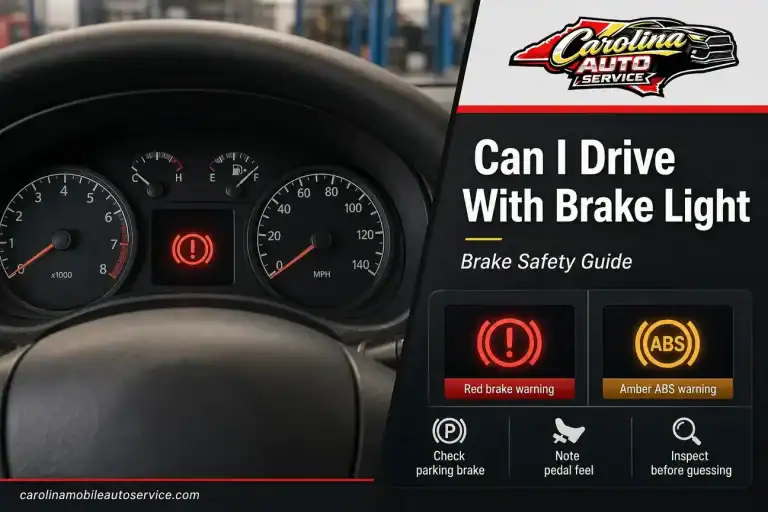
Can I Drive With the Brake Warning Light On
If your brake warning light comes on, treat it as a warning, not a diagnosis. First, confirm the parking brake is fully released. If the red warning stays on, the pedal feels low or sinking, braking feels weak, you see fluid, smell burning, notice smoke, or see both brake and ABS indicators together, stop in a safe place and arrange towing or roadside help instead of trying to make it to a shop.
Quick Answer: brake warning light decisions
Quick Answer: A red brake-system warning can be as simple as a parking-brake reminder, but it can also point to a condition that needs immediate attention. If the light stays on after the parking brake is released or braking feels different, do not keep driving to “see what happens.” General educational information, not a diagnosis. Only an in-person inspection can confirm what a vehicle needs.
What the red brake light may be telling you
A red brake light is usually tied to the vehicle’s main brake warning system, but the exact symbol and message vary by make, model and year. Some dashboards show the word “BRAKE.” Others show a brake symbol, a message in the driver information display, or more than one warning at the same time.
Common possibilities include an engaged parking brake, low brake-fluid level, a brake-fluid or pressure concern, an electronic brake-system warning, or a vehicle-specific fault. That does not mean one of those items is automatically the failed part. A warning light is a clue. The vehicle still needs inspection and testing before anyone can say what repair, if any, is needed.
The owner’s manual matters because it explains the symbol used on your vehicle and the manufacturer’s instructions for that warning. Two vehicles can use similar-looking icons but handle the message differently. If the manual says to stop driving or seek service immediately, follow that instruction.
If a warning appears after a recent brake repair, tire rotation, wheel work, jump start, battery replacement, or long downhill drive, note that timing. It may help the shop narrow the testing path, but it still does not confirm the cause by itself.
First check: is the brake light on because of the parking brake?
When the brake light on the dash appears, the first basic check is whether the parking brake is fully released. Many vehicles use the same red warning area to remind the driver that the parking brake is engaged. A floor pedal, hand lever, dashboard switch or electronic parking brake button may not be fully released even when it looks close.
Do this only when you can do it without distraction. Come to a safe stop if needed, confirm the parking brake is released, and watch what the warning does. If the light goes out and the vehicle otherwise behaves normally, do not treat that as proof that the brake system was inspected or cleared. Note the behavior and monitor for a repeat warning.
If the brake light on the dash remains after the parking brake is released, do not assume it is only a sticky switch or harmless reminder. It may indicate something else in the brake system or warning circuit. That is the point where driver observations become important: pedal feel, stopping response, fluid, odor, noise, and any other warning lights.
When to stop driving instead of continuing
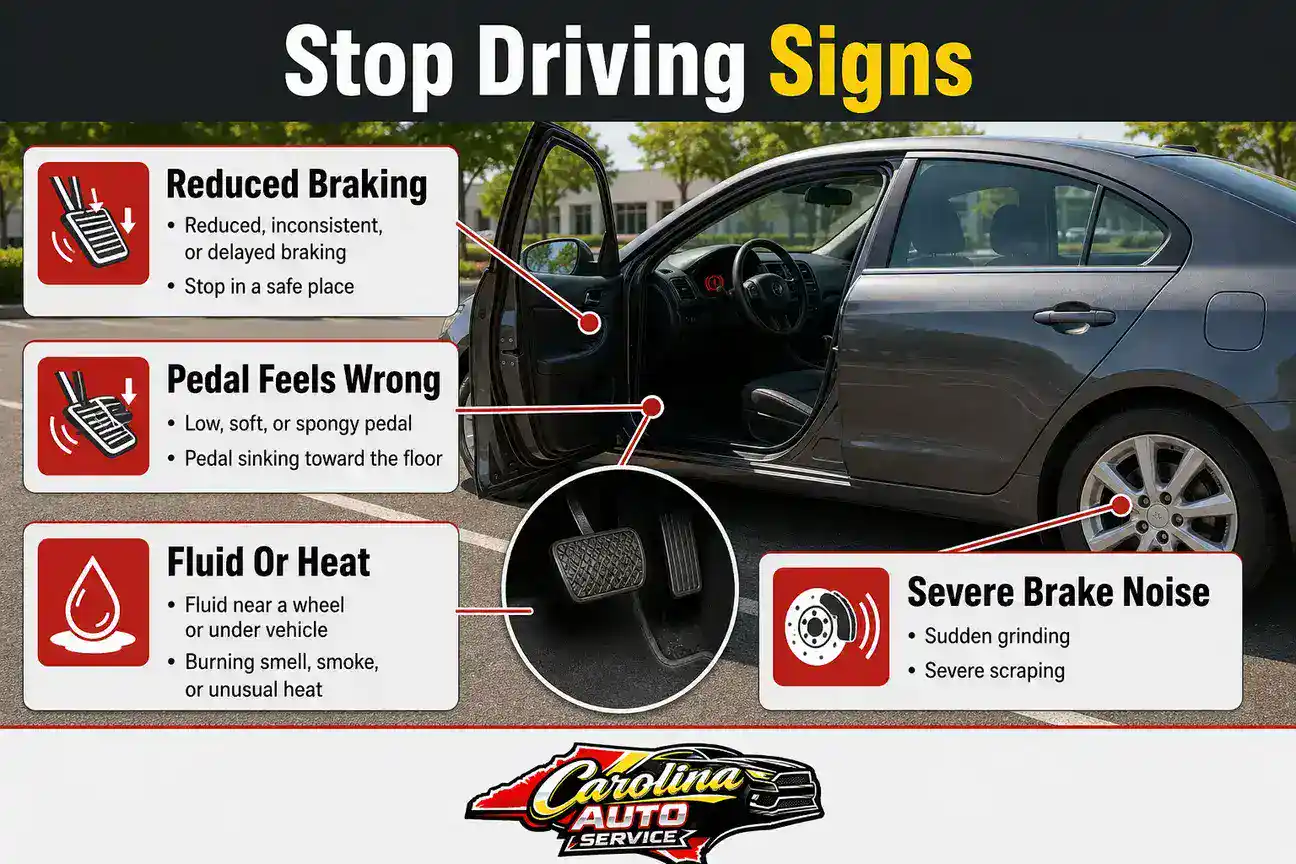
This is the most important part. If braking is reduced, inconsistent, delayed, or different from normal, stop in a safe place. If the pedal feels low, soft, spongy, or continues sinking toward the floor, stop in a safe place. If you see fluid near a wheel or under the vehicle, smell burning, see smoke, feel a wheel area getting unusually hot, or hear sudden grinding or severe scraping, stop in a safe place.
Do not drive on just to reach the shop when the braking system is giving urgent symptoms. Arrange towing or roadside assistance from a safe location. A roadside-assistance program may apply to qualifying service in some situations, but it is not a shop-operated towing or roadside repair service. If that benefit may apply to you, review the roadside assistance program terms after you are safe.
The goal is not to panic. The goal is to avoid gambling with reduced braking. A red warning by itself does not identify the failed part, but warning lights plus abnormal pedal feel, reduced stopping, visible fluid, smoke, or overheating should be treated as a serious brake-safety concern.
| What you notice | Cautious action |
|---|---|
| Light appears briefly at startup and goes out as described in the manual | Note the behavior and consult the manual if it repeats or changes. |
| Red warning remains after the parking brake is released | Arrange prompt inspection and do not assume the cause. |
| Low, soft, spongy, or sinking pedal | Stop in a safe place and arrange towing or roadside help. |
| Reduced, delayed, weak, or inconsistent braking | Stop in a safe place and arrange towing or roadside help. |
| Visible fluid near a wheel or under the vehicle | Stop in a safe place, especially if the pedal or braking response has changed. |
| Red brake warning plus ABS warning | Take the combination seriously; stop if braking is abnormal or warnings remain. |
| Smoke, burning smell, severe grinding, or unusually hot wheel area | Stop in a safe place and arrange towing or roadside help. |
How to read the brake warning meaning without guessing
The safest way to think about brake warning meaning is “what system is asking for attention?” not “what part failed?” A red warning may be associated with fluid level, parking-brake status, hydraulic pressure, brake wear effects, or an electronic warning. Those possibilities are not all repaired the same way.
Fluid level is a good example. Low brake fluid may be associated with a leak, but it may also be associated with brake wear or another condition depending on the design. Seeing the reservoir level by itself does not confirm why it is low. Adding fluid also does not prove the vehicle is ready to drive, because the underlying reason still needs to be found.
Pedal feel gives important context. A pedal that is slightly different from normal may be easy for a driver to overlook, but a pedal that sinks, needs pumping, or travels farther than usual deserves caution. Brake hydraulic systems are designed to transmit pedal force to braking components; when pedal feel changes, the cause needs evidence-based testing.
Another part of brake warning meaning is timing. Did the warning appear after startup, during a hard stop, after a long downhill grade, in stop-and-go traffic, after a puddle, or after a repair? Did it happen cold, hot, at highway speed, or only while turning? Those details help guide inspection without jumping to conclusions.
For hybrid vehicles, do not attempt high-voltage diagnosis or brake-by-wire system work yourself. Hybrid warning lights and brake-system messages can involve conventional braking, electronic controls, and high-voltage safety systems. The NHTSA electric and hybrid vehicle safety page is a useful reminder that electrified vehicles require additional safety awareness around high-voltage systems.
How the red warning differs from an amber ABS warning
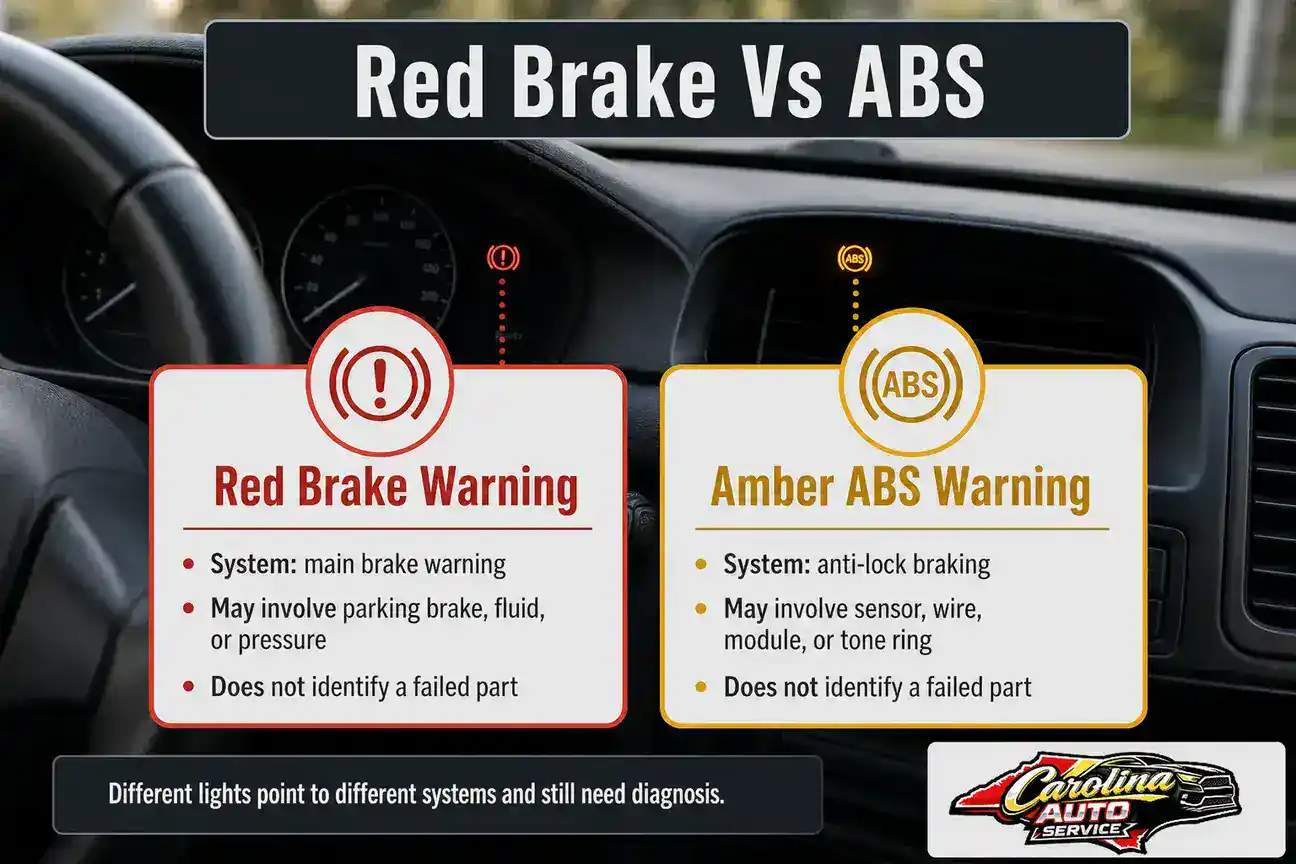
The red warning and the amber ABS warning are related to braking, but they are not the same message. The red warning generally concerns the main brake-system warning function, parking-brake status, fluid level, pressure-related concerns, or other brake-system faults depending on the vehicle.
The amber ABS warning points toward the anti-lock braking system. ABS helps reduce wheel lockup during certain braking conditions, but an ABS warning does not prove which sensor, wire, module, tone ring, hydraulic component, or control issue is involved. It simply tells you the anti-lock system has detected a condition that needs diagnosis.
A vehicle may appear to brake in ordinary conditions even with an ABS warning present, but that should not be turned into a claim that it is safe to continue driving without inspection. If the pedal feels normal and only an amber ABS warning is present, follow the owner’s manual and arrange prompt diagnosis. If the red warning appears with it, the situation deserves more caution.
Other dashboard warning lights can also affect how the situation is handled. A stability-control light, traction-control light, hybrid warning, check engine light, or charging-system warning may change the diagnostic path. Carolina Auto Service also handles check-engine-light diagnostics for warning-light concerns beyond the brake system.
When brake ABS lights appear together
When brake ABS lights appear together, treat the combination as more concerning than a parking-brake reminder alone. It can point toward a broader brake-system or electronic brake-control issue, but it still does not identify the failed part by itself.
Some vehicle-specific service information and recalls can involve brake, ABS, traction-control, or electronic-control warnings appearing together. Because those situations depend on year, make, model, equipment and stored diagnostic codes, they should not be generalized to every Toyota, Honda, Subaru, Jeep, GMC, Buick, Chevrolet, domestic, import, or hybrid vehicle. If you want to check whether your specific vehicle has an open safety recall, use the NHTSA recalls lookup with the vehicle’s identification number.
If brake ABS lights come on and the pedal, stopping distance, steering feel, or warning messages also change, stop in a safe place and arrange help. If the warning combination remains but braking seems unchanged, do not call it normal. Use the owner’s manual, avoid unnecessary driving, and schedule an inspection so the stored codes and system data can be checked.
For drivers, the key point is simple: one light gives a clue; two related lights give more context; neither one replaces testing. Guessing from the dashboard alone can lead to unnecessary parts replacement or, worse, ignoring a condition that needed immediate attention.
Possible causes when the red brake light stays on
A persistent red brake light can be associated with several conditions. The list below is not a diagnosis. It is a starting point for inspection:
- Parking brake not fully released or a parking-brake switch concern.
- Low brake-fluid level.
- Fluid loss from a hose, line, caliper, wheel cylinder, master cylinder area, or another hydraulic component.
- Brake wear that changes fluid level or sensor readings, depending on vehicle design.
- Electrical, sensor, wiring, or module communication concern.
- ABS or electronic brake-control fault when ABS or stability warnings are present.
- Vehicle-specific issue addressed by a manufacturer bulletin or recall.
- Previous repair, wheel work, battery event, or related service that changed system status.
The right repair path depends on evidence. A low reservoir does not automatically mean a leak is confirmed. A warning after a battery replacement does not automatically mean a module failed. A grinding noise does not automatically name the part. Diagnosis before assumptions protects the driver and helps avoid replacing parts that testing did not support.
Should you add brake fluid before driving?
Be careful with this one. If the brake light on the dash is joined by a low or sinking pedal, visible fluid, weak stopping, or a burning smell, adding fluid is not the answer that makes the vehicle okay to drive. Stop in a safe place and arrange help.
If you are parked and can safely view the reservoir without disassembling anything, the level may be useful information to report. Do not open components you are not familiar with, do not crawl under a vehicle supported only by a jack, and do not assume the fluid type or condition without checking the owner’s manual. Using the wrong fluid can create additional problems.
If fluid is low, the question is why. It may be related to wear, leakage, or another system condition. That is why a brake inspection looks for both the warning and the evidence behind it.
What an in-shop brake inspection may evaluate
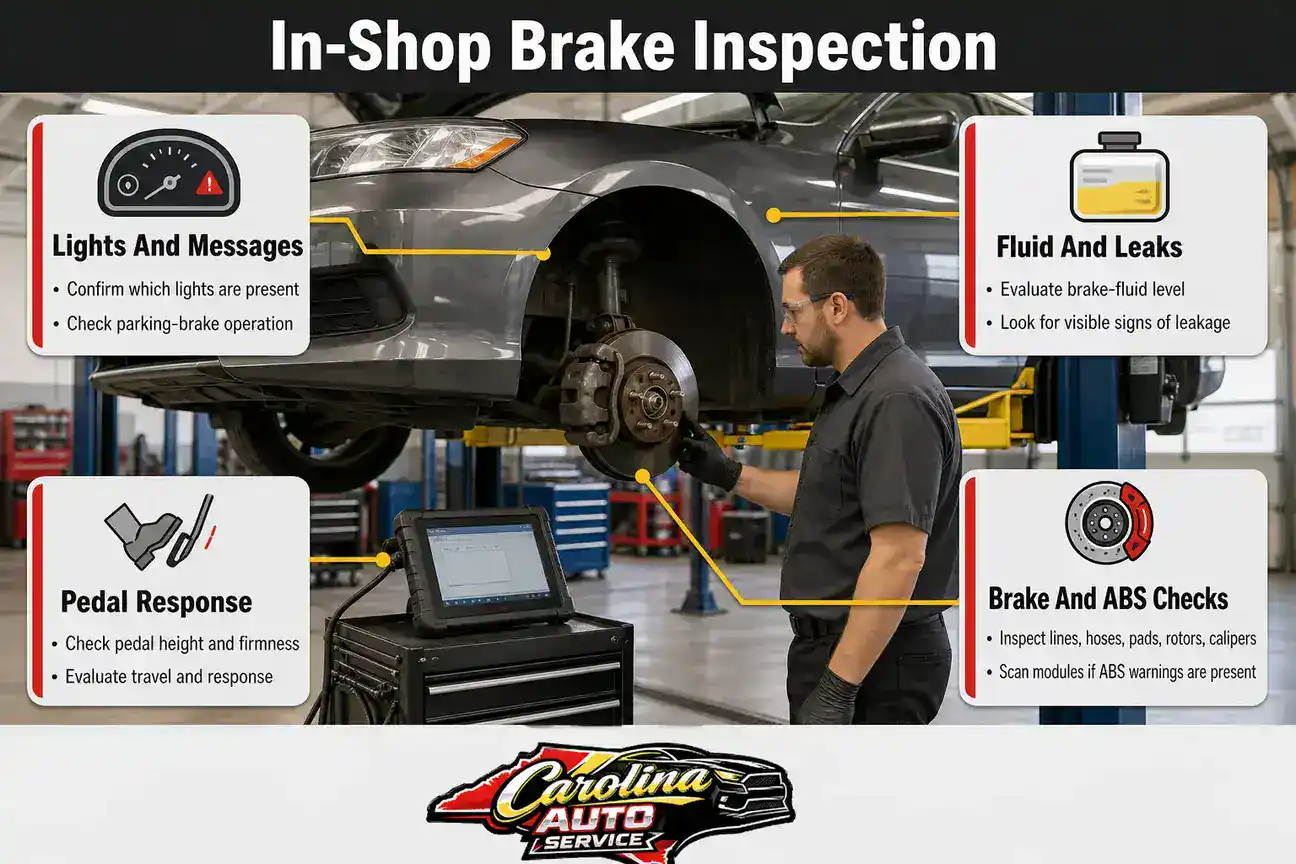
At Carolina Auto Service, brake concerns are handled through in-shop inspection and testing. For this kind of warning, brake service may include confirming which lights and messages are present, checking the parking-brake operation, and evaluating fluid level and visible signs of leakage.
An inspection may also look at pedal height, firmness, travel and response. The technician may check lines, hoses, hydraulic components, pads, shoes, rotors, drums, calipers and related hardware where applicable. If ABS or electronic brake-control warnings are present, scanning relevant modules and reviewing codes or data may be part of the diagnostic process.
The condition of the vehicle matters. If braking performance is abnormal, test driving may not be appropriate until the vehicle is inspected and the immediate concern is understood. Some testing can be done visually or electronically before any road evaluation is considered.
Inspection may also look for uneven wear, overheating, contamination, fluid condition, damaged wiring, loose connectors, abnormal movement, or evidence that a wheel-end component is affected. None of these findings should be assumed before the vehicle is checked.
The process should end with clear findings, recommendations, and an estimate before authorized repairs begin. The FTC auto repair basics page advises consumers to understand the repair work and ask questions, and North Carolina law addresses motor vehicle repair estimates. Carolina Auto Service’s site also emphasizes an explanation of findings and approval before authorized repairs begin.
What to write down before arranging service
Good notes can shorten the path from warning light to evidence. You do not need to diagnose the vehicle. Just record what happened as accurately as you can.
- The exact warning color, symbol, words and message shown.
- Whether the parking brake was engaged or recently used.
- Whether the warning appeared at startup, while driving, while braking, after a turn, or after a stop.
- Whether the warning went away, stayed on, flashed, or returned later.
- Whether the pedal felt normal, low, soft, hard, spongy, or sinking.
- Whether stopping distance, pulling, vibration, grinding, scraping, odor, smoke, or heat changed.
- Whether brake ABS lights, traction-control lights, hybrid warnings, or other dashboard warnings appeared.
- Recent work, battery replacement, wheel service, tire change, fluid service, or unusual road event.
- Vehicle year, make, model, approximate mileage and any owner’s manual message.
The more specific the notes, the easier it is to avoid guessing. “The red brake light came on after I started the car” is useful. “The warning came on while braking downhill, the pedal felt lower, and I smelled burning near the right rear wheel” is even more useful.
Winston-Salem drivers: what to do next
In Winston-Salem stop-and-go traffic near Hanes Mall and I-40, it can be tempting to keep going if you are only a few minutes from your destination. Do not do that if braking is reduced, the pedal is sinking, fluid is visible, smoke is present, or the red warning remains with other brake symptoms. Stop somewhere safe and arrange towing or roadside help.
If the vehicle does not show urgent symptoms and you are arranging inspection, Carolina Auto Service is an in-shop repair facility at 160 Hanes Mall Circle in Winston-Salem. You can request an appointment and describe the warning, when it appeared, whether the parking brake was involved, and any pedal or stopping changes. The shop confirms the appointment time.
Drivers from Forsyth County who have questions about location or hours can use the shop hours and directions page. If repairs are recommended after inspection, ask about terms for a nationwide limited 24-month/24,000-mile parts and labor warranty on qualifying repairs. Warranty details can vary by repair, so review the warranty on qualifying repairs before approving work.
How warning-light diagnosis helps avoid wrong assumptions
The reason careful diagnosis matters is that brake warnings overlap. A driver might describe the brake warning meaning as “my brakes are failing,” when the actual evidence could point to a parking-brake switch, a fluid-level concern, an ABS-related fault, or something else. Another driver might say the warning is “just a sensor,” when the pedal feel suggests the vehicle should not be driven.
Both reactions are understandable. Dashboard lights are designed to get attention, not explain the full failure path. A scan tool, visual inspection, fluid-level check, pedal evaluation, and component inspection each tell part of the story. The repair recommendation should come after those facts are gathered.
That is especially true when the brake light on the dash comes and goes. Intermittent warnings may still leave stored codes or evidence. Heat, vibration, moisture, traffic conditions, brake use, and electrical connections can all affect when symptoms show up. If you can describe the pattern, the shop has a better starting point.
Seven practical safe choices before you decide to drive
Use these seven choices as a calm checklist, not as a substitute for inspection:
- Confirm the parking brake position. Make sure it is fully released and observe whether the warning changes.
- Check the owner’s manual message. Follow the vehicle-specific instruction for the warning shown.
- Pay attention to pedal feel. A low, soft, spongy, or sinking pedal is an urgent sign to stop.
- Notice stopping response. Longer stopping distance, delayed braking, pulling, or pumping the pedal means stop in a safe place.
- Look for obvious fluid from a safe position. Fluid near a wheel or under the vehicle is a reason to avoid driving.
- Take combined warnings seriously. Brake ABS lights together deserve prompt attention, especially with any braking change.
- Arrange inspection before assuming the repair. The brake warning meaning depends on the evidence found during testing.
A brake warning light should not be ignored, and it should not be treated as a confirmed diagnosis from the driver’s seat. If anything about braking feels abnormal, stop in a safe place and arrange help. If the warning does not come with urgent symptoms, schedule an in-shop inspection, bring your notes, and let testing confirm what the vehicle needs.
General educational information, not a diagnosis. Only an in-person inspection can confirm what a vehicle needs.
Frequently Asked Questions
Can I drive with the red brake warning light on if the parking brake is released?
If the red warning remains after the parking brake is fully released, do not assume it is harmless. If braking feels different, the pedal is low or sinking, fluid is visible, or other warnings appear, stop in a safe place and arrange towing or roadside help.
What does it mean if the brake warning and ABS lights come on together?
The combination can point to a broader brake-system or electronic brake-control concern, but it is not a diagnosis by itself. If braking performance changes or the lights remain on, the vehicle should be inspected rather than driven normally.
Is a low brake pedal an emergency?
A pedal that is unusually low, soft, spongy, needs pumping, or continues sinking toward the floor should be treated as urgent. Stop in a safe place and arrange help instead of trying to drive to a shop.
Can low brake fluid turn on the red brake light?
Low brake fluid can be associated with a red brake-system warning, depending on the vehicle. The reason for the low level still has to be found, because it may involve wear, leakage, or another condition.
Should I add brake fluid before driving?
Do not assume adding fluid makes the vehicle ready to drive. If the warning is paired with a low pedal, visible fluid, reduced braking, smoke, heat, or odor, stop safely and arrange assistance. The correct fluid type and the cause of the low level need to be confirmed.
What will a shop check when the brake warning is on?
An in-shop inspection may confirm the warning lights and messages, check parking-brake operation, inspect brake-fluid level and leakage signs, evaluate pedal feel, inspect brake components, and scan brake or ABS modules when appropriate.
Does the brake warning always mean the brakes have failed?
No. It can be a parking-brake reminder or another warning condition, but it can also be linked to serious brake-system concerns. The light is a clue; inspection and testing confirm what the vehicle needs.