
Cooling System Service: When Should You Schedule It?
Cooling system service should be based on your vehicle’s owner’s manual, the manufacturer maintenance schedule, and what the vehicle is doing right now—not on one universal mileage number. If you are adding coolant repeatedly, seeing the temperature gauge climb, smelling a sweet odor, noticing residue or puddles, or dealing with symptoms after a previous repair, it is time to arrange an in-person inspection. Only inspection and testing can confirm what your vehicle needs.
Quick Answer: Follow the owner’s manual and manufacturer schedule for planned coolant replacement and related service. Schedule sooner when symptoms show up, especially coolant loss, temperature changes, leaks, warning lights, unusual smells, or concerns after recent cooling-system work. If the gauge reaches the hot zone, a temperature warning appears, steam is visible, or coolant is rapidly leaking, stop in a safe place and arrange towing or roadside assistance instead of continuing to drive.
How cooling system service decisions should start
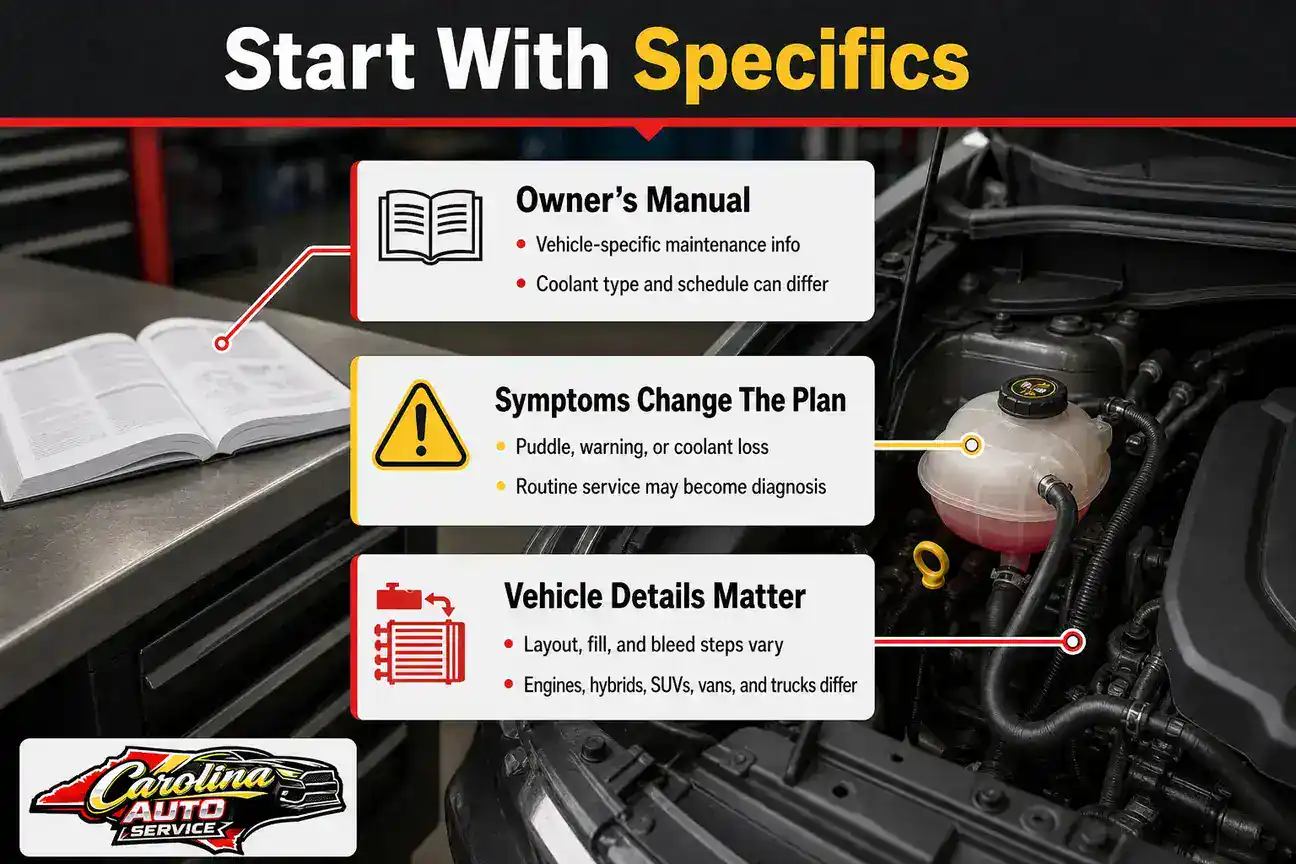
The best starting point is the maintenance information written for your exact vehicle. FuelEconomy.gov advises drivers to read the owner’s manual because automakers provide vehicle-specific operating and maintenance information. That matters because coolant type, cooling-system layout, fill procedure, air-bleeding steps, and maintenance schedules can differ between engines, model years, hybrids, SUVs, vans, and light trucks.
A proper decision also looks at symptoms. A maintenance schedule may tell you when planned cooling system maintenance is due, but symptoms can move the conversation from routine service to diagnosis. A coolant puddle, a temperature warning, or recurring coolant loss is not just a calendar item. It is a clue that needs testing before anyone names a failed part.
This is why “service the cooling system every so many miles” is too broad to be useful. Some vehicles have long-life coolant, some have multiple cooling circuits, and some require specific filling or initialization procedures. The coolant service interval in your manual is the planned maintenance reference, while real-world symptoms tell you whether the system deserves attention sooner.
Think of the owner’s manual as the planned-maintenance side of the decision and the vehicle’s symptoms as the diagnostic side. If both point in the same direction, scheduling is straightforward. If they conflict, symptoms deserve attention because a leak, warning, or overheating event can happen before the next listed maintenance item.
What does a car’s cooling system do?
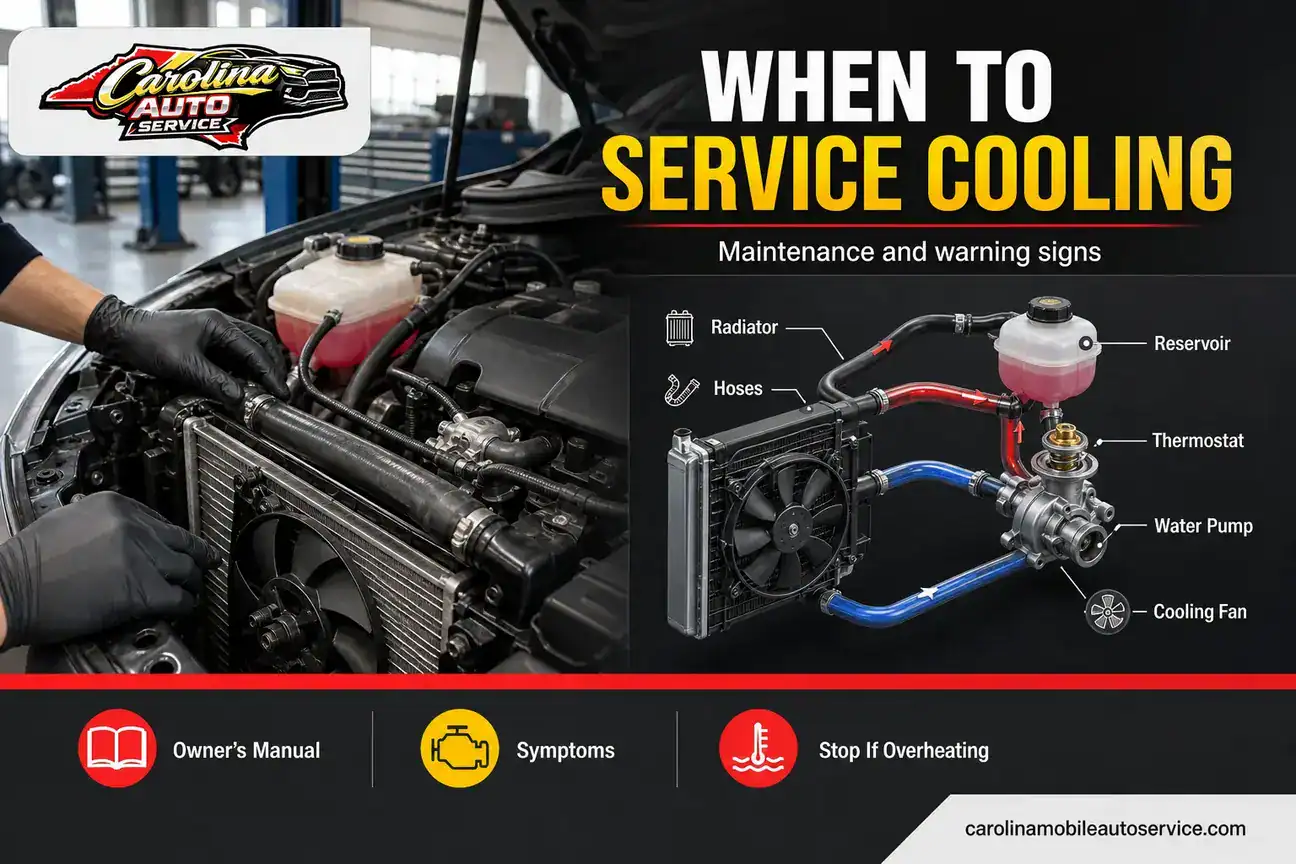
The cooling system helps manage engine temperature. It circulates coolant through passages in the engine and through components that can include a radiator, hoses, a reservoir, thermostat housing, water pump, fans, sensors, and controls. On some vehicles, additional systems may share heat-management duties or have separate circuits.
That sounds simple, but the system has to work under very different conditions. A vehicle may idle in traffic, climb a hill, run the A/C on a hot day, cruise on the highway, or start cold after sitting overnight. If the system cannot move heat properly, the engine temperature may rise, fluctuate, or trigger a warning. Those symptoms can be associated with many possible causes, so diagnosis before assumptions matters.
Cooling-system concerns can also affect cabin comfort. Poor heat from the vents, when combined with coolant loss or temperature changes, can be another clue. It does not prove one specific part has failed, but it can help a technician understand what to test.
For drivers planning cooling system maintenance, the key is to separate routine service from troubleshooting. Routine maintenance follows the manufacturer schedule. Troubleshooting starts when the vehicle shows a symptom, even if the scheduled coolant service interval has not arrived.
Is there one coolant service interval for every vehicle?
No. There is no single coolant service interval that applies to every vehicle. The owner’s manual and manufacturer maintenance schedule should guide whether coolant replacement is specified and when that service is due. If the manual has normal and severe-use schedules, the correct category depends on how the vehicle is used.
Several factors explain why one interval is not reliable. Coolant chemistry varies. Engine designs vary. Some vehicles use pressurized reservoirs, specific radiator cap designs, electric fans, electronically controlled thermostats, or multiple cooling circuits. Hybrids and plug-in hybrids may have additional cooling needs for components beyond a conventional engine cooling loop.
The same model family can also change over time. A coolant specification, fill procedure, or service note for one model year may not match another. That is why relying on memory from a previous vehicle, a generic chart, or a coolant bottle color can lead to the wrong conclusion. The maintenance schedule for your vehicle is the safer reference.
A coolant service interval is also not the same thing as leak diagnosis. If your manual says coolant is not due for routine replacement yet, but the reservoir keeps dropping, the system still deserves attention. Repeated coolant loss can be associated with an external leak, internal coolant loss, evaporation from a hot surface, trapped air, an improper prior service, or another condition that inspection must sort out.
The safest wording is this: the coolant service interval tells you when planned maintenance may be due; symptoms tell you when the vehicle may need a cooling system inspection sooner.
What signs mean cooling system maintenance needs attention?
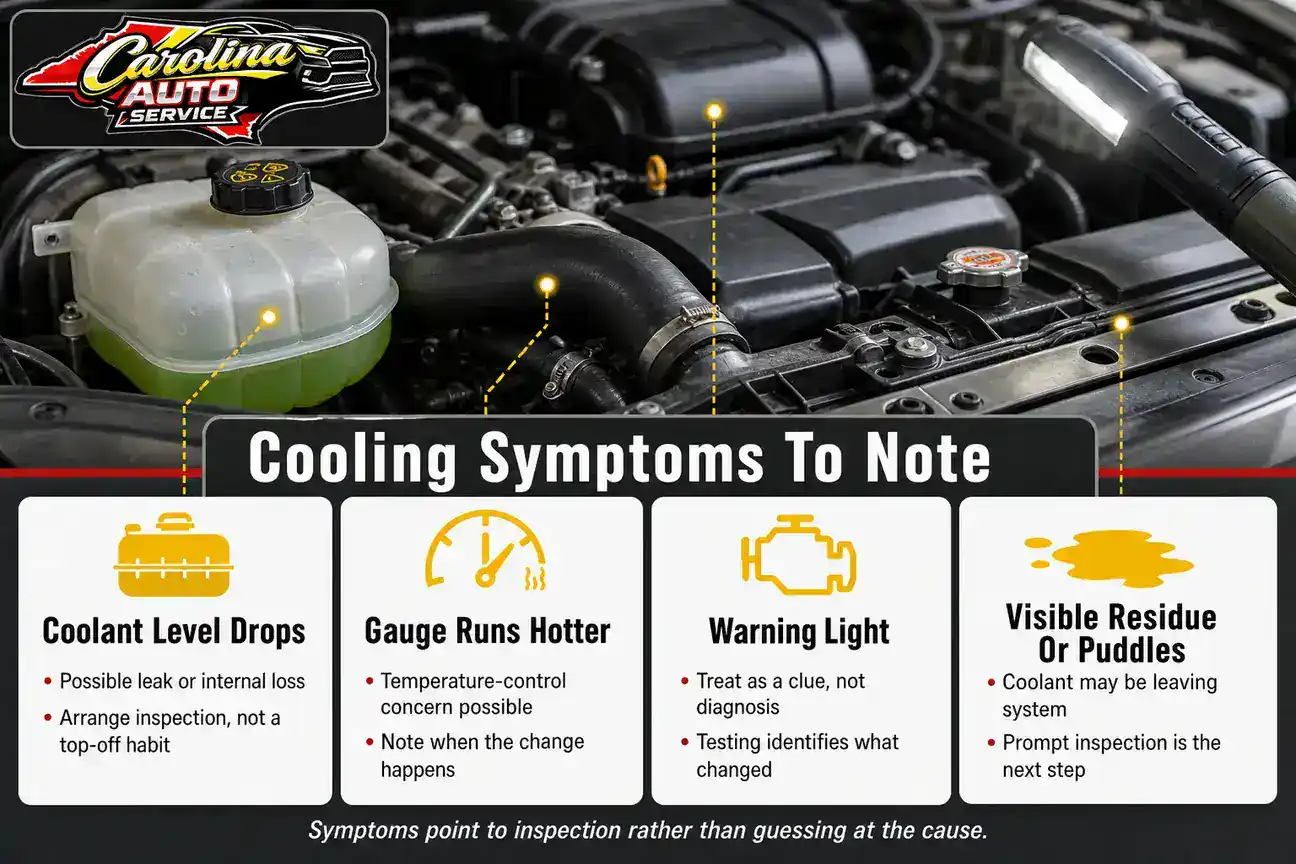
Cooling system maintenance deserves attention when the vehicle shows a pattern, not just when a date arrives on the calendar. Some signs point toward routine scheduling. Others mean the vehicle should be inspected promptly. A symptom is a clue, not a diagnosis, so the goal is to identify what changed and then test the system.
| Driver notices | What it may mean | Next step |
|---|---|---|
| Coolant level repeatedly drops | Possible external leak, internal loss, evaporation from a hot surface, or another coolant-loss concern | Arrange inspection rather than treating it as normal |
| Gauge runs hotter than usual or fluctuates | Cooling-system or temperature-control concern is possible | Avoid assuming the cause; arrange diagnosis |
| Visible puddle, damp area, crusty residue, or staining | Possible external leak from a connection, hose, radiator area, reservoir, pump area, or related component | Have the source identified |
| Sweet or unusual smell after driving | Possible coolant contact with a hot surface or a small leak | Schedule an inspection and note when the smell appears |
| Steam, vapor, or overheating warning | Potentially urgent overheating condition | Stop safely and arrange towing or roadside help |
| Concern after a prior radiator, hose, or water-pump repair | Possible recurrence, trapped air, related part issue, installation-related concern, or separate problem | Bring repair history and symptom details to the shop |
A visible leak does not always reveal the whole story. Coolant can travel across shields, brackets, hoses, and engine surfaces before it drips. Residue may remain after an old repair. A damp area near one component may come from another location. That is why a cooling system inspection may include pressure testing or other checks when appropriate to the vehicle.
Temperature behavior is also important. A gauge that rises only at idle may lead testing in a different direction than a gauge that rises on the highway. A symptom that appears with the A/C on may point the inspection toward airflow, fan operation, load, or control data. None of those clues proves the cause by itself, but they help narrow the test plan.
When planning cooling system maintenance, do not ignore smells. A sweet odor after driving can be associated with coolant, especially if there is also a low reservoir, visible residue, or temperature change. It still needs confirmation because other smells can come from unrelated sources.
Poor cabin heat can also matter when it appears with coolant loss or temperature changes. By itself, weak heat may have several explanations. Combined with a low reservoir, gurgling sounds, or a fluctuating gauge, it becomes useful information for the inspection.
When should you stop driving?
Stop in a safe place and arrange towing or roadside assistance if the temperature warning indicates overheating, the gauge reaches the hot zone, steam is visible, coolant is rapidly leaking, or the vehicle shows severe loss of power with a temperature concern. Do not drive on just to reach a shop. Continuing to operate an overheating vehicle can increase the risk of further damage.
Do not open a hot radiator cap or a pressurized coolant reservoir. A hot cooling system can be under pressure, and opening it can release hot coolant or steam. Also avoid working under a vehicle supported only by a jack. This article is not a set of DIY repair steps; it is meant to help you decide when professional inspection is needed.
If you already receive qualifying service through Carolina Auto Service, a roadside assistance program may apply depending on terms. That program is a third-party benefit, not towing or roadside repair performed by the shop. If overheating or rapid coolant loss is happening now, focus first on getting the vehicle and passengers to a safe place.
What can a cooling system inspection check?
A cooling system inspection is not a one-size-fits-all checklist. It is a diagnostic process shaped by the vehicle, the complaint, the maintenance history, and what the technician observes. At Carolina Auto Service, ASE-certified technicians use diagnosis before assumptions, then explain findings and provide an estimate before authorized repairs begin.
The inspection may begin with the driver’s description. When did the temperature change happen? Was the engine cold or fully warmed up? Was the vehicle idling, climbing a hill, moving at highway speed, sitting in traffic, or using the A/C? Did a warning light appear? If a warning light or stored fault information is involved, check-engine-light diagnostics or scan-tool data may be part of the evaluation.
Depending on the vehicle and symptom, a cooling system inspection may include the coolant level and visible condition, signs of external leaks, dried coolant residue, hose condition, reservoir condition, radiator area, thermostat housing, water-pump area, cooling fan operation, temperature readings, pressure testing when appropriate, and related controls. It may also include looking for signs of air trapped in the system or evidence that a previous service did not follow the correct procedure.
If symptoms suggest coolant may be leaving the system without an obvious external leak, additional testing may be needed. Internal coolant loss cannot be confirmed by a glance at the reservoir. It requires inspection and appropriate diagnostic steps based on the vehicle and symptoms.
For hybrid vehicles, a cooling system inspection may need to consider hybrid-specific circuits or manufacturer procedures. Carolina Auto Service has a confirmed hybrid service page for hybrid maintenance and diagnostics. NHTSA provides separate safety information for electric and hybrid vehicles, which is another reason owners should not attempt high-voltage work or hybrid-specific procedures themselves. The correct process depends on the exact vehicle.
A good inspection also checks the basics before jumping to conclusions. A low level, wrong coolant, loose cap, air pocket, inoperative fan, belt concern, or leak from a connection can all create symptoms that mimic other problems. The point is not to guess the most expensive possibility. The point is to confirm what is actually happening.
Why do coolant type and service procedures vary?
Coolant is not chosen by color alone. Green, red, blue, pink, orange, and “universal” labels do not automatically tell you what your vehicle requires. The manufacturer specification matters, and mixing incompatible coolant types can be inappropriate unless the vehicle documentation specifically permits it.
Cooling system maintenance may also involve a specific mixture, approved fluid, fill method, bleed procedure, or reset step. Some vehicles are sensitive to trapped air. Others may require scan-tool commands or a specific sequence to circulate coolant properly. On hybrids, separate circuits may have separate procedures.
That is why topping off with an unspecified product is risky. It may make the reservoir look better for the moment while creating a compatibility issue or hiding the rate of coolant loss. If you have had to add coolant more than once, the better question is not only “what coolant goes in?” but “where did the coolant go?”
The owner’s manual and manufacturer schedule are the first references for when to service coolant. They also help identify the proper coolant specification and any vehicle-specific notes that matter before fluid is added or replaced.
When a coolant service interval is due, the procedure should match the vehicle. When a symptom is present, the inspection should identify the cause before replacing fluid or parts. Those are two related but different decisions.
How do previous repairs change the decision?
A prior radiator, hose, thermostat housing, or water-pump repair is useful history, but it does not prove the same part has failed again. A recurring symptom is still a clue, not a diagnosis. Testing should confirm whether the current issue involves the repaired component, another leak source, trapped air, coolant level, a cap or reservoir concern, fan operation, or something unrelated.
Bring repair records if you have them. The date of the work, parts replaced, coolant added, and symptoms before and after the repair can help guide the inspection. If the concern returned shortly after service, that timing matters. If the concern appeared months later under different conditions, that matters too.
For a driver, the practical rule is simple: do not assume and do not ignore. A prior repair can make the vehicle’s history clearer, but only a current inspection can confirm what it needs now. If the previous work involved the radiator or related cooling components, the radiator repair and cooling-system repair page is the best service reference. If symptoms or prior records point toward the pump area, the water-pump service page is the better starting point.
How to decide when to service coolant instead of waiting
Drivers often ask when to service coolant because they are trying to avoid unnecessary work without missing a problem. That is the right mindset. The answer depends on whether you are dealing with planned maintenance, a symptom, or a history of recurring concerns.
Use this practical decision path:
- If there are no symptoms: Check your owner’s manual and manufacturer maintenance schedule. If a coolant service interval is listed for your vehicle and driving conditions, follow that schedule.
- If the coolant level keeps dropping: Do not treat that as ordinary cooling system maintenance. Arrange inspection to find out why the coolant is leaving the system.
- If the temperature gauge changes: Note when it happens and arrange diagnosis. A changing gauge can be associated with several causes.
- If a warning light appears: Treat it as a clue that needs testing. FuelEconomy.gov says that when the check engine light comes on, have your vehicle inspected by a mechanic; cooling-related warnings deserve the same cautious mindset.
- If coolant was recently serviced or parts were replaced: Bring the history with you. The issue may or may not involve the same area.
- If overheating, steam, or rapid coolant loss occurs: Stop driving safely and arrange towing or roadside assistance.
This approach keeps the coolant service interval in its proper place. It is a maintenance guide, not a guarantee that nothing can go wrong before that point. It also prevents unnecessary guessing when symptoms need a cooling system inspection.
What should Winston-Salem drivers note before scheduling?
Winston-Salem drivers can help the shop by writing down when the concern appears. Does it happen on a cold start, after the engine warms up, while idling, at highway speed, on hills, in stop-and-go traffic, or when the A/C is on? Local heat, humidity, traffic around Hanes Mall and I-40, and winter cold snaps can make symptoms more noticeable, but they do not prove what failed.
Before scheduling, note the gauge position, any warning-light wording, how often coolant has been added, where you see residue or puddles, and whether there is a sweet smell, steam, belt noise, fan noise, poor cabin heat, or recent repair history. If you know the coolant type listed in the owner’s manual, bring that information too. If you do not know, do not guess by color.
For planned cooling system maintenance, bring the owner’s manual or maintenance schedule if you have it. For symptoms, bring the timeline. “It runs warm only at idle with the A/C on” is more useful than “it overheats sometimes.” “I added coolant twice in three weeks” is more useful than “it might be low.” Specific details help guide testing.
Drivers from nearby areas such as Clemmons and Lewisville can use the same symptom notes when they schedule at the Winston-Salem shop. The vehicle’s condition matters more than where the drive started. If the vehicle is already overheating or losing coolant rapidly, stop safely and arrange towing or roadside assistance rather than trying to make the trip.
Cooling-system repair in Winston-Salem
Carolina Auto Service performs in-shop diagnosis, maintenance, and repair at its Winston-Salem shop. For overheating, coolant loss, temperature changes, radiator concerns, or cooling-system leaks, start with radiator repair and cooling-system repair. For coolant leaks or symptoms that appear related to the pump area, see water-pump service.
When you request service, describe the symptom, when it happens, whether a warning light appeared, how often coolant has been added, and any recent cooling-system work. You can request an appointment online or call 336-765-8599. Appointment requests are not confirmed until the shop confirms a time.
After inspection, Carolina Auto Service explains the findings and provides clear repair recommendations and an estimate before authorized repairs begin. The Federal Trade Commission’s auto repair basics also encourages consumers to understand estimates and authorizations before repair work proceeds. Ask about the nationwide limited 24-month/24,000-mile parts and labor warranty on qualifying repairs, or review the Carolina Auto Service warranty information.
Bottom line for cooling system maintenance
Cooling system service is due when your owner’s manual and manufacturer schedule say it is due, and it deserves earlier attention when the vehicle shows symptoms. Coolant loss, temperature changes, visible residue, sweet smells, warning lights, prior repair concerns, and poor heat with coolant symptoms are all reasons to arrange inspection rather than guess.
There is no universal fluid, procedure, or mileage rule that fits every vehicle. The right coolant service interval, the right coolant type, and the right diagnostic process are vehicle-specific. If the vehicle is overheating, steaming, losing coolant rapidly, or showing a hot-zone warning, stop safely and arrange towing or roadside assistance.
General educational information, not a diagnosis. Only an in-person inspection can confirm what a vehicle needs.
Frequently Asked Questions
How often should coolant be replaced?
There is no universal interval. The vehicle’s owner’s manual and manufacturer maintenance schedule should determine whether coolant replacement is specified and when that service is due.
Is it normal to add coolant occasionally?
Repeated coolant loss deserves inspection rather than being assumed normal. The cause may be external leakage, internal loss, evaporation from a hot surface, trapped air, or another cooling-system concern.
Can I drive with a temperature warning light on?
Do not continue driving with an overheating indication, steam, rapid coolant loss, or a gauge in the hot zone. Stop safely and arrange towing or roadside assistance.
Does a previous water-pump or radiator repair mean the same part failed again?
No. A recurring symptom is a clue, not a diagnosis. Inspection and testing are needed to identify whether the current concern involves the previous repair area, another component, trapped air, coolant level, or a separate issue.
Can I use any green, red, blue, or universal coolant?
Coolant color alone should not determine product selection. Use the specification and procedure required for the particular vehicle, and avoid mixing fluids unless the vehicle documentation permits it.
What information should I give the repair shop?
Report when the symptom occurs, gauge behavior, warning lights, coolant additions, visible leaks or residue, smells, noises, and any recent cooling-system work. The more specific the timeline, the more useful it is for diagnosis.
Are hybrid cooling systems serviced the same way as conventional systems?
Not necessarily. Hybrid designs and procedures can vary significantly, so the owner’s manual and a vehicle-specific diagnostic process should guide service. Do not attempt high-voltage or hybrid-specific procedures yourself.