
Brake Fluid Leak: 7 Essential Safe Next Steps
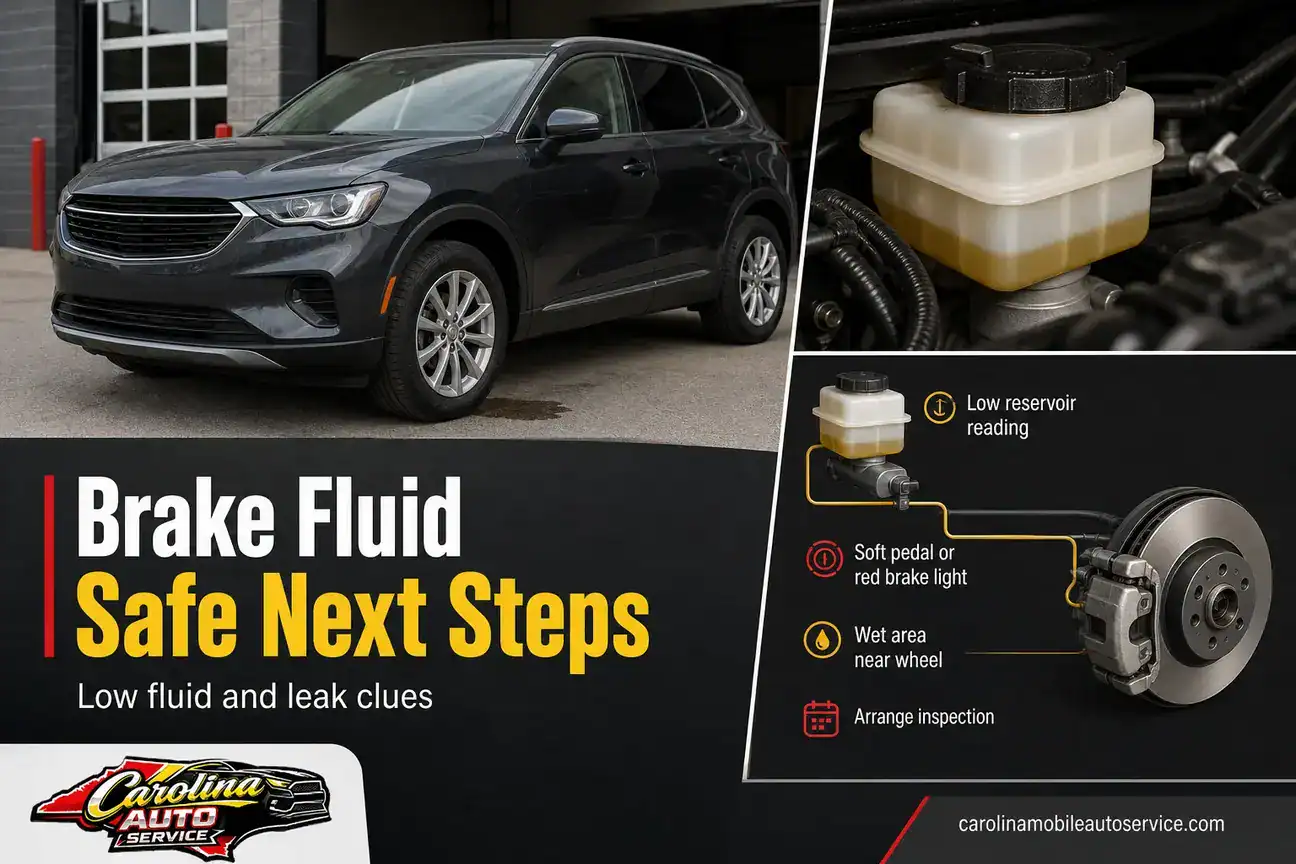
A brake fluid leak and low brake fluid can be related, but they are not the same diagnosis. A low reservoir reading, a red brake warning light, a wet spot near a wheel, or a change in pedal feel is a clue that needs inspection, not proof of one failed part. For Winston-Salem drivers, the safest next step depends on what is happening right now: if braking feels different, the pedal sinks or travels farther than usual, the vehicle does not slow normally, or fresh fluid is appearing, stop in a safe place and arrange towing or roadside assistance.
Quick Answer: Low brake fluid does not always mean a leak, and a visible leak does not identify the exact source. Do not assume the vehicle is safe to drive based only on the reservoir level or because a warning light later turns off. If the pedal feel or stopping ability has changed, treat it as urgent.
Quick Answer: Is low brake fluid the same as a brake fluid leak?
No. Low brake fluid means the fluid level in the reservoir appears below the expected range for that vehicle. A leak means brake fluid may be escaping from part of the hydraulic system. One can point toward the other, but the level by itself does not confirm where the fluid went or why.
A red brake light, an active wet area, a brake fluid puddle, a soft or sinking pedal, increased pedal travel, or reduced braking raises the urgency. Vehicle safety issues can also be vehicle-specific, so drivers can use the NHTSA recall search to check for open recalls by VIN. A recall search is useful background, but it does not replace an in-person brake inspection when symptoms are present.
The practical takeaway is simple: a symptom or warning light is a clue, not a diagnosis. Only an in-person inspection can confirm what the vehicle needs and whether it should be driven.
7 safe next steps if you suspect brake fluid loss
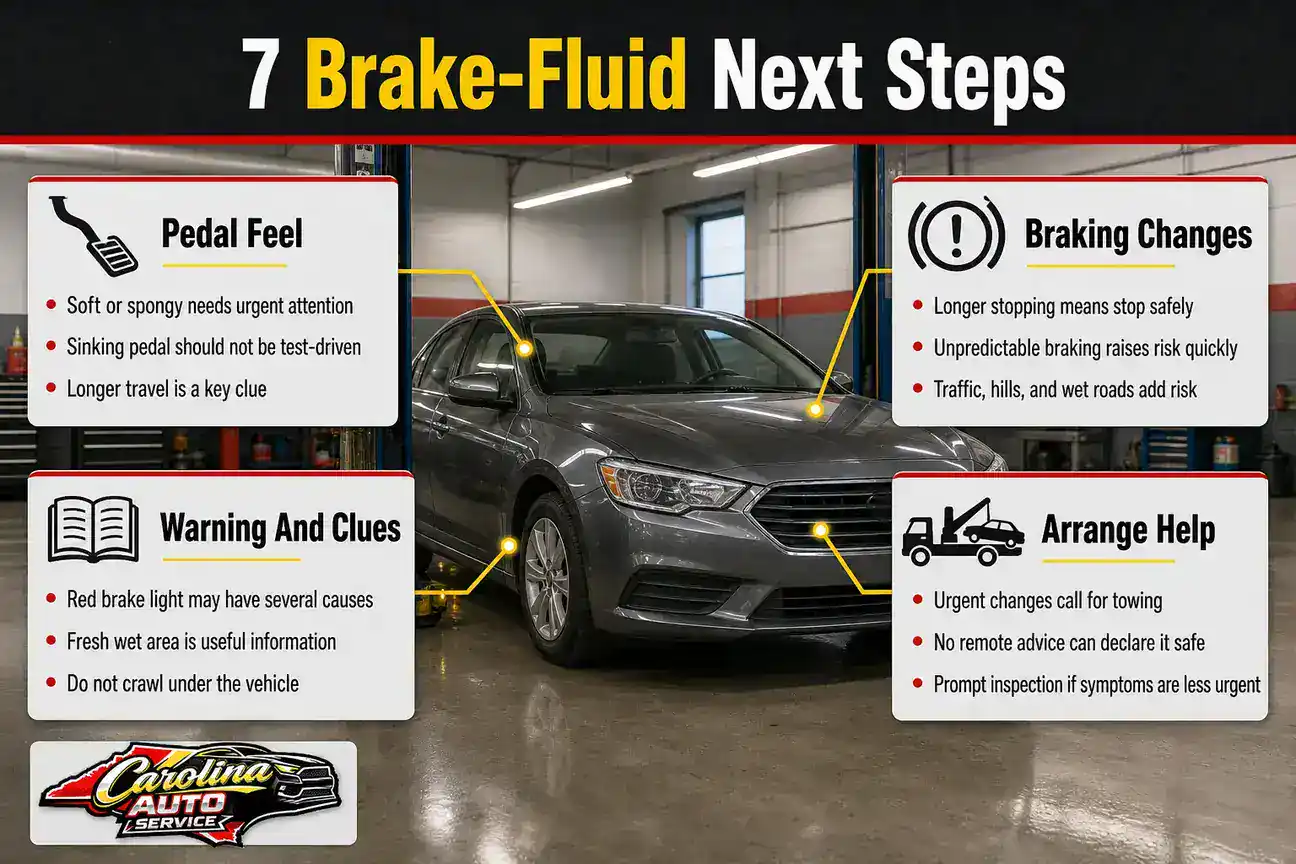
If you are dealing with possible brake fluid loss, do not keep driving just to see whether the symptom repeats. Brake-system concerns can change quickly, and remote advice cannot confirm that a vehicle is safe. Use these seven next steps to decide what to do without turning the situation into a guess.
1. Pay attention to pedal feel
A pedal that becomes soft, spongy, sinks while held, or travels farther than usual needs urgent attention. Pedal feel is one of the most important clues because it relates directly to how the vehicle responds when you try to stop. Do not keep driving to “test” whether the pedal improves.
2. Watch for reduced braking
If the vehicle takes longer to slow, does not decelerate normally, or feels unpredictable when braking, stop in a safe place and arrange towing or roadside assistance. Reduced braking can create risk quickly, especially in traffic, on hills, or in wet weather.
3. Do not ignore a brake fluid warning
A brake fluid warning or red brake-system light may be related to fluid level, parking brake status, or another vehicle-specific condition. The owner’s manual can help identify what the symbol means for your vehicle, but the light alone does not prove the cause. If the light appears with changed pedal feel or reduced braking, treat it as urgent.
4. Look for fluid clues without working under the vehicle
A fresh wet area near a wheel or under the vehicle can be useful information, but it should not turn into roadside brake repair. Do not crawl under the vehicle, remove wheels, or work under a vehicle supported only by a jack. If you can safely observe where the wet area is, note the location for the shop.
5. Use the owner’s manual for vehicle-specific information
Your owner’s manual identifies warning-light meanings, reservoir information, and the brake-fluid specification for that vehicle. Brake-fluid reservoirs, markings, and electronic brake systems vary. The manual is useful context, but it still cannot confirm why the level changed or whether the vehicle is safe to drive.
6. Avoid repeated topping off
Adding fluid again and again can hide a problem without correcting why the level changed. It can also make it harder to understand how quickly the level is dropping. Using the wrong fluid or allowing contamination into the system can create additional concerns, so follow only the manufacturer’s instructions.
7. Arrange the right help for the symptom
Urgent braking changes call for towing or roadside assistance; less urgent concerns still need prompt professional evaluation. If the vehicle has no reduced braking, no changed pedal feel, and no active leak, you may be able to request an appointment for inspection, but no remote guidance can declare the vehicle safe.
What does low brake fluid mean on its own?
A low brake fluid reading is a starting point. It may be associated with hydraulic-fluid loss, normal brake wear changing the position of caliper pistons, previous service history, an inaccurate reading, a reservoir or cap concern, or another vehicle-specific condition. It does not identify a failed master cylinder, caliper, line, hose, or sensor by itself.
The owner’s manual matters because brake-fluid reservoirs, level markings, fluid specifications, and warning messages vary by vehicle. Some reservoirs are easy to see; others are harder to judge without the correct lighting or access. Some vehicles also have electronically controlled brake systems that require vehicle-specific diagnostic procedures.
Repeatedly adding fluid is not a substitute for diagnosis. If the level keeps dropping, the reason still needs to be found. If the wrong fluid is used, or if contamination enters the system, the concern can become more complicated. For that reason, this article is not a brake-system DIY guide. It is meant to help you decide when to stop driving, what to note, and what an in-shop inspection may examine.
When should you stop driving?
Brake concerns are safety concerns. If braking ability changes suddenly, if you cannot confidently control the vehicle, or if there is a visible active leak, stop in a safe place and arrange towing or roadside assistance. Do not drive on just to reach a shop when braking performance is uncertain.
A brake fluid warning should be taken more seriously when it appears with a soft pedal, longer pedal travel, reduced braking, or fresh fluid. Warning lights and symptoms can have different meanings by vehicle, but a change in how the vehicle stops is never something to guess about from the driver’s seat.
| What you notice | Recommended next step |
|---|---|
| Soft, sinking, or unusually long-travel pedal | Stop in a safe place and arrange towing or roadside assistance. |
| Reduced braking or increased stopping distance | Stop in a safe place and arrange towing or roadside assistance. |
| Active wet leak or fresh fluid appearing near a wheel or under the vehicle | Stop in a safe place and arrange towing or roadside assistance. |
| Red brake warning light with changed pedal feel or reduced braking | Stop in a safe place and arrange towing or roadside assistance. |
| Warning light only, with no other obvious symptom | Check the owner’s manual and arrange prompt professional evaluation; do not assume the vehicle is safe to drive. |
| Noise or vibration with normal pedal feel | Schedule an inspection, but seek urgent assistance if braking changes, smoke appears, or a warning light comes on. |
This stop-driving guidance is intentionally cautious. It is not a claim that every low reading has the same cause. It is a safety-first way to respond when braking, warning lights, or visible fluid create uncertainty.
How can a brake fluid warning differ from an ABS light?
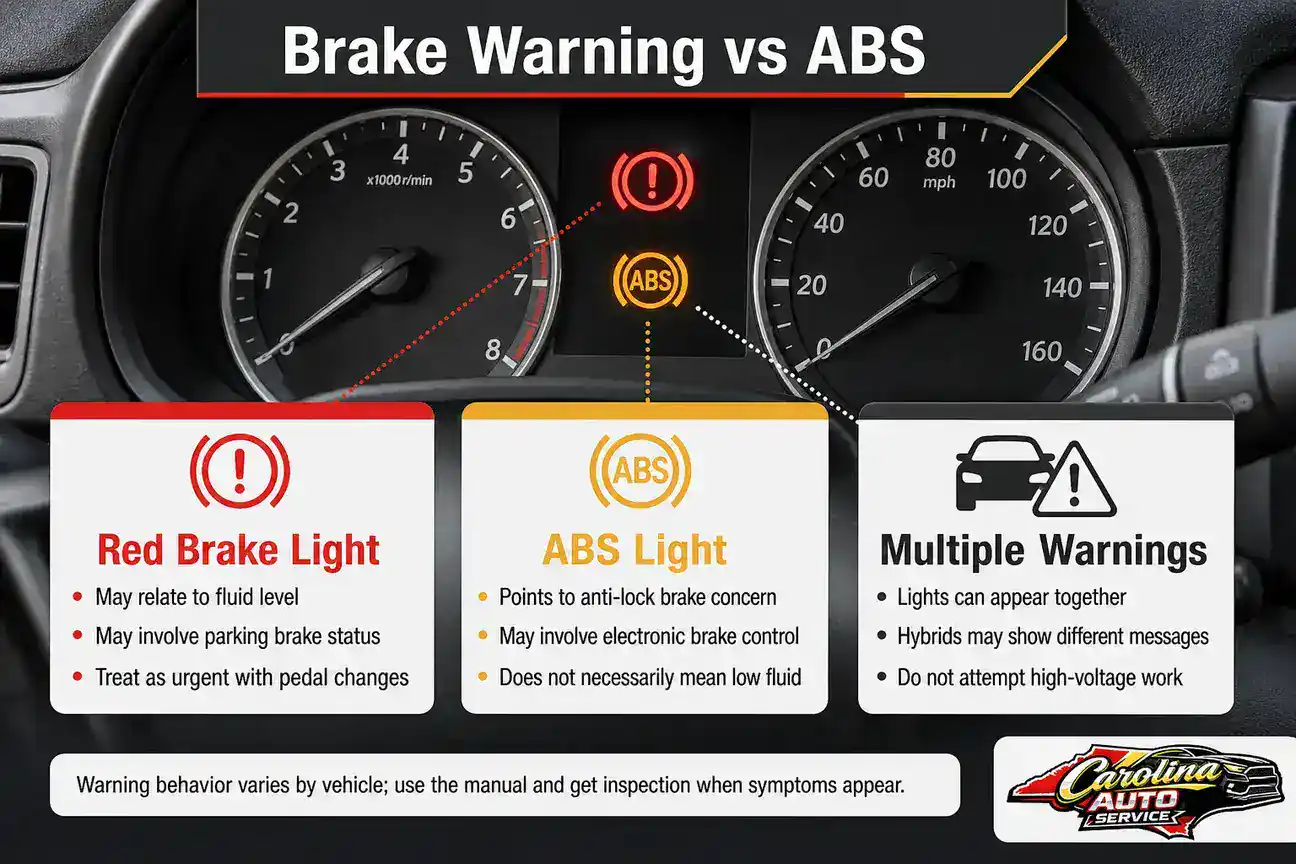
A brake fluid warning is often discussed as though it has one meaning, but warning-light behavior varies by make, model, and brake-system design. A red brake warning light may be associated with fluid level, the parking brake, or another brake-system condition. An ABS light may point toward an anti-lock braking or electronic brake-control concern and does not necessarily mean the reservoir is low.
Multiple warning lights can appear at once. A hybrid or electronically controlled brake system can also display messages that are different from a conventional hydraulic system. If you drive a hybrid and see high-voltage or brake-system warnings together, do not attempt electrical or brake-system work yourself. NHTSA’s electric and hybrid vehicle safety information is a reminder that these vehicles have specialized systems that require appropriate procedures.
If the red brake light is on and the pedal feels normal, the concern still deserves prompt attention. If the light is on and the pedal feels soft, sinks, travels farther, or stopping distance increases, follow the stop-driving guidance above.
What if you see a brake fluid puddle?
A brake fluid puddle near a wheel, under the middle of the vehicle, or below the engine bay should be treated seriously, but the location of the spot does not prove the exact source. Fluid can travel along parts before it drips. Road splash, water from air conditioning, oil, coolant, power-steering fluid on some vehicles, or other fluids can also confuse the picture.
Do not crawl under a vehicle at the roadside or work under a vehicle supported only by a jack. Do not clean the area if the vehicle is being inspected soon; the pattern of wetness can help the technician. If the puddle is fresh, the pedal has changed, a warning light is on, or braking feels weaker, stop in a safe place and arrange assistance rather than driving farther.
A brake fluid puddle can be associated with a hydraulic leak, but it still takes inspection to determine whether the fluid is actually brake fluid and where it is coming from. The reservoir, cap, master-cylinder area, brake lines, hoses, caliper areas, wheel-cylinder areas on some vehicles, and related connections may all need to be checked. The exact list depends on the vehicle’s brake design.
How can you distinguish a fluid concern from other brake symptoms?
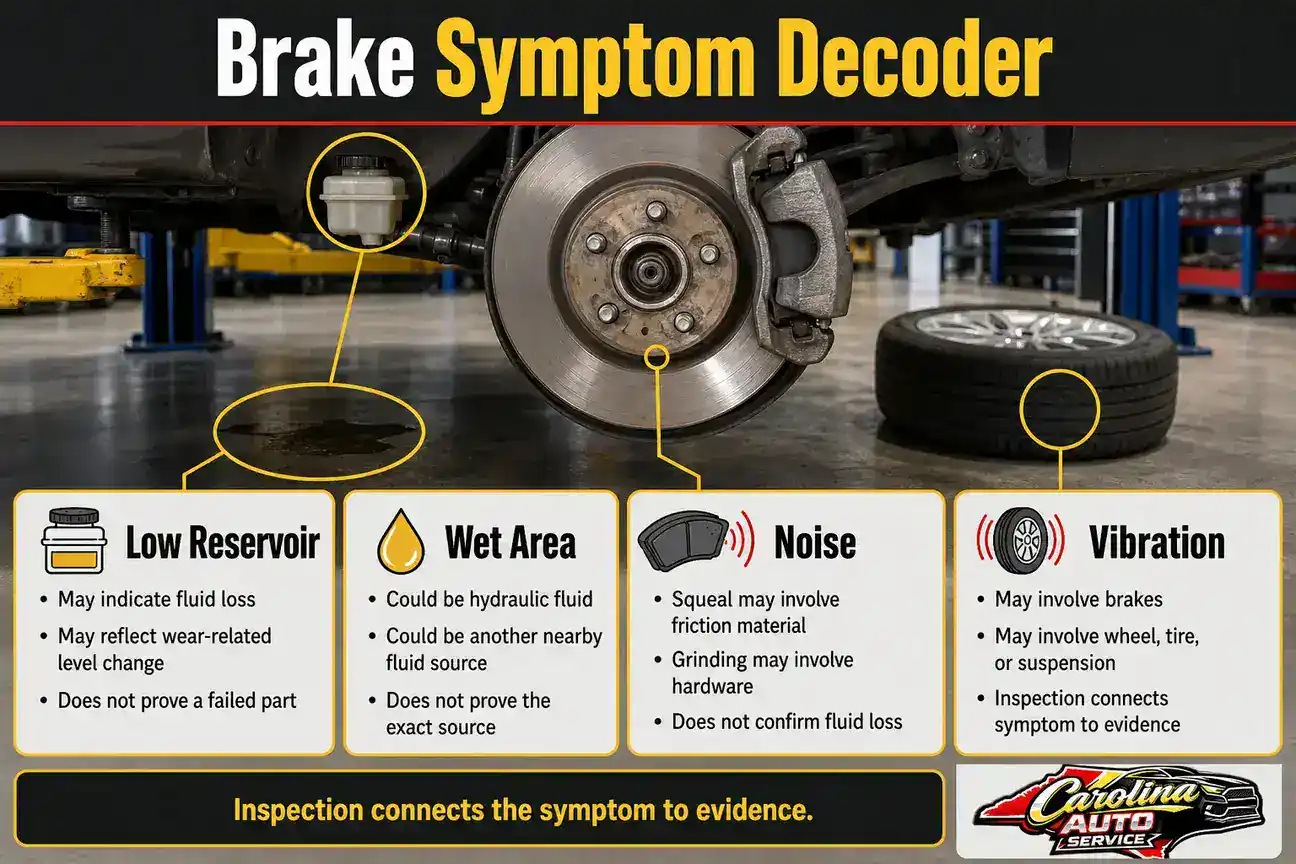
Brake noise, vibration, warning lights, and fluid level can overlap, but they do not all mean the same thing. A squeal or grinding noise may involve friction material or hardware. A vibration or pulsation may involve brake, wheel, tire, or suspension-related concerns. A visible wet area may be unrelated to brakes, or it may be an important hydraulic clue. Inspection connects the symptom to evidence.
| What you notice | What it may indicate | What it does not prove |
|---|---|---|
| Low reservoir reading | Fluid loss, wear-related level change, prior service history, or another condition | A specific failed component |
| Wet area near a wheel or brake line | Possible hydraulic-fluid leak or another nearby fluid source | The exact leak source |
| Squeal or grinding | Friction-material, rotor, drum, shoe, pad, or hardware concern | That a leak exists |
| Vibration or pulsation | Brake, wheel, tire, steering, or suspension-related concern | That fluid is low |
| Red brake warning light | Fluid-level, parking-brake, or system-related condition | One universal cause for every vehicle |
| ABS warning light | ABS or electronic brake-control concern | A low reservoir by itself |
The most important distinction is pedal feel and stopping response. A hard pedal, soft pedal, sinking pedal, long pedal travel, or reduced braking can point in different directions. None should be diagnosed over the phone, and none should be ignored when the way the vehicle stops has changed.
What should you do right now?
If braking is impaired, move to a safe location as conditions allow and stop. Avoid repeated “test stops” to see if the pedal improves. A brake system may feel different from one stop to the next, and continuing to drive can increase risk if the vehicle is losing hydraulic pressure or braking ability.
If there is an active leak, a fresh brake fluid puddle, a red warning light with changed pedal feel, smoke, a strong burning smell, severe grinding, or reduced deceleration, arrange towing or roadside assistance. Carolina Auto Service does not perform roadside repair or towing. A roadside assistance program may apply to qualifying service, and drivers should review terms rather than assuming coverage.
If the concern appears schedulable, gather details before you request service. Note the vehicle year, make, model, mileage, warning messages, whether the light stays on or comes and goes, and whether the symptom happens cold, hot, during braking, after parking, or at certain speeds. If you can observe a wet spot without touching the vehicle or working underneath it, note where it appears.
For warning-light context beyond brakes, Carolina Auto Service also provides check-engine-light diagnostics for vehicle warning lights and diagnostic concerns. A code or warning light is still a clue, not a diagnosis; testing and inspection confirm the next step.
What may cause brake fluid loss?
Brake fluid loss can have more than one explanation. A hydraulic leak may lower the reservoir. Brake-pad wear can change caliper piston position and affect the fluid level. Prior service, an incorrectly read reservoir, a cap or sensor concern, or a vehicle-specific design issue may also be part of the story. The point is not to guess; it is to find evidence.
Hydraulic systems include several areas that may need inspection. Depending on the vehicle, a technician may look around the reservoir, master-cylinder area, metal lines, flexible hoses, calipers, wheel areas, and other connections. On some vehicles, drum-brake components or electronically controlled brake assemblies may also be relevant. The inspection should follow the vehicle’s service information rather than a one-size-fits-all assumption.
A low brake fluid reading with a normal pedal still matters. The absence of a soft pedal does not rule out a leak, and the absence of visible fluid does not prove the system is sealed. Some fluid evidence may be hidden by wheel position, shields, or the way the vehicle is parked. That is why brake concerns are best handled with diagnosis before assumptions.
Recalls are another reason not to jump to conclusions. Recall information can be tied to specific vehicles and specific systems, not one universal failure point. Drivers can check a vehicle identification number using NHTSA’s recall search, but a recall search does not replace inspection when braking symptoms are present.
What will an in-shop inspection examine?
An in-shop brake inspection is meant to separate clues from confirmed findings. At Carolina Auto Service, ASE-certified technicians perform in-shop diagnosis and repair at the Hanes Mall Circle shop. The goal is to inspect, explain the findings, provide clear repair recommendations, and give an estimate before authorized repairs begin.
A brake-fluid concern may involve checking the fluid level and condition according to the vehicle’s specifications. The inspection may also look for visible hydraulic-fluid evidence around the reservoir, master-cylinder area, lines, hoses, calipers, wheel areas, and related connections. If the fluid appears contaminated or the wrong fluid may have been added, that becomes part of the diagnostic conversation.
Pedal feel and travel matter. A technician may compare pedal behavior with what is expected for that vehicle and may consider whether the symptom points toward hydraulic, mechanical, brake-assist, ABS, or electronic brake-control concerns. The exact testing depends on the vehicle and the symptoms.
The inspection may also include friction components such as pads, rotors, drums, shoes, and visible hardware where applicable. This matters because noises, vibration, and wear patterns can create brake concerns that are separate from fluid level. A grinding noise, for example, does not prove brake fluid loss, but it still deserves attention.
Warning-light and diagnostic information may be checked when relevant. On newer vehicles, stored data, vehicle-specific service information, and system tests can help connect the driver’s complaint with evidence. For brake concerns specifically, you can learn more about Carolina Auto Service’s brake service and inspection approach.
Consumer guidance also supports asking questions and understanding what work is being recommended. The FTC’s auto repair basics page explains practical steps consumers can take when choosing repair work, and North Carolina law includes repair-estimate requirements in G.S. 20-354.3. Those resources are general information, while the vehicle still needs an in-person diagnosis.
When can a brake concern be scheduled?
Some brake concerns can be scheduled promptly instead of handled as an immediate roadside emergency, but that does not mean the vehicle has been declared safe to drive. A noise or vibration with unchanged pedal feel, no warning light, no smoke, and no reduced braking may be appropriate for a prompt appointment. A slightly low brake fluid reading with no other symptoms still deserves evaluation because the cause is unknown.
The line changes when braking performance changes. If a pedal becomes soft, sinks, travels farther, or the vehicle does not slow normally, do not continue driving to keep an appointment. Stop in a safe location and arrange towing or roadside assistance. This is especially important if a brake fluid warning appears with any change in how the vehicle stops.
If the issue appears schedulable, use the appointment request to describe what you noticed. Include when the warning appeared, whether it stays on, whether the pedal changed, and whether there is a visible wet spot. You can request an appointment, and the shop will confirm the appointment time.
For terms related to qualifying repairs, Carolina Auto Service lists a nationwide limited 24-month/24,000-mile parts and labor warranty on qualifying repairs. Ask about terms, and review the warranty on qualifying repairs when coverage questions are part of your decision.
What should Winston-Salem drivers note before the appointment?
Good notes help the inspection start in the right place. Drivers in Winston-Salem and Forsyth County should write down when the concern first appeared and what was happening at the time. Was the vehicle parked overnight? Did the warning come on during braking? Did the pedal feel different after a stop-and-go drive, after a hard stop, or after the vehicle sat?
Note whether the warning light is red, amber, or accompanied by a message. If the light comes and goes, record when it turns on and off. If you saw a brake fluid puddle, note the location relative to the vehicle: front left, front right, rear area, center, or under the engine bay. Do not wipe it away if the vehicle will be inspected soon.
Pedal description is especially useful. “Soft,” “spongy,” “hard,” “sinks while held,” “goes farther than usual,” and “normal but light is on” all point to different checks. If stopping distance changed, say so clearly. If noise or vibration appears only during braking, turning, backing up, or at a certain speed, include that too.
Also mention recent brake work, collisions, pothole impacts, towing, maintenance, or any time someone added fluid. Bring the vehicle’s owner’s manual if you have questions about warning messages or fluid specifications. The more precise the symptom description, the easier it is to avoid assumptions.
How Carolina Auto Service approaches brake-fluid diagnosis
Carolina Auto Service provides in-shop auto repair at 160 Hanes Mall Circle in Winston-Salem. For brake concerns, the approach is diagnosis before assumptions: inspect the symptom, compare it with vehicle-specific information, explain the findings, and provide an estimate before authorized repairs begin.
The shop works on domestic, import, hybrid cars, SUVs, light trucks, vans, and fleet vehicles in the shop. Hybrid brake concerns may require vehicle-specific procedures, and drivers should not attempt high-voltage or electronic brake-system work themselves. If warning lights involve both braking and hybrid-system messages, describe all of them when arranging service.
If your vehicle has an active leak, changed pedal feel, reduced braking, or a warning light with braking changes, arrange towing or roadside assistance instead of driving to the shop. If your concern is schedulable, you can request an appointment or call 336-765-8599. Describe the pedal feel, warning light, visible leak, and when it happens. Carolina Auto Service confirms the appointment time.
For address, hours, and directions, you can also contact Carolina Auto Service. Vehicle drop-off outside business hours may be available, but that does not change the stop-driving guidance for serious brake symptoms.
Key takeaways before you decide what to do
- A brake fluid leak and a low reservoir reading are related possibilities, not interchangeable diagnoses.
- A brake fluid warning with soft pedal feel, longer pedal travel, reduced braking, or visible fresh fluid should be treated as urgent.
- A brake fluid puddle does not identify the exact source, but it is important evidence for inspection.
- Noise and vibration can be unrelated to brake fluid loss, but they still deserve inspection if braking changes or a warning light appears.
- Do not assume the vehicle is safe to drive based only on fluid level, warning-light behavior, or the absence of noise.
- Check for open recalls by VIN, but do not use a recall search as a replacement for inspection when symptoms are present.
General educational information, not a diagnosis. Only an in-person inspection can confirm what a vehicle needs.
Frequently Asked Questions
Does low brake fluid always mean there is a leak?
No. The level is a clue, not a diagnosis. Wear, previous service, sensor or reservoir conditions, and hydraulic fluid loss may all need consideration before anyone can confirm the cause.
Can I drive with a brake fluid leak?
Do not assume the vehicle is safe to drive. If there is an active leak, warning light, soft or sinking pedal, increased pedal travel, reduced braking, or increased stopping distance, stop safely and arrange towing or roadside assistance.
What does a red brake warning light mean?
It may relate to brake-fluid level, the parking brake, or another vehicle-specific brake-system condition. Check the owner’s manual and arrange professional evaluation; the light alone does not identify the cause.
Is an ABS warning light the same as a low-brake-fluid warning?
Not necessarily. An ABS light may indicate an ABS or electronic brake-system concern. Warning-light meanings vary by vehicle, so diagnostic testing and the owner’s manual matter.
Can brake noise cause low brake fluid?
Noise and low fluid may be unrelated. Squealing, grinding, vibration, and pulsation require inspection, especially if braking performance or pedal feel has changed.
Should I add brake fluid before visiting a shop?
Follow only the vehicle manufacturer’s instructions. Do not use the wrong fluid, repeatedly top off a potentially leaking system, or attempt brake-system work without proper equipment and training.
What will a brake inspection check?
An in-shop inspection may evaluate fluid level and condition, visible hydraulic-fluid evidence, lines and hoses, wheel areas, pedal feel and travel, friction components, warning-light data, and vehicle-specific diagnostic information.