
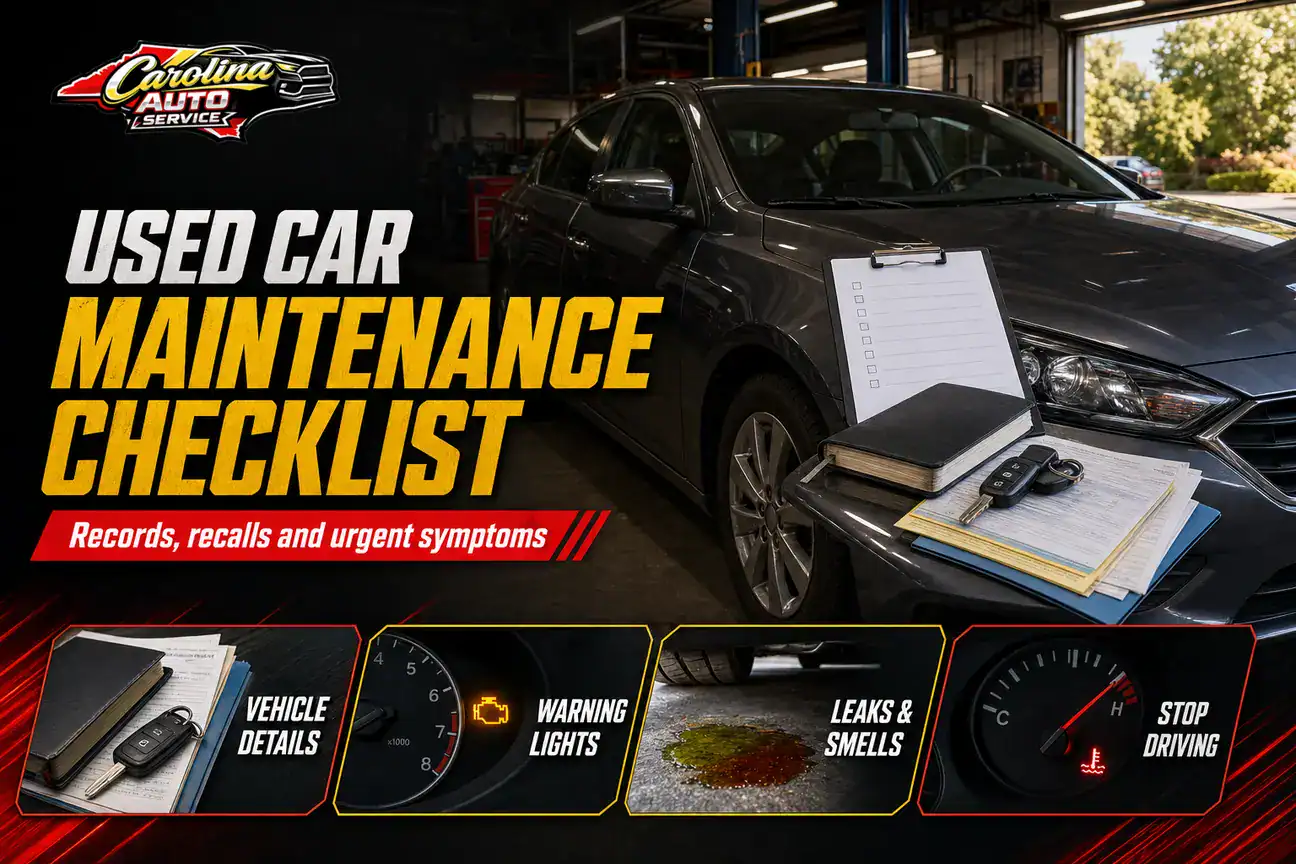
Used Car Maintenance Checklist: What to Check First
A used car maintenance checklist should help you build a maintenance baseline, not guess at whether the vehicle is safe. Start with the VIN, owner’s manual, current mileage, used car records, warning lights, visible leaks, braking feel, overheating signs, starting behavior, charging symptoms, unusual noises, and a vehicle recall check. If the vehicle has reduced braking, low oil pressure, overheating, fuel smell, smoke, severe steering trouble, electrical smoke, or serious warning-light symptoms, stop in a safe place and arrange assistance instead of driving on.
Quick Answer
First, identify the vehicle accurately, gather its records, compare what is documented against the manufacturer schedule, and note every symptom before erasing codes or topping off fluids. If the vehicle operates normally but its history is incomplete, schedule routine maintenance or diagnostics. If a safety-related symptom appears, treat it as urgent until an in-person inspection proves otherwise.
What should you collect before checking the vehicle?
The first part of any post-purchase inspection is paperwork and identification. That may sound less important than looking under the hood, but accurate vehicle details keep you from using the wrong fluid, wrong maintenance interval, or wrong recall information. Two cars with the same badge may have different engines, drivetrains, hybrid systems, and service requirements.
Write down the year, make, model, trim, engine, transmission type if known, drivetrain, current mileage, and VIN. Note whether it is a hybrid or plug-in hybrid. If the owner’s manual is missing, look for the correct manufacturer information before assuming what oil, coolant, brake fluid, transmission fluid, or service interval applies.
Gather every service clue you have, even if it is messy. Useful used car records can include paper invoices, digital service history, state inspection paperwork, registration documents, warranty paperwork, previous-owner notes, and photos of past repairs. Do not treat missing paperwork as proof that the vehicle was neglected. Treat it as an unknown that needs sorting.
- VIN and current mileage
- Year, make, model, trim, engine, drivetrain, and hybrid status
- Owner’s manual and manufacturer maintenance schedule
- Receipts, invoices, inspection paperwork, and previous-owner notes
- Photos of warning lights, leaks, smoke, or dashboard messages
- A short list of current symptoms and when they happen
For a driver in Winston-Salem who just bought or inherited a vehicle, this first paperwork pass often prevents wasted effort. It gives a shop a clearer starting point and helps separate normal maintenance from a symptom that needs diagnosis.
How to use a used car maintenance checklist without guessing
A checklist is useful only if it stays honest about what is known and what is not known. A receipt is evidence that work was performed, but it does not prove the present condition of every related part. A clean-looking engine bay is reassuring, but it does not confirm fluid condition, brake condition, cooling-system performance, or charging-system health.
Build your list in four columns: documented, reported but undocumented, unknown, and due or overdue according to the owner’s manual. That structure keeps the maintenance baseline practical. It also helps you avoid replacing everything at once just because the vehicle is new to you.
The owner’s manual and manufacturer schedule matter because there is no one universal interval for every used vehicle. Engine design, oil specification, severe-use conditions, hybrid equipment, timing-belt design, transmission type, and driving pattern can all change what is due. FuelEconomy.gov’s maintenance guidance also points drivers toward proper maintenance as part of keeping a vehicle operating efficiently, but the vehicle-specific schedule should still come from the manual.
Common baseline items include engine oil and filter history, air and cabin filter history, coolant service evidence, brake work, transmission-service records, spark-plug history where applicable, timing-belt evidence where applicable, and any hybrid-specific maintenance items listed by the manufacturer. The right oil, fluid specification, and interval should come from the vehicle’s documentation, not a generic rule.
A good maintenance baseline also includes what not to do. Do not drain fluids just to “see what happens.” Do not clear warning-light codes before diagnosis. Do not open a hot radiator cap. Do not work under a vehicle supported only by a jack. Do not assume that a seller’s verbal description is the same as a documented service record.
How should used car records be organized?
Used car records are easiest to understand when sorted by mileage first, then date. Mileage shows where the vehicle was in its life when the work was performed. Dates help explain long storage, seasonal use, or repeated repairs in a short period.
Create a simple list of each record. Include the mileage, date, service performed, parts or fluids mentioned, shop or dealer name if listed on the document, and any notes about symptoms. If a receipt says “inspection” or “service” without detail, mark it as unclear rather than assuming what was checked.
Look for patterns. Repeated coolant additions may suggest a cooling-system concern that needs testing. Repeated brake work on one corner may be associated with a hydraulic, caliper, hardware, or wheel-end issue, but the receipt alone does not identify a failed part. Multiple charging or starting complaints may point toward an electrical diagnostic path, but testing is needed.
Keep warranty paperwork separate from ordinary maintenance receipts. The Federal Trade Commission’s auto repair basics guidance encourages consumers to understand estimates, repairs, and records before authorizing work. For North Carolina drivers, repair-estimate rules may also be relevant; North Carolina law addresses motor vehicle repair estimates. If you have questions about authorization or estimate details, ask before approving work.
What does a practical post-purchase inspection include?
A practical post-purchase inspection is not a promise that the vehicle is safe and not a substitute for diagnostic testing. It is a structured look at records, visible condition, warning lights, maintenance status, and symptoms after you already own or manage the vehicle.
Start outside the vehicle. Look for uneven stance, obvious body damage near wheels, low-looking tires, cracked lamps, missing underbody shields, or anything hanging loose. Tire sales and alignment are not confirmed services here, but tire condition and steering behavior still matter to the overall picture. If a tire looks damaged, severely low, or unsafe, do not drive until it is addressed through an appropriate tire professional.
Inside the vehicle, check that the warning lights illuminate during the normal bulb check and note which lights remain on after startup. Confirm that seat belts latch, mirrors adjust, wipers work, defrost operates, and the horn functions. These observations do not diagnose the vehicle, but they show what needs attention.
Under the hood, limit yourself to safe observations. With the vehicle parked securely and cool where required, look for wet areas, cracked or swollen hoses, loose caps, low fluid levels according to the owner’s manual, rodent debris, corrosion around electrical connections, or signs of overheating. Do not reach near moving belts or fans.
On a cautious test drive only when there are no urgent symptoms, note idle quality, shifting behavior, braking feel, steering feel, vibration, temperature gauge behavior, and whether any warning light appears. If anything feels unsafe, stop. Do not “test it harder” to see if the symptom gets worse.
Which warning lights should be checked first?
Warning lights deserve early attention because they can point toward engine, brake, charging, airbag, temperature, oil-pressure, stability, tire-pressure, hybrid, or emissions-related concerns. A light or trouble code is a clue, not a diagnosis. The same light can appear for many reasons, and a scan code does not automatically identify the failed part.
Note whether the light is steady, flashing, intermittent, or paired with a dashboard message. Write down when it appears: key on, engine start, idle, acceleration, braking, turning, hot engine, cold engine, A/C on, or after refueling. This context matters more than a code alone.
A steady check-engine light with normal operation may allow time to arrange prompt diagnostics, but it still should not be ignored. A flashing light with severe shaking, loss of power, smoke, or fuel odor is different. That combination calls for stopping safely and arranging assistance rather than driving on.
For warning lights, Carolina Auto Service’s check-engine-light diagnostics page is the approved internal starting point. Diagnostics can include code retrieval, data review, visual inspection, electrical testing, and system-specific checks as needed. The goal is diagnosis before assumptions, not replacing parts based only on a light.
What leaks, smells, or smoke should you look for while parked?
Park on a clean, level surface when possible and look for new spots after the vehicle sits. Note the location under the vehicle, color, smell, and texture. Engine oil, coolant, brake fluid, transmission fluid, power-steering fluid on vehicles that use it, washer fluid, and A/C condensation can all leave different clues. Appearance can suggest a system, but it cannot confirm the failed part.
Clear water under the passenger side after using the A/C may be ordinary condensation. A colored, oily, slippery, fuel-smelling, or rapidly growing spot is different. A fuel odor, smoke, or suspected fuel leak should be treated as urgent. Stop in a safe place and arrange assistance.
Coolant leaks may appear near hoses, the radiator, the water-pump area, heater hoses, or other cooling-system parts, depending on the vehicle. A water-pump concern is only one possibility. If the temperature gauge rises, the temperature warning appears, or steam is visible, do not continue driving to reach a shop. Cooling systems need inspection and testing to confirm the cause.
For overheating, coolant loss, or temperature warnings, the more specific internal destination is radiator repair and cooling-system repair.
Which noises, vibrations, and driving symptoms matter?
Noise descriptions help, but the conditions around the noise help even more. Write down whether the sound happens cold or hot, at idle or while moving, during acceleration or braking, while turning, over bumps, at a certain speed, or with the A/C or defroster on. Also note whether it changes with engine speed or vehicle speed.
Use plain descriptions. A clunk, click, squeal, grind, knock, hum, whine, rattle, or vibration can be associated with different systems. Braking noise may be related to brake friction material, hardware, rotors, hydraulic behavior, wheel-end parts, or another issue. A driveline clunk may be associated with mounts, joints, axles, transmission behavior, or suspension movement. Testing confirms the cause.
For braking noises, vibration during braking, brake warning lights, or a pedal that feels different, start with brake service. For shifting concerns, delayed engagement, slipping sensations, or transmission-related warning symptoms, the relevant internal page is transmission diagnostics. If the symptom includes clunks, axle noises, or driveline vibration, drivetrain diagnosis may also be part of the path, but the symptom still needs inspection.
Do not keep driving a vehicle with reduced braking, a sinking pedal, sudden steering looseness, loss of steering assistance, smoke from a wheel, or a burning smell. Those symptoms are different from a mild noise that can be scheduled promptly.
How should starting and charging problems fit the maintenance baseline?
Starting and charging problems deserve their own notes because they can be intermittent. A vehicle may start normally for a seller, then struggle after sitting overnight, after a hot restart, during a cold snap, or after short-trip driving. That pattern is useful diagnostic information, but it still does not identify a failed part by itself.
Write down the exact behavior. A slow crank may be associated with battery condition, cable connections, starter current draw, engine mechanical drag, oil viscosity concerns, or charging history. A rapid clicking sound may point the diagnostic path toward low available voltage or connection issues. A single click can suggest a different testing path. A crank/no-start means the engine turns but does not run, which can involve fuel, ignition, air, timing, security, sensor, or control issues. For stalling, rough running, misfire symptoms, and no-start concerns, engine diagnostics may be part of the in-shop evaluation.
Repeated jump-starts are a warning sign, not a maintenance plan. Jump-starting may get the vehicle running temporarily, but it does not explain why the battery was low, whether the charging system is working, or whether a parasitic draw is present. If the vehicle repeatedly needs a jump, add that to the used car records and avoid relying on it for normal transportation until the concern is tested.
Charging symptoms can show up while driving. Dim headlights, flickering interior lights, a battery or charging warning light, weak blower speed, electrical accessories acting erratically, or a vehicle that loses power after running may indicate an electrical or charging concern. Those symptoms should be taken seriously because a vehicle can stall or lose electrical support unexpectedly.
Hot, cold, and intermittent behavior matters. A starter-related symptom may appear only when the engine is heat-soaked. A weak battery or connection problem may be worse after a cold night. A crank/no-start that happens only after refueling, only in rain, only after sitting for several days, or only after a short stop can point technicians toward different tests. Note the temperature, how long the vehicle sat, whether the lights were dim, and whether the engine cranked normally.
| Starting or charging clue | What to note before the appointment | When not to drive |
|---|---|---|
| Slow crank | Cold or hot engine, how long it sat, and whether lights dimmed | If cranking is paired with burning odor, smoke, or repeated stalling |
| Clicking with no start | Rapid clicks or one click, dashboard behavior, and recent jump-starts | If electrical smoke, strong burning smell, or melted wiring is suspected |
| Crank/no-start | Whether it happens cold, hot, after refueling, in rain, or intermittently | If fuel odor, smoke, or severe warning lights are present |
| Repeated jump-starts | How often it happens and whether the vehicle was sitting or recently driven | If the vehicle stalls, warning lights appear, or lights go dim while driving |
| Dim or flickering lights | Whether it happens at idle, while driving, with accessories on, or during startup | If the charging warning appears with loss of power or electrical failure |
Do not keep driving if the vehicle has a charging warning light with dim lights, loss of electrical power, repeated stalling, burning electrical odor, visible electrical smoke, or a no-start paired with fuel smell or smoke. Stop in a safe place and arrange assistance. If the vehicle is parked and the concern is intermittent without urgent symptoms, document the conditions carefully and schedule diagnosis before relying on it.
How do you set a maintenance baseline for fluids and filters?
A maintenance baseline is most useful when it follows the vehicle, not a generic chart. Engine oil, coolant, brake fluid, transmission fluid, differential fluid where applicable, power-steering fluid where applicable, filters, spark plugs, belts, and timing belts may all have different requirements based on the vehicle design and use.
Start with documented work. If an oil change receipt includes the correct specification and mileage, mark it documented. If the previous owner says it was done but has no paperwork, mark it reported but undocumented. If nothing is known, mark it unknown. Then compare those items to the owner’s manual.
Unknown oil history without warning symptoms can usually be scheduled promptly rather than treated as an immediate emergency. That does not mean the vehicle has been declared safe; it means there is no urgent symptom in that one category. If the oil-pressure warning appears, if the engine knocks, or if oil loss is severe, stop in a safe place and arrange assistance.
Coolant history also matters. Coolant condition, freeze protection, pressure retention, fans, hoses, radiator condition, water-pump area, thermostat operation, and related controls may all be part of a cooling-system evaluation. A baseline is not simply topping off a reservoir. If coolant is disappearing, there is a smell, or the gauge runs hot, the concern moves from routine maintenance into diagnosis.
How does a vehicle recall check fit into the checklist?
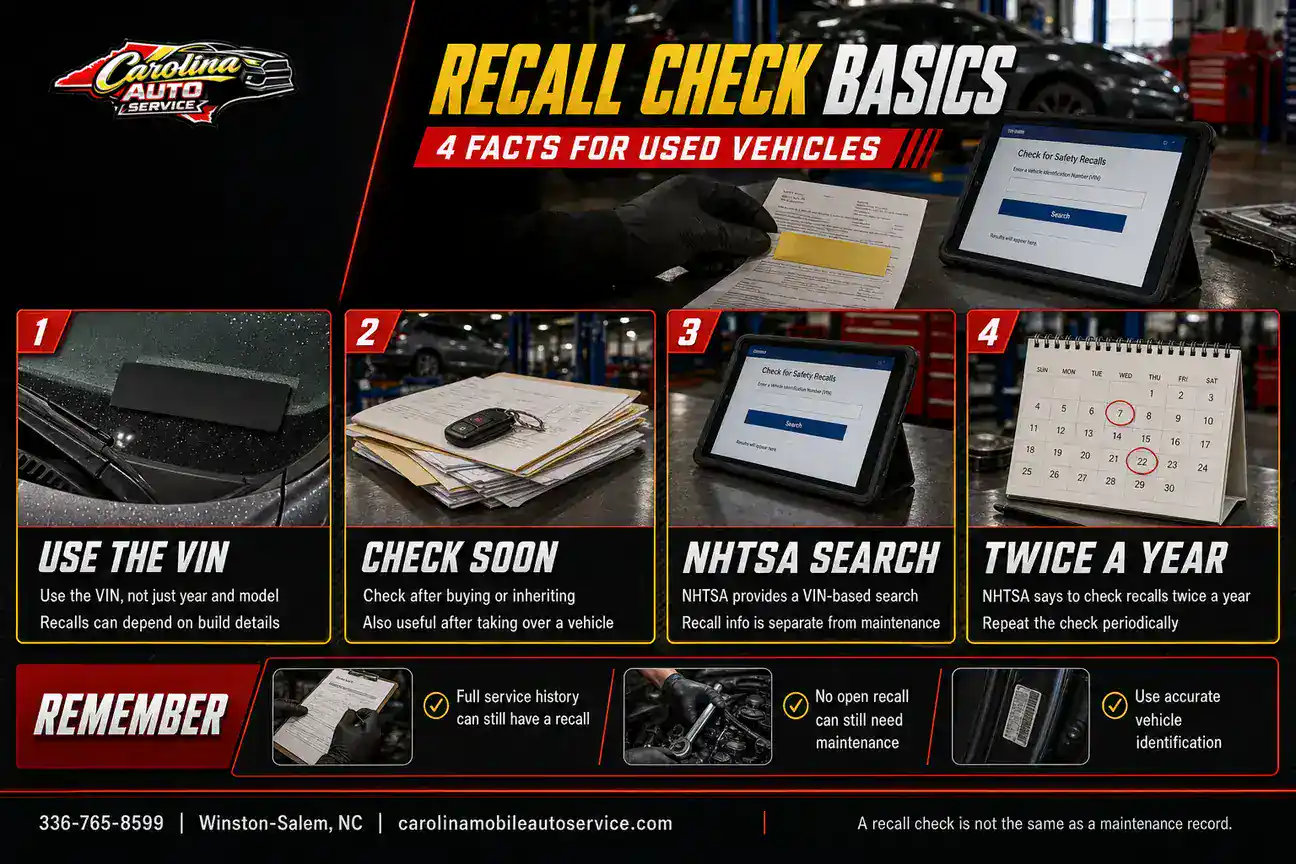
A vehicle recall check should happen soon after buying, inheriting, or taking over any used vehicle. Use the VIN, not just the year, make, and model. A VIN search is more specific because recalls can depend on build details and installed equipment.
The National Highway Traffic Safety Administration provides a VIN-based recall search and states on its NHTSA recalls page to “Check recalls twice a year.” That makes a vehicle recall check useful both immediately after purchase and periodically afterward. It is also separate from maintenance records. A car can have a full service history and still have an open recall, or it can have no open recall and still need maintenance or repair.
Recall information does not diagnose a current symptom. If a recall is open, follow the manufacturer’s recall instructions. If no recall appears, that does not rule out worn brakes, overdue fluids, cooling-system problems, electrical faults, or non-recall defects. Keep the recall result with your used car records so the next service discussion starts with the same information.
If warning lights, braking problems, stability-control messages, or tire-pressure warnings are present, do not assume the recall search explains them. Critical safety systems need in-person inspection and testing. Recall status is one evidence stream; symptoms and physical condition are another.
What about hybrids and high-voltage warnings?
Hybrid and plug-in hybrid vehicles need the same careful record review as any used vehicle, plus attention to hybrid-specific systems. Confirm the exact hybrid model, battery type where the manufacturer identifies it, cooling requirements, brake-system design, warning messages, and manufacturer maintenance guidance.
Do not disconnect, probe, open, or attempt to repair high-voltage components as a do-it-yourself task. If the vehicle shows a hybrid-system warning, high-voltage warning, inverter message, battery warning, “stop safely” message, unusual loss of propulsion, or electrical smoke, stop in a safe place and arrange assistance. NHTSA’s electric and hybrid vehicle safety information is a useful safety reference, but it is not a substitute for the manufacturer’s maintenance schedule or professional diagnosis.
Carolina Auto Service provides hybrid service at its in-shop facility. As with any other symptom, a hybrid warning is a clue, not a diagnosis. Testing determines whether the concern is related to cooling, controls, wiring, braking, charging, battery management, or another system.
When should you stop driving instead of scheduling maintenance?
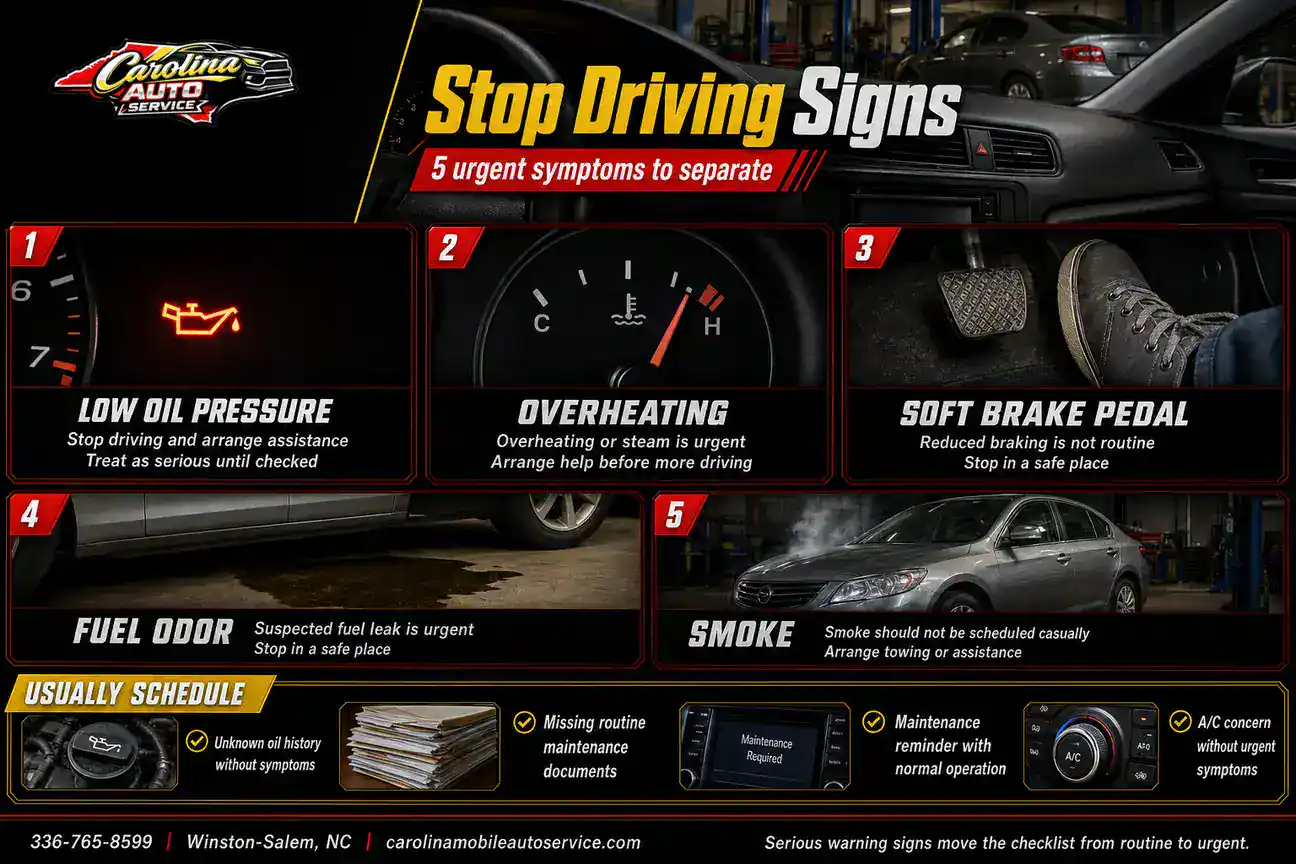
Some used-car issues can be scheduled promptly. Others call for stopping in a safe place and arranging towing or roadside assistance. This is not about panic; it is about avoiding additional damage or a safety risk when the vehicle is giving serious warning signs.
| Usually schedule promptly | Stop driving and arrange assistance |
|---|---|
| Unknown oil-change history without warning symptoms | Low oil-pressure warning |
| Missing documentation for routine maintenance | Overheating, steam, or temperature warning |
| Maintenance reminder with normal vehicle operation | Reduced braking or a soft brake pedal |
| Minor non-progressive noise needing diagnosis | Fuel odor, suspected fuel leak, or smoke |
| A/C performance concern without electrical or engine symptoms | Flashing warning light with severe shaking or power loss |
| Fluid-service history that cannot be verified | Sudden steering loss or severe steering looseness |
| Intermittent starting concern when the vehicle remains parked | Hybrid high-voltage or stop-safely warning |
| Dim lights or repeated jump-starts while the vehicle is parked | Charging warning with dim lights, stalling, or electrical smoke |
“Usually schedule” does not mean “safe to drive.” It means the symptom described is often less urgent than the warning signs in the right column. Only an in-person inspection can confirm what condition the vehicle is in.
What should you bring to an in-shop appointment?
The more specific your notes are, the more useful the appointment can be. Bring the VIN, mileage, owner’s manual if available, used car records, recall search result, and any photos or videos that show warning lights, leaks, smoke, noises, or messages. If you took notes while driving, bring those too.
Describe the symptom in ordinary language. For example: “cold start rattle for two seconds,” “vibration through the seat around a certain speed,” “brake pedal lower than expected,” “temperature gauge rises in stop-and-go traffic,” “clicking sound while turning left,” or “slow crank after sitting overnight.” Avoid diagnosing it yourself unless another shop has already provided written findings.
Vehicle-use details help set the maintenance baseline. Mention short-trip commuting, stop-and-go traffic near Hanes Mall and I-40, long highway drives, towing, carrying heavy loads, long storage, business or fleet use, and whether the vehicle is driven daily or only occasionally. Forsyth County driving can include heat, humidity, pollen, potholes, and traffic conditions that make symptom details useful, but the manufacturer schedule still leads the maintenance plan.
- Current mileage and VIN
- Owner’s manual and manufacturer schedule if available
- All invoices, receipts, inspection documents, and previous-owner notes
- Vehicle recall check results
- Photos or videos of warning lights, smoke, leaks, or noises
- Exact conditions when symptoms occur
- Recent repairs, parts replaced, or fluids added
- Your priority: safety concern, baseline maintenance, or symptom diagnosis
If the vehicle is operating normally and you are ready to build a baseline, you can request an appointment and describe the records, mileage, symptoms, and warning lights. The shop confirms the appointment time. For address details, phone information, and shop hours and directions, use the contact page. If you prefer to talk through what to bring, call 336-765-8599 during business hours.
How does Carolina Auto Service approach a baseline visit?
Carolina Auto Service handles in-shop auto repair and diagnostics at 160 Hanes Mall Circle in Winston-Salem. For a used vehicle with incomplete history, the goal is not to sell every possible service. The goal is to sort evidence, inspect the vehicle, diagnose reported symptoms, and explain priorities clearly.
ASE-certified technicians can review the symptoms and records, inspect relevant systems, perform testing when needed, and explain findings before authorized repairs begin. Customers receive repair recommendations and an estimate before work is approved. Ask about terms for the nationwide limited 24-month/24,000-mile parts and labor warranty on qualifying repairs.
This kind of visit is best described as establishing a maintenance baseline and diagnosing known concerns after ownership. It should not be confused with a guarantee of condition, a remote safety clearance, or a formal statement that every system is safe. Used vehicles can hide prior work, deferred maintenance, intermittent faults, and symptoms that only appear under certain conditions.
General educational information, not a diagnosis. Only an in-person inspection can confirm what a vehicle needs.
How should you prioritize your next move?
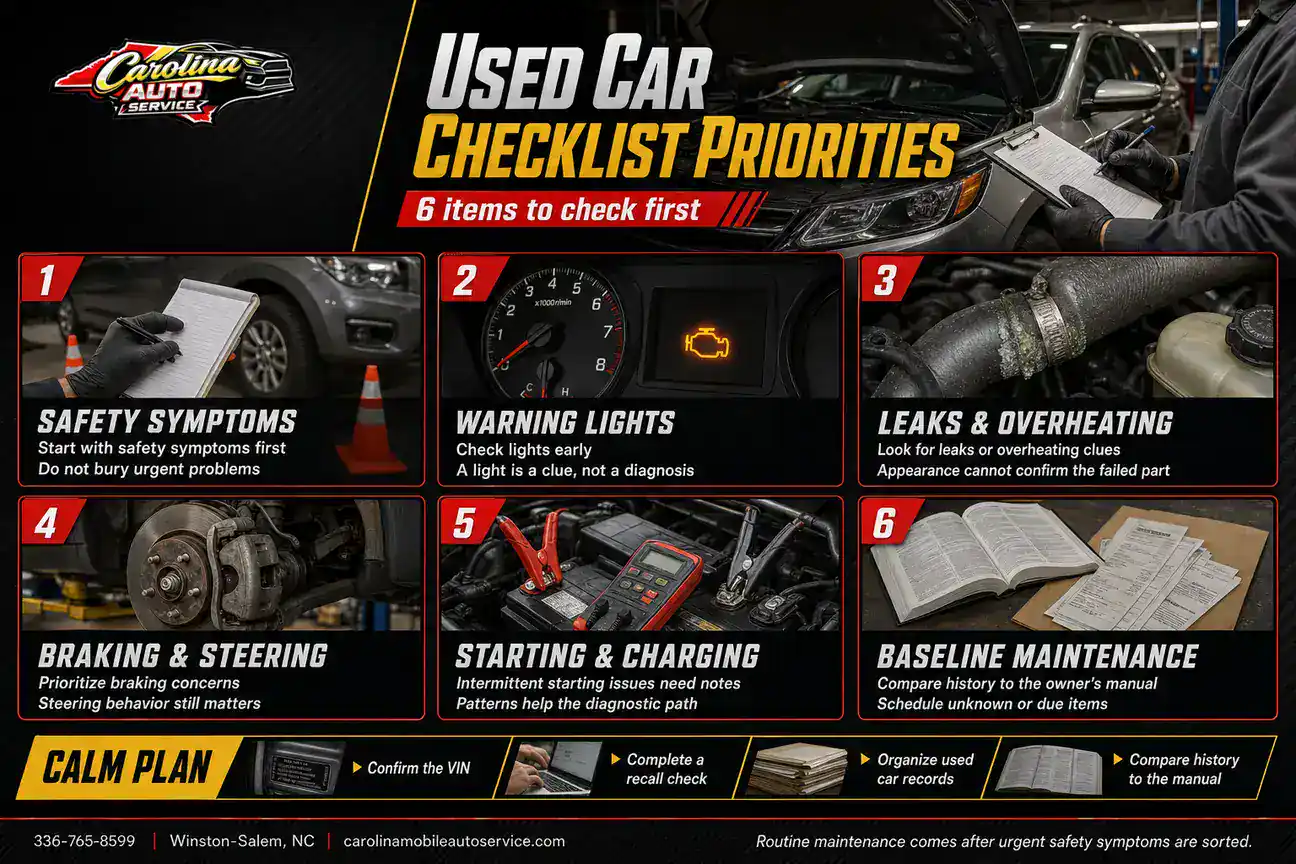
Start with safety symptoms first, then warning lights, then leaks or overheating clues, then braking and steering concerns, then starting and charging problems, then baseline maintenance. This order keeps urgent problems from being buried under routine items.
If the vehicle has no urgent symptoms, the used car maintenance checklist can become a calm plan: confirm the VIN, complete a vehicle recall check, organize used car records, compare maintenance history to the owner’s manual, and schedule the items that are unknown or due. If the vehicle does have a serious symptom, stop treating it as routine maintenance and arrange help before more driving.
A maintenance baseline is not about guessing. It is about knowing what is documented, what is unknown, what needs inspection, and what deserves immediate attention. That approach gives Winston-Salem drivers a clearer way to care for a newly purchased or inherited vehicle without overstating what a checklist can prove.
Frequently Asked Questions
What is the first thing to do after buying a used car with no records?
Record the VIN and mileage, obtain the correct owner’s manual, run a vehicle recall check, and organize any available service evidence. Then schedule an in-shop baseline evaluation rather than assuming missing records prove neglect or that the vehicle is safe.
Can I keep driving if the check-engine light is on?
A steady light with normal operation may allow time to arrange prompt diagnostics, but it does not identify the cause. A flashing light, severe shaking, loss of power, smoke, fuel odor, or another serious symptom calls for stopping safely and arranging assistance.
How can I tell whether a used-car maintenance item is overdue?
Compare the vehicle’s mileage, age, engine, drivetrain, and use with the manufacturer’s maintenance schedule in the owner’s manual. There is no single interval that applies to every used vehicle.
Should I run a VIN recall check if the seller says the car was serviced?
Yes. Maintenance records and recall status answer different questions. NHTSA provides a VIN-based recall search and recommends checking recalls twice a year.
What should I do if the vehicle is overheating?
Stop in a safe place, switch the vehicle off, and arrange towing or roadside assistance. Do not continue driving or open a hot radiator cap; an in-person cooling-system diagnosis is needed.
What should I do if a used car has slow cranking, clicking, or repeated jump-starts?
Write down when it happens, whether the engine is hot or cold, whether lights dim, and how often the vehicle needs a jump-start. If there is a charging warning, stalling, burning odor, visible smoke, or major electrical failure, stop safely and arrange assistance.
What information helps a shop diagnose a used-car noise or vibration?
Note when it occurs, whether the vehicle is cold or warm, the speed and road surface, whether you are braking, turning, accelerating, or shifting, and whether the sound changes with engine speed or vehicle speed.
Is a post-purchase inspection the same as a pre-purchase inspection?
No. A post-purchase inspection happens after you already own or manage the vehicle. It helps establish a maintenance baseline, sort records, and diagnose symptoms, but it should not be treated as a guarantee of vehicle condition.