
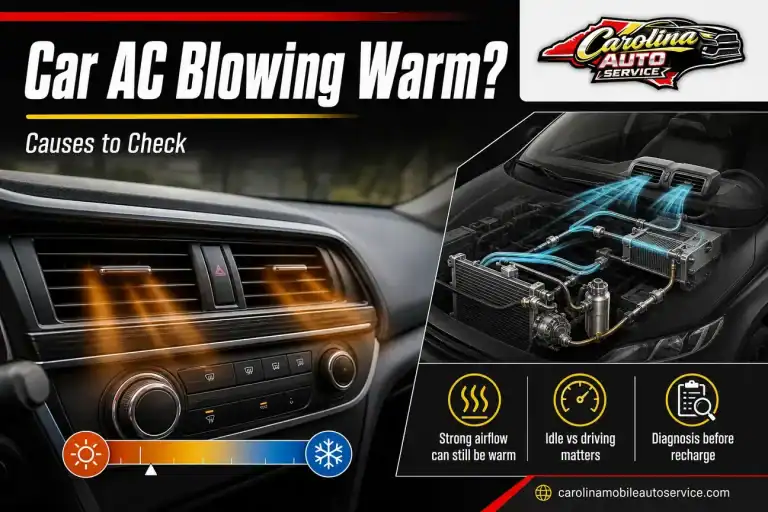
Why Is My Car AC Blowing Warm Air? Causes to Check
If you have car AC blowing warm air, the problem is real, but the symptom does not point to one guaranteed failed part. The useful clues are whether the air volume is strong or weak, whether cooling changes at idle versus road speed, and whether you notice noises, odors, warning lights, or overheating.
Quick Answer: Car AC blowing warm air can be associated with refrigerant loss, compressor or clutch concerns, inadequate condenser airflow, restricted cabin airflow, electrical controls, or a blend-door problem. If the AC is warmer at idle but improves while driving, that pattern gives a technician useful information but does not identify a failed component. An in-shop inspection can verify the complaint, test system operation, and establish what repair, if any, is supported by the findings.
What does car AC blowing warm actually tell you?
Warm air from the vents tells you the air-conditioning system is not removing heat from the cabin the way you expect. It does not prove that the refrigerant is low, the compressor has failed, the condenser fan is bad, or the blend door is stuck. In plain shop language, a symptom is a clue, not a diagnosis.
A good first step is separating temperature from airflow. Strong airflow that is warm can point the inspection toward refrigerant-related evidence, compressor operation, condenser airflow, electrical controls, or air-mixing doors. Weak airflow that is also not cold can involve cabin-airflow restrictions, blower operation, evaporator icing, mode-door operation, or more than one concern at the same time.
Also notice the conditions. Does it happen after sitting in traffic? Only after the vehicle is hot? Only after a short drive? Only on one side of a dual-zone system? Does the air start cold and then go warm? Details like these help an automotive air-conditioning service inspection focus on what is actually happening instead of guessing.
AC warm at idle but cooler while driving
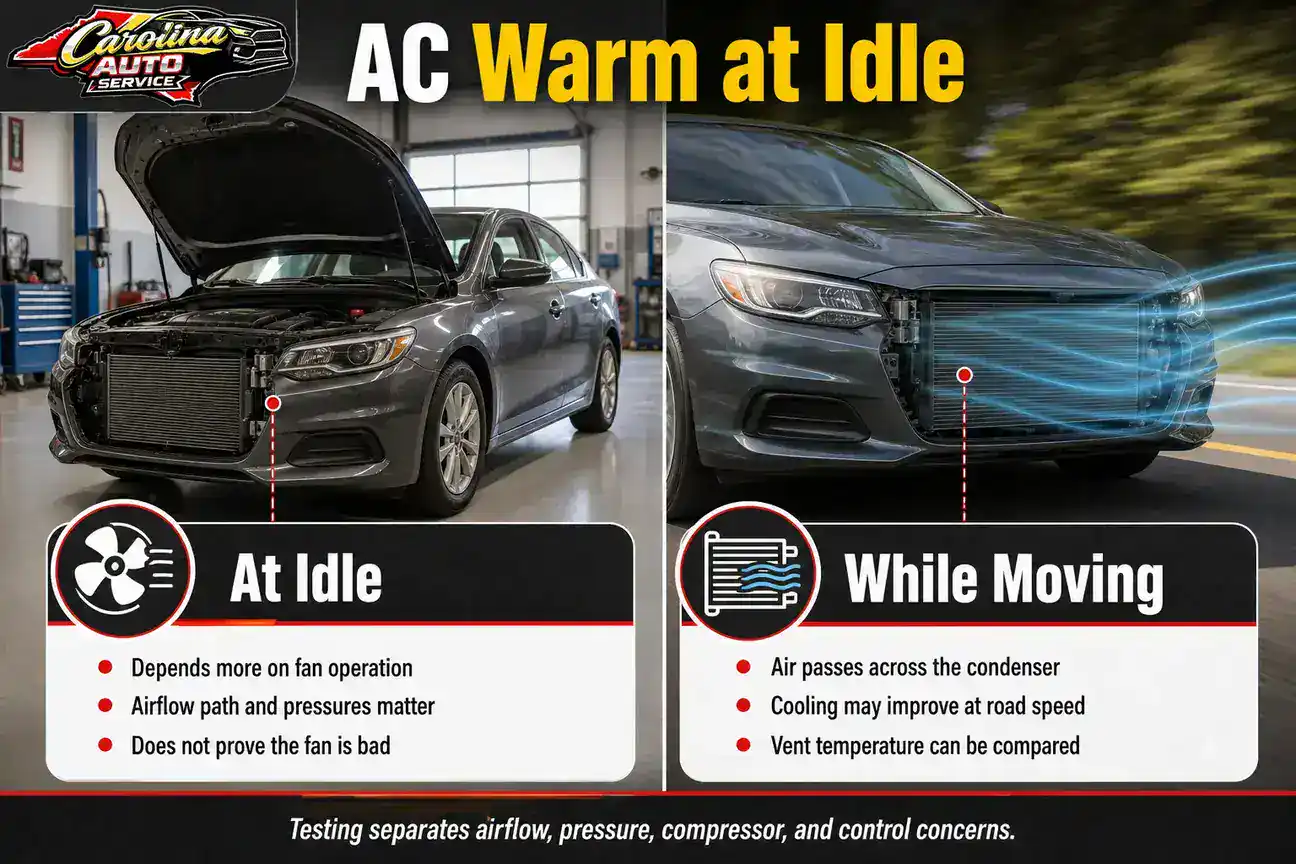
AC warm at idle is one of the most useful patterns to describe because airflow across the front of the vehicle changes when you start moving. At road speed, air naturally passes across the condenser. At idle, the system depends more on fan operation, airflow path, pressure behavior, and controls. That does not prove the fan is bad, but it gives the shop a direction for testing.
When a driver says the AC warm at idle concern improves once the car is moving, possible inspection areas include condenser airflow, cooling-fan command, refrigerant pressures at different engine speeds, compressor engagement, and engine-temperature interaction. A technician may compare vent temperature at idle and raised rpm, verify fan operation, and observe whether the compressor is being commanded on under the conditions that reproduce the symptom.
Hot-weather operation can also affect what you feel from the vents. FuelEconomy.gov says most AC systems will cool the vehicle faster while driving and advises drivers not to idle with the AC running before driving. That helps explain why a car may feel different at idle than in motion, but it still does not identify a failed part.
If your AC warm at idle concern is new, getting worse, or paired with a rising temperature gauge, smoke, burning odor, or severe belt-area noise, treat those added symptoms seriously. The AC pattern is only one part of the vehicle’s overall condition.
Could low refrigerant cause the car AC not cold concern?
Low refrigerant is one possibility when the car AC not cold complaint shows up, but it is not the only possibility. Refrigerant level can be low because of a leak, prior service history, component damage, or another system issue. The charge level alone does not identify the source of the concern.
A low charge may keep the system from cooling properly or may cause the compressor to operate differently than expected. However, a car AC not cold complaint can also involve compressor command, condenser airflow, an electrical input, a pressure sensor, cabin airflow, or a blend-door concern. That is why “just recharge it” is not the same as diagnosis.
The U.S. Environmental Protection Agency’s MVAC guidance says vehicle owners generally have several service options, including topping off, evacuating and recharging, or repairing or replacing leaking components and then recharging. That guidance does not mean every warm-air complaint is caused by low refrigerant, and it does not create one universal service approach for every vehicle.
There is also an important safety and compliance boundary. Do not attempt to vent, recover, or recharge refrigerant at home. According to the EPA’s regulatory requirements for MVAC system servicing, paid MVAC service providers must be properly trained and certified, must use refrigerant handling equipment that has been certified, refrigerant cannot be intentionally released (vented), and recovered refrigerant must be either recycled or reclaimed before it can be recharged.
If your car AC not cold issue turns out to involve refrigerant, an inspection can help determine whether the measured charge is appropriate for the vehicle, whether there is evidence of refrigerant loss, and whether other parts of the system are operating as expected.
AC compressor symptoms drivers should write down
AC compressor symptoms are not proof that the compressor has failed. They are clues that justify testing compressor command, clutch engagement where applicable, belt-driven components, wiring, pressure-related protection, and related controls. The same noise or behavior can sometimes come from nearby parts.
Useful AC compressor symptoms to note include cooling that drops out intermittently, clicking when AC is requested, a grinding or squealing sound near the belt area, cooling that changes with engine speed, or a noticeable idle change when the AC turns on. If your vehicle has an electrically driven compressor, especially on some hybrid models, the testing path may be vehicle-specific.
Do not work around moving belts, pulleys, fans, or high-voltage hybrid components. If the sound is severe, the belt area smells hot, or the vehicle shows a warning light with unsafe behavior, move out of traffic, stop in a safe place, and arrange towing or roadside assistance. Do not keep driving just to reach a shop.
During AC diagnosis, the question is not simply “is the compressor bad?” The better question is whether the compressor is being commanded correctly, whether it is engaging or operating as designed for that vehicle, whether system pressures make sense, and whether another condition is preventing normal cooling.
How condenser airflow changes cooling performance
The condenser helps reject heat from the refrigerant circuit. If condenser airflow is limited at idle, the vent temperature may behave differently than it does at road speed. That is why a warm-at-idle complaint often leads to checks around fan operation, airflow path, debris, condenser condition, and system pressure response.
Again, condenser airflow is a diagnostic direction, not a verdict. A vehicle that cools better while moving may have a fan-control concern, an airflow obstruction, a pressure issue, a compressor-performance concern, or more than one condition. Testing is what separates one possibility from another.
Drivers should not reach into the engine compartment to test a fan or clear anything near moving parts. Electric fans may operate unexpectedly, and belts or pulleys can injure you quickly. A shop can evaluate fan command, electrical supply, fan operation, and the system’s response under controlled conditions.
For a driver from Clemmons commuting through summer traffic near Hanes Mall or I-40, a weak idle-cooling pattern can be easier to notice because the vehicle spends more time sitting still with heat load on the cabin. That local driving pattern can help describe the symptom, but it does not prove the cause.
Can cabin airflow or a blend door make the car AC not cold?
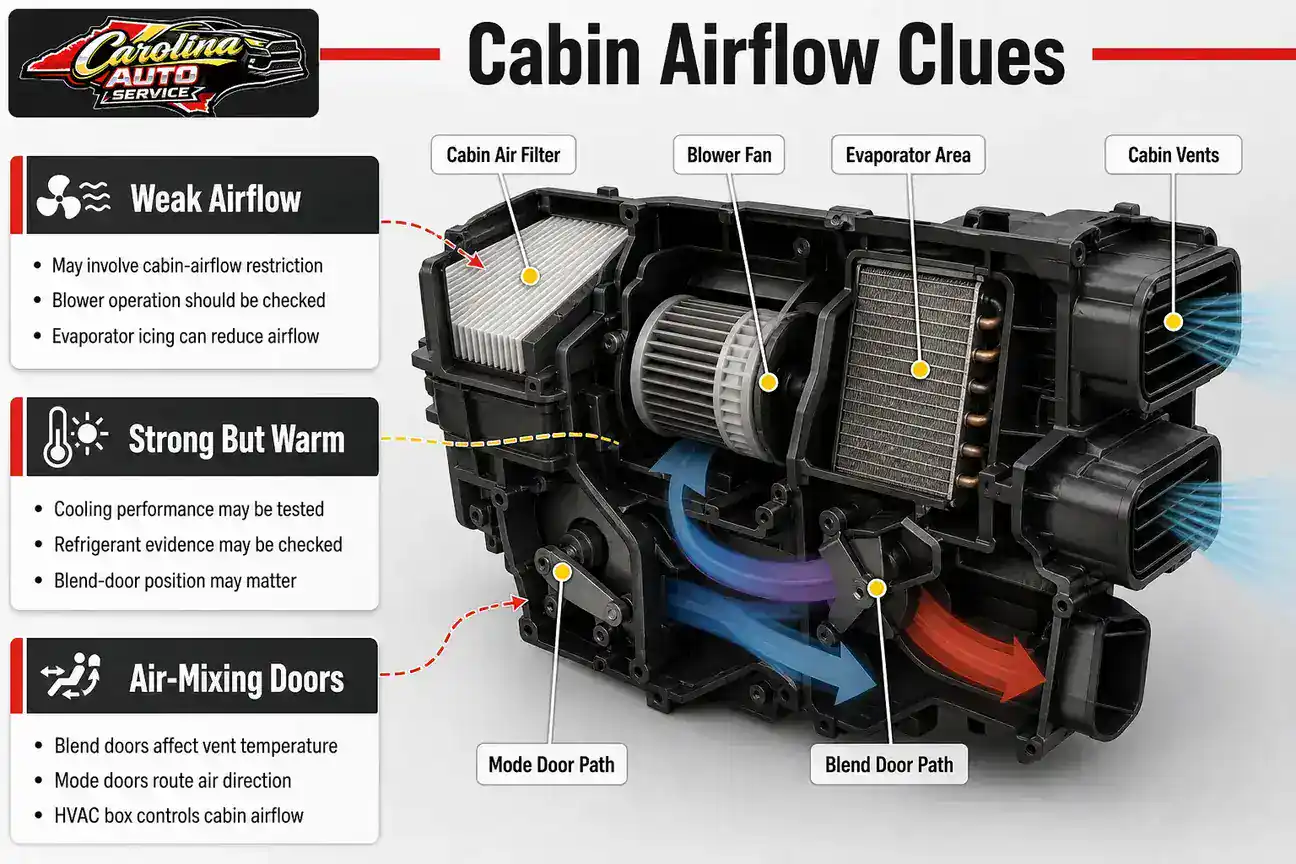
Yes, cabin-side problems can make a car AC not cold complaint feel like a refrigeration problem even when the issue is partly or mostly airflow or air mixing. A restricted cabin filter, weak blower operation, evaporator icing, mode-door concern, or blend-door fault may affect what comes out of the vents.
A restricted cabin filter can reduce airflow, but it should not be named as the automatic cause. If airflow is weak on all fan speeds, airflow testing matters. If air is strong but warm, the inspection may focus more heavily on cooling performance, refrigerant-related evidence, compressor operation, controls, or blend-door position.
Blend doors and mode doors route air through the HVAC box and mix warm and cool air. If the temperature changes from one vent to another, does not respond to the temperature knob, or changes only on one side of a dual-zone system, the technician may check actuator response and control inputs. Those clues can support AC diagnosis, but they still require testing.
Some symptoms overlap. Evaporator icing, for example, can reduce airflow after the system runs for a while and then seem better after the vehicle sits. Electrical inputs or sensors may also change compressor operation. The shop’s job is to reproduce the complaint, measure what is happening, and avoid replacing parts based on a guess.
Electrical controls and sensors can interrupt cooling
Modern AC systems rely on electrical inputs as well as mechanical operation. A pressure sensor, temperature sensor, relay, fuse, wiring issue, control head, body control module input, or engine-management decision may influence whether the compressor is allowed to run. That means a warm-air complaint can be electrical even when the vents and buttons seem normal.
This is another reason AC diagnosis matters. A compressor may not engage because it is being protected from a pressure condition. It may not receive the proper command. The command may be present but the circuit may not complete. The vehicle may reduce AC operation because another system is reporting a concern.
For hybrids, air-conditioning systems may involve electrically driven components or vehicle-specific high-voltage designs. Do not attempt high-voltage testing or repair. If your hybrid has warning messages, unusual electrical odors, or abnormal cooling behavior, note the exact message and have the system inspected by a qualified shop with the proper vehicle information.
What should you do right now before scheduling AC diagnosis?
Before you schedule AC diagnosis, write down what the system does under repeatable conditions. You do not need to take anything apart. The goal is to give the shop a clear symptom story so the vehicle can be checked efficiently and safely.
- Note whether the airflow is strong, weak, or changes with fan speed.
- Record whether the air is warmer at idle and cooler while driving.
- Write down whether cooling changes with recirculation, vent mode, or temperature setting.
- Notice if the problem is constant, intermittent, or only after the vehicle has been parked in heat.
- Listen for clicking, grinding, squealing, rattling, or belt-area noise when AC is requested.
- Watch for warning lights, rising temperature gauge, smoke, steam, burning odor, or sudden power loss.
- Include the vehicle year, make, model, mileage, hybrid status, and recent repair history.
Do not open refrigerant lines, install refrigerant products, bypass switches, or work around moving engine components. If you want to plan service, you can request an appointment and describe the symptom, when it happens, and any warning lights. Carolina Auto Service confirms the appointment time.
When should you stop driving?
A warm-air complaint by itself is often a schedulable concern, but no article can tell you your vehicle is safe to drive without an in-person inspection. Stop in a safe place and arrange towing or roadside assistance if the AC concern happens with overheating, a rising temperature gauge, steam, smoke, a strong burning smell, severe belt or pulley noise, sudden loss of engine power, visible wiring damage, or a warning light that is flashing or paired with unsafe vehicle behavior.
Do not keep driving just to reach the shop when those serious symptoms appear. The AC may be only one sign of a larger cooling, electrical, belt-drive, or engine-management concern. If a third-party roadside assistance program may apply to qualifying service, review the program terms separately; the repair decision still needs an in-person inspection.
What will an in-shop AC diagnosis establish?
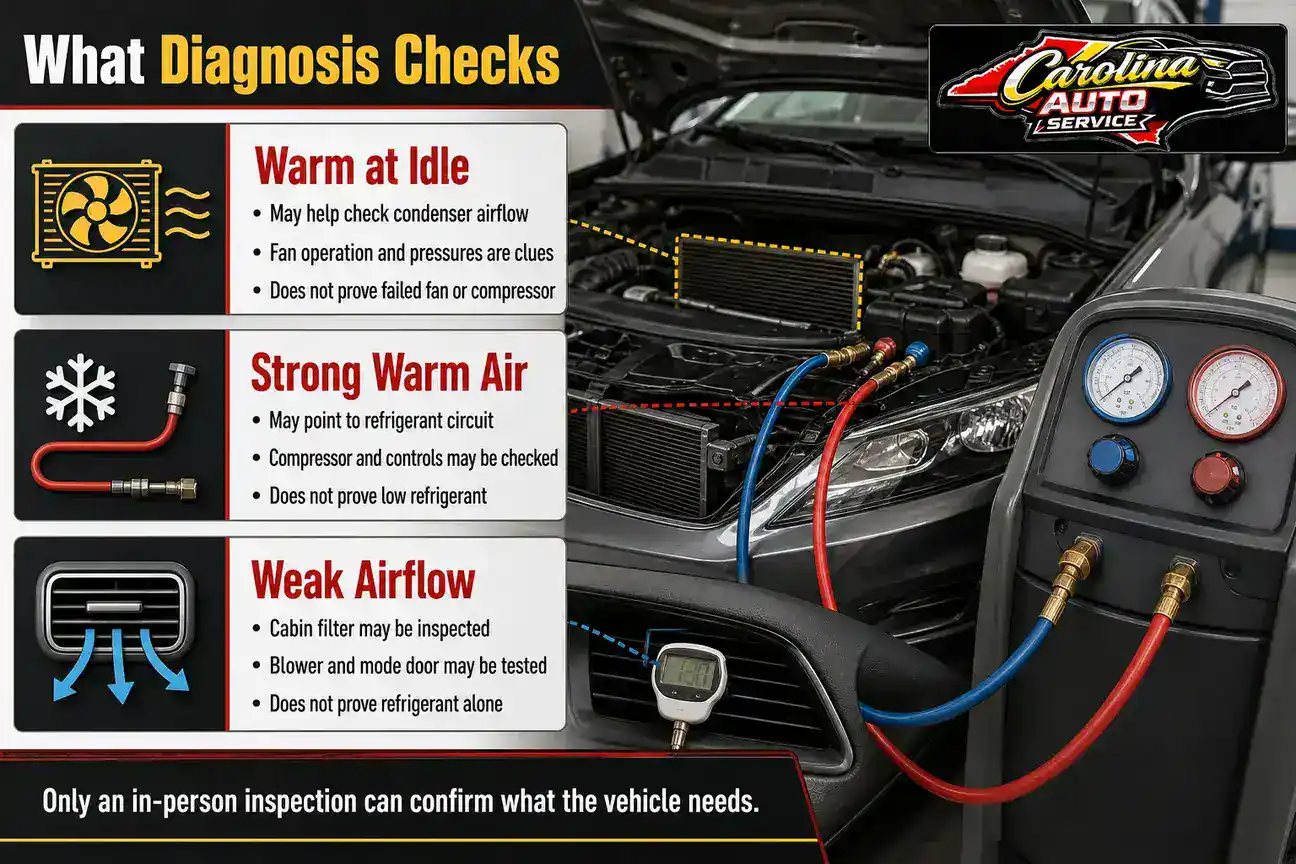
A proper AC diagnosis starts by verifying the complaint under the conditions you reported. If the air is warm only at idle, the shop may reproduce that pattern. If the problem happens after a longer drive, the technician may compare the system cold, warm, and under load as appropriate for the vehicle.
| Driver observation | What it may help the shop investigate | What it does not prove |
|---|---|---|
| Warm at idle, cooler while moving | Condenser airflow, fan operation, pressure behavior, compressor performance | A failed fan or compressor |
| Strong airflow, warm temperature | Refrigerant circuit, compressor, condenser airflow, controls, blend door | Low refrigerant specifically |
| Weak airflow and poor cooling | Cabin filter, blower, evaporator icing, airflow doors | A clogged filter specifically |
| Clicking, grinding, or squealing with AC request | Compressor or clutch, belt, pulley, or related electrical command | Compressor failure |
| Intermittent cooling | Pressure protection, electrical control, clutch engagement, sensor, or icing concern | A single failed component |
An in-shop inspection may include vent-temperature measurement, refrigerant-pressure checks, evidence of refrigerant loss, compressor command and engagement checks, cooling-fan operation, electrical power and ground testing, fuse and relay checks, blower evaluation, air-door response, and vehicle-specific service information.
The point is not to sell a part before the evidence supports it. Carolina Auto Service emphasizes diagnosis before assumptions, then explains findings and provides clear repair recommendations and an estimate before authorized work begins. The Federal Trade Commission’s auto repair basics guidance also advises consumers to ask for a written estimate and understand authorization before repairs are performed.
The Carolina Auto Service warranty includes a nationwide limited 24-month/24,000-mile parts and labor warranty on qualifying repairs; ask about terms for your repair.
How Winston-Salem drivers can prepare for an appointment
Drivers in Winston-Salem and Forsyth County can make the appointment conversation more useful by describing the pattern instead of only saying “the AC does not work.” Say whether the vehicle has AC warm at idle, whether the air becomes cooler on the road, whether the airflow is weak, and whether the problem is worse in stop-and-go traffic or after the cabin has been heat-soaked.
Bring up recent work, unusual noises, odors, warning lights, overheating, or any history of refrigerant service. If your vehicle has an owner’s manual, use it for vehicle-specific operating information; FuelEconomy.gov also advises drivers to read the owner’s manual for vehicle-specific guidance. Manufacturer information matters because AC controls, hybrid systems, refrigerant type, and service procedures vary by vehicle.
If you are coming from Clemmons, Lewisville, or elsewhere in Forsyth County, note the driving conditions that make the symptom show up. Repeated short trips, hot parking lots, and slow traffic can make differences between idle and moving operation easier to notice. Those details guide testing, but they still do not prove a specific repair.
Schedule car AC repair for a warm-air concern
If your AC is blowing warm, blowing weak, or changing temperature between idle and driving, Carolina Auto Service can inspect the vehicle at the Winston-Salem shop on Hanes Mall Circle. The team handles in-shop car AC repair and diagnostics for everyday cars, SUVs, light trucks, vans, hybrids, and fleet vehicles.
To plan the visit, schedule an appointment or call 336-765-8599. Include the symptom, whether the concern is AC warm at idle, any AC compressor symptoms, and whether you noticed warning lights, smoke, odors, or overheating. The shop confirms the appointment time.
General educational information, not a diagnosis. Only an in-person inspection can confirm what a vehicle needs.
When you are dealing with car AC blowing warm air, the safest approach is to treat the pattern as information, not a verdict. Strong airflow, weak airflow, idle-only cooling loss, noise, odor, and warning lights all tell part of the story. Testing connects those clues to a repair recommendation that fits your vehicle.
Frequently Asked Questions
Why is my car AC blowing warm air at idle but cold while driving?
That pattern can be associated with condenser airflow, cooling-fan operation, compressor performance, or system-pressure behavior. It is a useful clue for diagnosis, not proof that one particular component has failed.
Does warm air mean my car is low on refrigerant?
Low refrigerant or refrigerant loss is one possibility, but warm air can also involve the compressor, condenser airflow, electrical controls, cabin airflow, or blend-door operation. Testing is needed to determine whether the charge is low and why.
Should I add refrigerant myself?
Do not attempt to vent, recover, or recharge refrigerant yourself. Refrigerant service should be handled with the required training and equipment, and a recharge alone may not address the reason the system is not cooling.
Is it safe to drive when the AC is blowing warm?
The AC symptom alone does not establish that the vehicle is safe to drive. Stop in a safe place and arrange towing or roadside assistance if the concern occurs with overheating, smoke, burning odor, severe belt or compressor noise, sudden power loss, or serious warning-light behavior.
What should I tell the shop about the AC problem?
Describe whether the airflow is strong or weak, whether the air is warmer at idle, whether cooling improves with speed, when the symptom began, whether it is intermittent, and whether there are noises, odors, leaks, warning lights, or overheating.
Can a cabin filter cause warm air?
A restricted cabin filter may reduce airflow, but it does not automatically explain every warm-air complaint. The shop may compare airflow, blower operation, evaporator behavior, and HVAC door operation with the cooling-system checks.
What can an AC inspection confirm?
An inspection can help verify the symptom and evaluate refrigerant-related evidence, compressor operation, condenser airflow, electrical controls, blower performance, and air-mixing doors. The results support a repair recommendation and estimate before authorized work begins.