Car Vibrates at Highway Speeds but Not While Braking: What to Check
Quick Answer
If your car vibrates at highway speeds, tires and wheels are often among the first areas worth inspecting—but they are not the only possibilities. Tire imbalance, tire damage or nonuniformity, a bent wheel, wheel or hub runout, suspension or steering wear, wheel bearings, axles, driveshafts, mounts, and other rotating components can create similar symptoms.
Where you feel the vibration and what makes it change are important clues. A vibration in the steering wheel may point the inspection toward the front of the vehicle, while vibration felt mainly through the seat or floor may involve the rear wheels, body, or drivetrain. If the shake is severe, a tire is damaged, steering changes, or a wheel feels loose, reduce speed and stop driving when it is safe to do so.
A highway-speed vibration is one of those vehicle symptoms that can feel simple but has several possible causes.
A driver may describe the problem as:
“My car shakes at 60 mph.”
“The steering wheel vibrates around 65 to 70 mph.”
“The whole car feels smooth around town but shakes on the highway.”
“The vibration is in the seat instead of the steering wheel.”
“It only shakes when I accelerate at highway speed.”
Those descriptions are not interchangeable. The exact speed, where the vibration is felt, whether acceleration changes it, and whether braking changes it can help determine which systems should be inspected first.
This article focuses on vibration that occurs while cruising with the brakes released. If the shake mainly begins or becomes significantly worse when you press the brake pedal, the vehicle should follow a braking-related diagnostic path instead.
What Should You Do First if Your Car Vibrates at Highway Speeds?
If a vibration appears only at higher road speeds, reduce speed and note the conditions that make it begin or change. Do not repeatedly accelerate to highway speed just to reproduce a severe vibration. Stop driving and arrange appropriate assistance if you see tire damage, experience pressure loss, notice loose or unpredictable steering, hear severe wheel-end noise, or the vibration suddenly becomes much worse.
What You Notice
Recommended Next Step
Why It Matters
Vibration began after a pothole or curb impact
Reduce speed and arrange prompt inspection
Tire, wheel, hub, alignment, or suspension damage may be present
Steering wheel shakes mainly while braking
Follow the brake-vibration diagnostic path
Brake and wheel-end conditions move higher on the diagnostic list
Vibration changes significantly during acceleration versus coasting
Record the pattern for drivetrain diagnosis
Torque load may help distinguish axle, driveshaft, joint, or mount concerns
Severe shaking, visible tire bulge, pressure loss, or wheel looseness
Stop driving and arrange assistance
A tire or wheel-end failure may be developing
Vibration occurs in a narrow speed range but otherwise drives normally
Schedule tire, wheel, hub, and related inspection
Speed-sensitive rotating forces may become noticeable only within a specific range
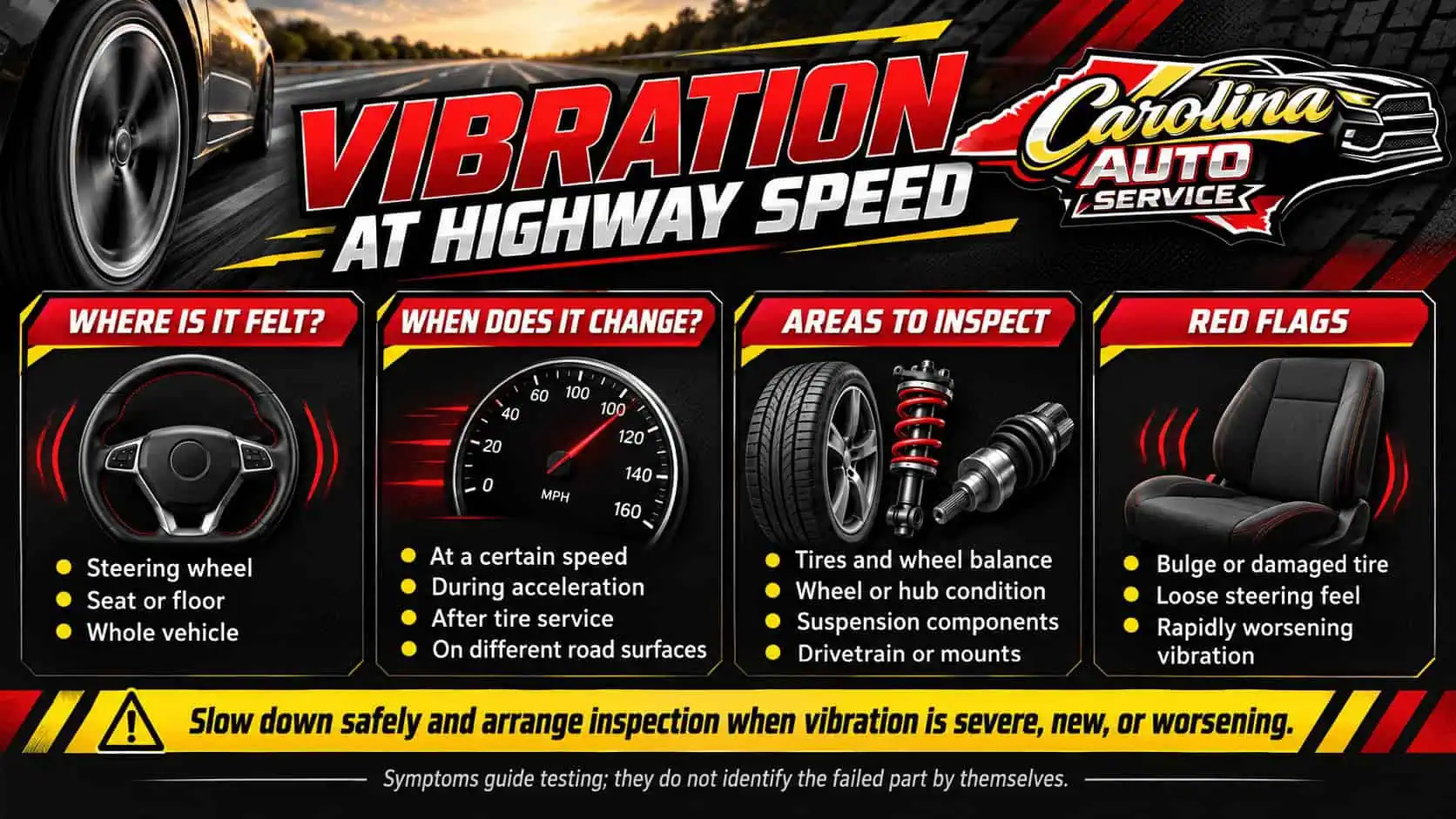
Key decision points for highway-speed vibration, including where the vibration is felt, what makes it change, which areas may need inspection, and warning signs that should prompt reduced speed or immediate evaluation.
Why Does My Car Vibrate at Highway Speeds?
Many vibrations become easier to feel as rotating speed increases. That does not mean every high-speed vibration is simply a wheel-balance problem.
A professional diagnosis should answer several questions:
Where Is It Felt?
Steering wheel, seat, floor, pedals, center console, or the entire vehicle? The location can help determine which components should be evaluated first.
When Does It Change?
Does it begin at 55 mph, peak at 65 mph, disappear above 70 mph, worsen during acceleration, or change while coasting?
What Happened Before It Started?
A pothole impact, curb strike, recent tire replacement, wheel removal, suspension repair, or new tire wear pattern can provide important context.
The symptom should guide the test plan. It should not be used to guess which component needs replacement.
1. Tire Imbalance or Tire Nonuniformity
Tires and wheels rotate rapidly at highway speed. If weight is distributed unevenly around the assembly, rotating force can become noticeable as vehicle speed increases.
This is why an imbalance may barely be noticeable at 30 mph but become much more obvious around 55, 65, or 70 mph.
However, a tire can create vibration even when conventional wheel balance appears acceptable.
Other tire-related causes can include:
Flat spotting
Irregular tread wear
Tire stiffness variation
Internal tire damage
Belt separation
Out-of-round condition
Improper bead seating
Diagnostic clue: If the tire and wheel appear balanced but vibration remains, road-force measurement or further tire inspection may reveal conditions that a basic spin balance does not identify.
2. Bent Wheel or Excessive Wheel Runout
A pothole, curb impact, road debris, or previous wheel damage can alter the shape of a wheel.
A wheel does not need to look obviously bent to create a vibration.
Technicians may evaluate both:
Radial runout — movement toward and away from the wheel center as it rotates
Lateral runout — side-to-side movement as the wheel rotates
Excessive runout can create a repeating force that becomes more noticeable with road speed.
Diagnostic clue: Measuring the tire, wheel, and hub separately can help determine which part of the rotating assembly contributes most to the movement.
3. Tire Pressure or Tire Damage
Tire pressure affects how the tire carries load and maintains its shape.
Improper pressure, visible damage, sidewall bulges, irregular tread wear, or internal tire problems can affect both vibration and handling.
Inspect Tire Safety Before Trying to Balance the Vibration
A visibly damaged tire should not simply be balanced and returned to service. Bulges, exposed cords, significant pressure loss, severe tread damage, or evidence of structural failure require a safety evaluation first.
The National Highway Traffic Safety Administration recommends regularly checking tire pressure, tread, and overall tire condition because tire problems can affect vehicle control and safety.
4. Wheel or Hub Mounting Problem
The wheel needs to sit correctly against the hub.
Corrosion, debris, improper mounting, damage, incorrect hardware, or other conditions at the mounting surface can prevent the wheel assembly from seating evenly.
This can be particularly relevant when a vibration begins immediately after:
Tire replacement
Tire rotation
Brake work
Wheel removal
Wheel replacement
If the symptom began right after a service involving wheel removal, tell the technician.
5. Wheel Bearing or Wheel-End Condition
A wheel bearing supports the rotating wheel and hub assembly. Wear, looseness, or damage can potentially contribute to noise, vibration, or changes in wheel movement.
Useful accompanying symptoms can include:
Growling or humming noise
Noise that changes during turns
Wheel play
Uneven tire wear
Changes in steering feel
A wheel bearing should not be condemned based on vibration alone. Bearing condition needs to be evaluated through inspection and appropriate testing.
6. Steering or Suspension Wear
Steering and suspension components help control wheel position while the vehicle travels over the road.
Wear or looseness in components such as:
Tie rods
Ball joints
Control-arm bushings
Other suspension joints
Mounting points
can allow unwanted movement or amplify a vibration originating somewhere else.
Diagnostic clue: Wandering steering, clunks, uneven tire wear, looseness, or a change in steering feel can make steering and suspension inspection more important.
7. CV Axle or Driveshaft Vibration
A highway-speed vibration is not always generated by a wheel.
Rotating drivetrain components can create vibration as well.
Depending on the vehicle, areas that may require evaluation include:
CV axles
CV joints
Driveshafts
Universal joints
Center-support bearings
Differential components
Drivetrain mounts
One of the most useful distinctions is whether the vibration changes when torque is applied.
Same speed + vibration changes significantly with acceleration = drivetrain load becomes a more important diagnostic clue
Does It Matter Whether the Vibration Is in the Steering Wheel or the Seat?
Yes—but it is a clue rather than a guaranteed diagnosis.
Where You Feel It
Areas Often Considered
Important Limitation
Steering wheel
Front tires, wheels, hubs, steering, suspension
Vibration can travel through the chassis, so location does not prove the source
A rotating component can generate vibration at a frequency that becomes most noticeable within a particular vehicle-speed range.
That is why some drivers report:
Smooth at 45 mph → vibration around 60–70 mph → smoother again at a different speed
This type of speed-specific pattern commonly leads technicians to investigate rotating components such as tires, wheels, hubs, or drivetrain parts.
But the exact speed at which the vibration occurs does not identify the failed part by itself.
The shop still needs to determine:
Whether the vibration follows road speed
Whether it follows engine RPM
Whether acceleration changes it
Whether coasting changes it
Whether steering input changes it
Whether braking changes it
Why Does the Vibration Change When I Accelerate?
If the vehicle vibrates more under acceleration but becomes smoother when you lift off the throttle while remaining at approximately the same road speed, drivetrain loading becomes an important clue.
Depending on the vehicle, a technician may inspect:
CV axles
Inner CV joints
Driveshafts
Universal joints
Center supports
Powertrain mounts
Differential or driveline components
Carolina Auto Service provides drivetrain inspection and repair when the vibration pattern points toward rotating drivetrain components rather than primarily toward tires or wheels.
What if the Car Shakes Mainly When Braking?
This is an important diagnostic split.
If the vehicle is smooth while cruising but begins vibrating primarily when the brake pedal is applied, brake-related and wheel-end causes should move higher on the diagnostic list. That symptom should not be treated as the same problem as a vibration that exists while cruising with the brakes released.
Carolina Auto Service's brake service addresses braking-related concerns, while highway-speed vibration without brake application follows the tire, wheel, hub, suspension, steering, and drivetrain diagnostic path described here.
Can Alignment Cause a Highway-Speed Vibration?
Alignment is often blamed whenever a vehicle shakes at speed, but alignment itself more commonly produces symptoms such as:
Vehicle pulling
Off-center steering wheel
Irregular tire wear
Reduced directional stability
Alignment problems can coexist with a vibration and can contribute to tire wear that later causes additional symptoms.
But simply performing an alignment does not correct every highway-speed vibration.
Vibration diagnosis should identify the rotating or moving source before alignment is assumed to be the repair.
Why Can a Car Start Vibrating After New Tires?
A vibration that begins immediately after tire installation or rotation provides useful diagnostic context.
Possible areas to inspect include:
Wheel balance
Tire seating
Tire nonuniformity
Wheel mounting
Hub mating surfaces
Wheel condition
Tire pressure
Existing wheel or suspension problems that became more noticeable
Do not assume the new tire itself is defective, but do tell the shop exactly when the vibration started.
What if the Vibration Started After Hitting a Pothole?
A pothole impact can affect more than wheel alignment.
Depending on the severity of the impact, technicians may need to inspect:
Tire sidewall and tread
Wheel shape
Wheel runout
Hub condition
Wheel bearing
Steering components
Suspension components
Alignment
If the steering wheel position changed or the vehicle began pulling after the impact, mention that as well.
When Should Highway-Speed Vibration Be Considered Urgent?
Not every vibration means a wheel is about to fail, but certain symptoms should move the situation out of the “monitor it” category.
Reduce Speed and Stop Driving When Appropriate If:
A tire has a visible bulge, exposed cords, or major damage
Tire pressure is dropping
The vibration becomes suddenly severe
The steering feels loose or unpredictable
A wheel appears loose
There is severe wheel-end noise
The vehicle becomes difficult to control
The vibration started after a significant impact and handling has changed
Do not continue driving at highway speed simply to determine whether the vibration will disappear.
If tire integrity, steering control, or wheel security is uncertain, arrange appropriate assistance rather than continuing to test the symptom on the road.
How Does a Professional Shop Diagnose Highway-Speed Vibration?
A good diagnosis begins by reproducing the symptom safely and identifying the vibration pattern before parts are replaced.
Record the exact speed range
The technician determines when the vibration begins, where it peaks, and whether it changes at higher or lower speeds.
Determine where the vibration is felt
Steering wheel, seat, floor, and body vibration can provide clues about the source.
Compare acceleration, cruise, and coast
Changing engine or drivetrain load while maintaining similar road speed helps distinguish some wheel-speed concerns from drivetrain-related vibration.
Inspect tires and tire pressure
The shop checks for visible damage, irregular wear, inflation problems, flat spots, and other tire conditions.
Evaluate wheel balance and tire uniformity
Spin balancing or road-force testing may be appropriate depending on the symptom and equipment available.
Measure wheel and hub runout when needed
Measurements can help isolate whether movement originates from the tire, wheel, mounting surface, or hub.
Inspect wheel bearings, steering, and suspension
Play, wear, loose joints, and damaged components are checked when the symptom points toward the wheel end or chassis.
Evaluate the drivetrain if load changes the vibration
Axles, driveshafts, joints, mounts, and other rotating drivetrain components may require inspection.
Advanced diagnosis may also use chassis sensors or vibration-frequency analysis to compare the vibration with wheel speed, engine speed, or driveshaft speed.
The purpose of those measurements is simple:
Identify which rotating system matches the vibration instead of replacing parts based on where the driver happens to feel it.
What Repairs Might Be Needed?
The correct repair depends on what the inspection and measurements confirm.
Possible repairs may include:
Correcting tire pressure
Replacing a structurally unsafe tire
Balancing a tire and wheel assembly
Match-mounting a serviceable tire and wheel when appropriate
Repairing or replacing a bent wheel
Correcting excessive hub or wheel runout
Replacing a failed wheel bearing
Repairing worn steering or suspension components
Replacing a damaged axle or joint
Repairing a confirmed driveshaft or drivetrain problem
Replacing a failed mount when testing supports it
The exact scope depends on the vehicle, component condition, test results, access, parts availability, and whether one fault has contributed to another.
There is no single “highway vibration repair.”
Why Balancing the Tires First Is Not Always Enough
Wheel balance is a logical early check for many speed-related vibrations, but repeatedly balancing the same tire and wheel without confirming the condition of the assembly can waste time and money.
A balanced assembly can still have:
A damaged tire
Tire nonuniformity
Excessive wheel runout
Hub runout
Mounting-surface problems
A wheel bearing problem
A suspension issue
A drivetrain-related vibration
That is why the repair recommendation should be tied to measurements and inspection findings.
How Should You Evaluate a Highway-Vibration Repair Recommendation?
Ask the technician to connect the recommendation to the evidence.
Useful questions include:
Was the vibration reproduced?
At what speed did it occur?
Was it strongest in the steering wheel or body?
Did acceleration or coasting change it?
Was tire damage found?
Was wheel balance measured?
Was road-force variation checked if needed?
Was wheel or hub runout measured?
Was bearing or suspension play found?
What evidence points toward the drivetrain if drivetrain work is recommended?
A parts list by itself does not explain why the repair is appropriate.
Common Mistakes That Make Vibration Diagnosis Harder
Balancing a visibly damaged tire. Tire safety should be evaluated first.
Calling every highway-speed shake an alignment problem. Alignment and vibration are not the same diagnosis.
Replacing brake rotors when the vehicle vibrates with the brakes released. Braking-related vibration should be separated from cruising-speed vibration.
Ignoring recent tire or wheel work. The timing of the symptom may be diagnostically useful.
Ignoring a recent pothole or curb impact. Wheels, tires, hubs, bearings, steering, and suspension can all be affected.
Replacing drivetrain parts because the vibration is felt through the floor. Tire and wheel vibration can also transmit through the vehicle body.
What Should You Tell the Repair Shop?
Specific information can dramatically improve the initial diagnostic plan.
Tell the shop:
The exact speed where the vibration begins
The speed where it feels strongest
Whether it disappears above or below that range
Whether it is felt in the steering wheel
Whether it is felt mainly in the seat or floor
Whether acceleration makes it worse
Whether coasting makes it better
Whether braking changes it
Whether turning changes it
Whether road surface affects it
Whether it started after tire service
Whether it started after a pothole or curb impact
Whether tires or wheels were recently replaced
Whether steering or suspension work was recently performed
Also provide the vehicle's year, make, model, mileage, and recent service history.
The more accurately the shop understands the conditions that reproduce the vibration, the more focused the initial inspection can be.
Highway-Speed Vibration Diagnosis in Winston-Salem, NC
Highway vibration may become especially noticeable on I-40 and other sustained-speed roads around Winston-Salem, but the road where the symptom appears does not identify its mechanical cause.
Carolina Auto Service can inspect supported tire, wheel-end, steering, suspension, and drivetrain causes at its Winston-Salem repair facility.
Carolina Auto Service is an in-shop repair facility. Vehicles are serviced at the Winston-Salem shop rather than through mobile roadside repair.
Schedule an In-Shop Vibration Inspection
If your vehicle vibrates at highway speed, Carolina Auto Service can inspect the tire, wheel, hub, bearing, steering, suspension, and drivetrain areas indicated by the symptom and testing.
If the vibration is severe, a tire is visibly damaged, steering control changes, or a wheel-end problem is suspected, reduce speed and arrange appropriate assistance rather than continuing to test the vehicle at highway speed.
Frequently Asked Questions About Highway-Speed Vibration
Why does my car shake only around 60 mph?
Some rotating-force problems become most noticeable within a particular speed range. Tire imbalance, tire nonuniformity, wheel runout, hub conditions, wheel bearings, or drivetrain components may be involved. The speed range is a useful clue, but inspection and measurement are still needed to identify the source.
Is highway-speed vibration always a tire-balance problem?
No. Tire balance is a common area to check, but tire damage, tire nonuniformity, bent wheels, hub runout, wheel bearings, steering or suspension wear, axles, driveshafts, joints, and mounts can create similar symptoms.
What does vibration in the steering wheel mean?
A steering-wheel vibration can make front tire, wheel, hub, steering, or suspension conditions more important to investigate. However, vibration can travel through the vehicle structure, so the location where you feel it does not prove where the problem originates.
Why does the vibration get better when I coast?
A vibration that changes noticeably when torque is removed can shift attention toward drivetrain components such as axles, joints, driveshafts, or mounts. Road speed, engine speed, gear, and tire/wheel condition still need to be considered before identifying the source.
Can wheel alignment cause a car to shake?
Alignment problems more commonly contribute to pulling, off-center steering, and irregular tire wear. Alignment can coexist with vibration, but tire balance, tire damage, runout, wheel condition, wheel bearings, and suspension looseness should also be evaluated rather than assuming alignment is the only cause.
Is it safe to drive with highway-speed vibration?
A mild new vibration should be inspected rather than ignored. Reduce speed and stop driving if the vibration becomes severe, a tire is visibly damaged or losing pressure, steering changes, a wheel feels loose, or another condition makes vehicle control uncertain.
How does a shop diagnose highway-speed vibration?
Diagnosis can include a controlled road test, tire-pressure and tire-condition inspection, wheel balance or road-force testing, wheel and hub runout measurements, wheel-bearing checks, steering and suspension inspection, and drivetrain evaluation. Vibration-frequency equipment may also help identify which rotating system matches the symptom.
How is highway-speed vibration different from shaking while braking?
Vibration that occurs mainly when the brake pedal is applied follows a brake and wheel-end diagnostic path. This article focuses on vibration present while cruising with the brakes released, where tires, wheels, hubs, suspension, steering, bearings, and drivetrain components may move higher on the inspection list.
Where can I get highway-speed vibration diagnosed in Winston-Salem?
Carolina Auto Service provides in-shop vehicle diagnosis in Winston-Salem for supported tire, wheel-end, steering, suspension, and drivetrain concerns. Call 336-765-8599 or request an appointment online.
For vehicle-specific tire pressures, load limits, wheel specifications, warning indicators, and service procedures, consult the owner's manual, tire-information placard, or manufacturer service information for the exact vehicle.
Quick Answer
If your car vibrates at highway speeds, tires and wheels are often among the first areas worth inspecting—but they are not the only possibilities. Tire imbalance, tire damage or nonuniformity, a bent wheel, wheel or hub runout, suspension or steering wear, wheel bearings, axles, driveshafts, mounts, and other rotating components can create similar symptoms.
Where you feel the vibration and what makes it change are important clues. A vibration in the steering wheel may point the inspection toward the front of the vehicle, while vibration felt mainly through the seat or floor may involve the rear wheels, body, or drivetrain. If the shake is severe, a tire is damaged, steering changes, or a wheel feels loose, reduce speed and stop driving when it is safe to do so.
A highway-speed vibration is one of those vehicle symptoms that can feel simple but has several possible causes.
A driver may describe the problem as:
“My car shakes at 60 mph.”
“The steering wheel vibrates around 65 to 70 mph.”
“The whole car feels smooth around town but shakes on the highway.”
“The vibration is in the seat instead of the steering wheel.”
“It only shakes when I accelerate at highway speed.”
Those descriptions are not interchangeable. The exact speed, where the vibration is felt, whether acceleration changes it, and whether braking changes it can help determine which systems should be inspected first.
This article focuses on vibration that occurs while cruising with the brakes released. If the shake mainly begins or becomes significantly worse when you press the brake pedal, the vehicle should follow a braking-related diagnostic path instead.
What Should You Do First if Your Car Vibrates at Highway Speeds?
If a vibration appears only at higher road speeds, reduce speed and note the conditions that make it begin or change. Do not repeatedly accelerate to highway speed just to reproduce a severe vibration. Stop driving and arrange appropriate assistance if you see tire damage, experience pressure loss, notice loose or unpredictable steering, hear severe wheel-end noise, or the vibration suddenly becomes much worse.
What You Notice
Recommended Next Step
Why It Matters
Vibration began after a pothole or curb impact
Reduce speed and arrange prompt inspection
Tire, wheel, hub, alignment, or suspension damage may be present
Steering wheel shakes mainly while braking
Follow the brake-vibration diagnostic path
Brake and wheel-end conditions move higher on the diagnostic list
Vibration changes significantly during acceleration versus coasting
Record the pattern for drivetrain diagnosis
Torque load may help distinguish axle, driveshaft, joint, or mount concerns
Severe shaking, visible tire bulge, pressure loss, or wheel looseness
Stop driving and arrange assistance
A tire or wheel-end failure may be developing
Vibration occurs in a narrow speed range but otherwise drives normally
Schedule tire, wheel, hub, and related inspection
Speed-sensitive rotating forces may become noticeable only within a specific range
Key decision points for highway-speed vibration, including where the vibration is felt, what makes it change, which areas may need inspection, and warning signs that should prompt reduced speed or immediate evaluation.
Why Does My Car Vibrate at Highway Speeds?
Many vibrations become easier to feel as rotating speed increases. That does not mean every high-speed vibration is simply a wheel-balance problem.
A professional diagnosis should answer several questions:
Where Is It Felt?
Steering wheel, seat, floor, pedals, center console, or the entire vehicle? The location can help determine which components should be evaluated first.
When Does It Change?
Does it begin at 55 mph, peak at 65 mph, disappear above 70 mph, worsen during acceleration, or change while coasting?
What Happened Before It Started?
A pothole impact, curb strike, recent tire replacement, wheel removal, suspension repair, or new tire wear pattern can provide important context.
The symptom should guide the test plan. It should not be used to guess which component needs replacement.
1. Tire Imbalance or Tire Nonuniformity
Tires and wheels rotate rapidly at highway speed. If weight is distributed unevenly around the assembly, rotating force can become noticeable as vehicle speed increases.
This is why an imbalance may barely be noticeable at 30 mph but become much more obvious around 55, 65, or 70 mph.
However, a tire can create vibration even when conventional wheel balance appears acceptable.
Other tire-related causes can include:
Flat spotting
Irregular tread wear
Tire stiffness variation
Internal tire damage
Belt separation
Out-of-round condition
Improper bead seating
Diagnostic clue: If the tire and wheel appear balanced but vibration remains, road-force measurement or further tire inspection may reveal conditions that a basic spin balance does not identify.
2. Bent Wheel or Excessive Wheel Runout
A pothole, curb impact, road debris, or previous wheel damage can alter the shape of a wheel.
A wheel does not need to look obviously bent to create a vibration.
Technicians may evaluate both:
Radial runout — movement toward and away from the wheel center as it rotates
Lateral runout — side-to-side movement as the wheel rotates
Excessive runout can create a repeating force that becomes more noticeable with road speed.
Diagnostic clue: Measuring the tire, wheel, and hub separately can help determine which part of the rotating assembly contributes most to the movement.
3. Tire Pressure or Tire Damage
Tire pressure affects how the tire carries load and maintains its shape.
Improper pressure, visible damage, sidewall bulges, irregular tread wear, or internal tire problems can affect both vibration and handling.
Inspect Tire Safety Before Trying to Balance the Vibration
A visibly damaged tire should not simply be balanced and returned to service. Bulges, exposed cords, significant pressure loss, severe tread damage, or evidence of structural failure require a safety evaluation first.
The National Highway Traffic Safety Administration recommends regularly checking tire pressure, tread, and overall tire condition because tire problems can affect vehicle control and safety.
4. Wheel or Hub Mounting Problem
The wheel needs to sit correctly against the hub.
Corrosion, debris, improper mounting, damage, incorrect hardware, or other conditions at the mounting surface can prevent the wheel assembly from seating evenly.
This can be particularly relevant when a vibration begins immediately after:
Tire replacement
Tire rotation
Brake work
Wheel removal
Wheel replacement
If the symptom began right after a service involving wheel removal, tell the technician.
5. Wheel Bearing or Wheel-End Condition
A wheel bearing supports the rotating wheel and hub assembly. Wear, looseness, or damage can potentially contribute to noise, vibration, or changes in wheel movement.
Useful accompanying symptoms can include:
Growling or humming noise
Noise that changes during turns
Wheel play
Uneven tire wear
Changes in steering feel
A wheel bearing should not be condemned based on vibration alone. Bearing condition needs to be evaluated through inspection and appropriate testing.
6. Steering or Suspension Wear
Steering and suspension components help control wheel position while the vehicle travels over the road.
Wear or looseness in components such as:
Tie rods
Ball joints
Control-arm bushings
Other suspension joints
Mounting points
can allow unwanted movement or amplify a vibration originating somewhere else.
Diagnostic clue: Wandering steering, clunks, uneven tire wear, looseness, or a change in steering feel can make steering and suspension inspection more important.
7. CV Axle or Driveshaft Vibration
A highway-speed vibration is not always generated by a wheel.
Rotating drivetrain components can create vibration as well.
Depending on the vehicle, areas that may require evaluation include:
CV axles
CV joints
Driveshafts
Universal joints
Center-support bearings
Differential components
Drivetrain mounts
One of the most useful distinctions is whether the vibration changes when torque is applied.
Same speed + vibration changes significantly with acceleration = drivetrain load becomes a more important diagnostic clue
Does It Matter Whether the Vibration Is in the Steering Wheel or the Seat?
Yes—but it is a clue rather than a guaranteed diagnosis.
Where You Feel It
Areas Often Considered
Important Limitation
Steering wheel
Front tires, wheels, hubs, steering, suspension
Vibration can travel through the chassis, so location does not prove the source
A rotating component can generate vibration at a frequency that becomes most noticeable within a particular vehicle-speed range.
That is why some drivers report:
Smooth at 45 mph → vibration around 60–70 mph → smoother again at a different speed
This type of speed-specific pattern commonly leads technicians to investigate rotating components such as tires, wheels, hubs, or drivetrain parts.
But the exact speed at which the vibration occurs does not identify the failed part by itself.
The shop still needs to determine:
Whether the vibration follows road speed
Whether it follows engine RPM
Whether acceleration changes it
Whether coasting changes it
Whether steering input changes it
Whether braking changes it
Why Does the Vibration Change When I Accelerate?
If the vehicle vibrates more under acceleration but becomes smoother when you lift off the throttle while remaining at approximately the same road speed, drivetrain loading becomes an important clue.
Depending on the vehicle, a technician may inspect:
CV axles
Inner CV joints
Driveshafts
Universal joints
Center supports
Powertrain mounts
Differential or driveline components
Carolina Auto Service provides drivetrain inspection and repair when the vibration pattern points toward rotating drivetrain components rather than primarily toward tires or wheels.
What if the Car Shakes Mainly When Braking?
This is an important diagnostic split.
If the vehicle is smooth while cruising but begins vibrating primarily when the brake pedal is applied, brake-related and wheel-end causes should move higher on the diagnostic list. That symptom should not be treated as the same problem as a vibration that exists while cruising with the brakes released.
Carolina Auto Service's brake service addresses braking-related concerns, while highway-speed vibration without brake application follows the tire, wheel, hub, suspension, steering, and drivetrain diagnostic path described here.
Can Alignment Cause a Highway-Speed Vibration?
Alignment is often blamed whenever a vehicle shakes at speed, but alignment itself more commonly produces symptoms such as:
Vehicle pulling
Off-center steering wheel
Irregular tire wear
Reduced directional stability
Alignment problems can coexist with a vibration and can contribute to tire wear that later causes additional symptoms.
But simply performing an alignment does not correct every highway-speed vibration.
Vibration diagnosis should identify the rotating or moving source before alignment is assumed to be the repair.
Why Can a Car Start Vibrating After New Tires?
A vibration that begins immediately after tire installation or rotation provides useful diagnostic context.
Possible areas to inspect include:
Wheel balance
Tire seating
Tire nonuniformity
Wheel mounting
Hub mating surfaces
Wheel condition
Tire pressure
Existing wheel or suspension problems that became more noticeable
Do not assume the new tire itself is defective, but do tell the shop exactly when the vibration started.
What if the Vibration Started After Hitting a Pothole?
A pothole impact can affect more than wheel alignment.
Depending on the severity of the impact, technicians may need to inspect:
Tire sidewall and tread
Wheel shape
Wheel runout
Hub condition
Wheel bearing
Steering components
Suspension components
Alignment
If the steering wheel position changed or the vehicle began pulling after the impact, mention that as well.
When Should Highway-Speed Vibration Be Considered Urgent?
Not every vibration means a wheel is about to fail, but certain symptoms should move the situation out of the “monitor it” category.
Reduce Speed and Stop Driving When Appropriate If:
A tire has a visible bulge, exposed cords, or major damage
Tire pressure is dropping
The vibration becomes suddenly severe
The steering feels loose or unpredictable
A wheel appears loose
There is severe wheel-end noise
The vehicle becomes difficult to control
The vibration started after a significant impact and handling has changed
Do not continue driving at highway speed simply to determine whether the vibration will disappear.
If tire integrity, steering control, or wheel security is uncertain, arrange appropriate assistance rather than continuing to test the symptom on the road.
How Does a Professional Shop Diagnose Highway-Speed Vibration?
A good diagnosis begins by reproducing the symptom safely and identifying the vibration pattern before parts are replaced.
Record the exact speed range
The technician determines when the vibration begins, where it peaks, and whether it changes at higher or lower speeds.
Determine where the vibration is felt
Steering wheel, seat, floor, and body vibration can provide clues about the source.
Compare acceleration, cruise, and coast
Changing engine or drivetrain load while maintaining similar road speed helps distinguish some wheel-speed concerns from drivetrain-related vibration.
Inspect tires and tire pressure
The shop checks for visible damage, irregular wear, inflation problems, flat spots, and other tire conditions.
Evaluate wheel balance and tire uniformity
Spin balancing or road-force testing may be appropriate depending on the symptom and equipment available.
Measure wheel and hub runout when needed
Measurements can help isolate whether movement originates from the tire, wheel, mounting surface, or hub.
Inspect wheel bearings, steering, and suspension
Play, wear, loose joints, and damaged components are checked when the symptom points toward the wheel end or chassis.
Evaluate the drivetrain if load changes the vibration
Axles, driveshafts, joints, mounts, and other rotating drivetrain components may require inspection.
Advanced diagnosis may also use chassis sensors or vibration-frequency analysis to compare the vibration with wheel speed, engine speed, or driveshaft speed.
The purpose of those measurements is simple:
Identify which rotating system matches the vibration instead of replacing parts based on where the driver happens to feel it.
What Repairs Might Be Needed?
The correct repair depends on what the inspection and measurements confirm.
Possible repairs may include:
Correcting tire pressure
Replacing a structurally unsafe tire
Balancing a tire and wheel assembly
Match-mounting a serviceable tire and wheel when appropriate
Repairing or replacing a bent wheel
Correcting excessive hub or wheel runout
Replacing a failed wheel bearing
Repairing worn steering or suspension components
Replacing a damaged axle or joint
Repairing a confirmed driveshaft or drivetrain problem
Replacing a failed mount when testing supports it
The exact scope depends on the vehicle, component condition, test results, access, parts availability, and whether one fault has contributed to another.
There is no single “highway vibration repair.”
Why Balancing the Tires First Is Not Always Enough
Wheel balance is a logical early check for many speed-related vibrations, but repeatedly balancing the same tire and wheel without confirming the condition of the assembly can waste time and money.
A balanced assembly can still have:
A damaged tire
Tire nonuniformity
Excessive wheel runout
Hub runout
Mounting-surface problems
A wheel bearing problem
A suspension issue
A drivetrain-related vibration
That is why the repair recommendation should be tied to measurements and inspection findings.
How Should You Evaluate a Highway-Vibration Repair Recommendation?
Ask the technician to connect the recommendation to the evidence.
Useful questions include:
Was the vibration reproduced?
At what speed did it occur?
Was it strongest in the steering wheel or body?
Did acceleration or coasting change it?
Was tire damage found?
Was wheel balance measured?
Was road-force variation checked if needed?
Was wheel or hub runout measured?
Was bearing or suspension play found?
What evidence points toward the drivetrain if drivetrain work is recommended?
A parts list by itself does not explain why the repair is appropriate.
Common Mistakes That Make Vibration Diagnosis Harder
Balancing a visibly damaged tire. Tire safety should be evaluated first.
Calling every highway-speed shake an alignment problem. Alignment and vibration are not the same diagnosis.
Replacing brake rotors when the vehicle vibrates with the brakes released. Braking-related vibration should be separated from cruising-speed vibration.
Ignoring recent tire or wheel work. The timing of the symptom may be diagnostically useful.
Ignoring a recent pothole or curb impact. Wheels, tires, hubs, bearings, steering, and suspension can all be affected.
Replacing drivetrain parts because the vibration is felt through the floor. Tire and wheel vibration can also transmit through the vehicle body.
What Should You Tell the Repair Shop?
Specific information can dramatically improve the initial diagnostic plan.
Tell the shop:
The exact speed where the vibration begins
The speed where it feels strongest
Whether it disappears above or below that range
Whether it is felt in the steering wheel
Whether it is felt mainly in the seat or floor
Whether acceleration makes it worse
Whether coasting makes it better
Whether braking changes it
Whether turning changes it
Whether road surface affects it
Whether it started after tire service
Whether it started after a pothole or curb impact
Whether tires or wheels were recently replaced
Whether steering or suspension work was recently performed
Also provide the vehicle's year, make, model, mileage, and recent service history.
The more accurately the shop understands the conditions that reproduce the vibration, the more focused the initial inspection can be.
Highway-Speed Vibration Diagnosis in Winston-Salem, NC
Highway vibration may become especially noticeable on I-40 and other sustained-speed roads around Winston-Salem, but the road where the symptom appears does not identify its mechanical cause.
Carolina Auto Service can inspect supported tire, wheel-end, steering, suspension, and drivetrain causes at its Winston-Salem repair facility.
Carolina Auto Service is an in-shop repair facility. Vehicles are serviced at the Winston-Salem shop rather than through mobile roadside repair.
Schedule an In-Shop Vibration Inspection
If your vehicle vibrates at highway speed, Carolina Auto Service can inspect the tire, wheel, hub, bearing, steering, suspension, and drivetrain areas indicated by the symptom and testing.
If the vibration is severe, a tire is visibly damaged, steering control changes, or a wheel-end problem is suspected, reduce speed and arrange appropriate assistance rather than continuing to test the vehicle at highway speed.
Frequently Asked Questions About Highway-Speed Vibration
Why does my car shake only around 60 mph?
Some rotating-force problems become most noticeable within a particular speed range. Tire imbalance, tire nonuniformity, wheel runout, hub conditions, wheel bearings, or drivetrain components may be involved. The speed range is a useful clue, but inspection and measurement are still needed to identify the source.
Is highway-speed vibration always a tire-balance problem?
No. Tire balance is a common area to check, but tire damage, tire nonuniformity, bent wheels, hub runout, wheel bearings, steering or suspension wear, axles, driveshafts, joints, and mounts can create similar symptoms.
What does vibration in the steering wheel mean?
A steering-wheel vibration can make front tire, wheel, hub, steering, or suspension conditions more important to investigate. However, vibration can travel through the vehicle structure, so the location where you feel it does not prove where the problem originates.
Why does the vibration get better when I coast?
A vibration that changes noticeably when torque is removed can shift attention toward drivetrain components such as axles, joints, driveshafts, or mounts. Road speed, engine speed, gear, and tire/wheel condition still need to be considered before identifying the source.
Can wheel alignment cause a car to shake?
Alignment problems more commonly contribute to pulling, off-center steering, and irregular tire wear. Alignment can coexist with vibration, but tire balance, tire damage, runout, wheel condition, wheel bearings, and suspension looseness should also be evaluated rather than assuming alignment is the only cause.
Is it safe to drive with highway-speed vibration?
A mild new vibration should be inspected rather than ignored. Reduce speed and stop driving if the vibration becomes severe, a tire is visibly damaged or losing pressure, steering changes, a wheel feels loose, or another condition makes vehicle control uncertain.
How does a shop diagnose highway-speed vibration?
Diagnosis can include a controlled road test, tire-pressure and tire-condition inspection, wheel balance or road-force testing, wheel and hub runout measurements, wheel-bearing checks, steering and suspension inspection, and drivetrain evaluation. Vibration-frequency equipment may also help identify which rotating system matches the symptom.
How is highway-speed vibration different from shaking while braking?
Vibration that occurs mainly when the brake pedal is applied follows a brake and wheel-end diagnostic path. This article focuses on vibration present while cruising with the brakes released, where tires, wheels, hubs, suspension, steering, bearings, and drivetrain components may move higher on the inspection list.
Where can I get highway-speed vibration diagnosed in Winston-Salem?
Carolina Auto Service provides in-shop vehicle diagnosis in Winston-Salem for supported tire, wheel-end, steering, suspension, and drivetrain concerns. Call 336-765-8599 or request an appointment online.
For vehicle-specific tire pressures, load limits, wheel specifications, warning indicators, and service procedures, consult the owner's manual, tire-information placard, or manufacturer service information for the exact vehicle.