
Car Won’t Start but Lights Come On? What Winston-Salem Drivers Should Do
You turn the key or press the start button. The dashboard lights illuminate. The radio may work. The headlights may appear normal. But the engine does not start.
This does not necessarily mean the battery is healthy. Lights and accessories require much less electrical power than the starter motor, so a weak battery may still operate them while failing under the much heavier starting load.
A no-start condition can also involve the starter, battery cables, ignition circuit, transmission range switch, fuel system, engine sensors or vehicle security system. The sound the vehicle makes can help narrow the possibilities, but it cannot confirm which component has failed.
Carolina Auto Service provides in-shop automotive diagnostics and repair in Winston-Salem for battery, starter, electrical, engine and drivability concerns. If your vehicle will not start, call 336-765-8599 or schedule an appointment at the shop at 160 Hanes Mall Circle.
Why Can the Lights Work When the Car Will Not Start?
The lights working means the battery has at least some available electrical energy. It does not prove that the battery can supply enough current to crank the engine.
The starting process normally requires several systems to work together:
- The battery supplies electrical energy.
- The ignition switch or start button sends a start request.
- The vehicle verifies the key, security status and transmission position.
- The starter relay and solenoid complete the starter circuit.
- The starter turns the engine.
- The engine-management system supplies the required fuel, air and ignition conditions.
- The engine begins running on its own.
A failure at any stage may prevent the vehicle from starting.
The American Automobile Association lists a weak or discharged battery, faulty starter, alternator problem, fuel-system issue and electrical fault among the possible reasons a vehicle may not start. That is why the symptom should be diagnosed before a battery, starter or another component is replaced. See AAA’s guide to common no-start causes.
First Question: Does the Engine Crank?
The most useful first distinction is whether the engine cranks.
Cranking is the repeated turning sound the engine makes immediately before it begins running. Drivers often describe this as the engine “turning over.”
The Engine Does Not Crank
The dashboard lights come on, but the engine does not turn.
You might hear:
- Repeated rapid clicks
- One solid click
- A faint click
- Complete silence
- A grinding sound
Possible areas include the battery, battery terminals, cables, grounds, starter, starter solenoid, relay, ignition switch, park/neutral switch, clutch switch, wiring or security system.
The Engine Cranks but Does Not Start
The engine turns normally or almost normally, but it never begins running.
Possible areas include:
- Fuel delivery
- Ignition or spark
- Crankshaft or camshaft sensors
- Engine timing
- Air measurement
- Compression
- Security authorization
- Engine-control electronics
If the engine cranks normally, the starter is already turning it. The diagnostic direction therefore shifts toward the systems required for combustion.
What Does the Sound Mean?
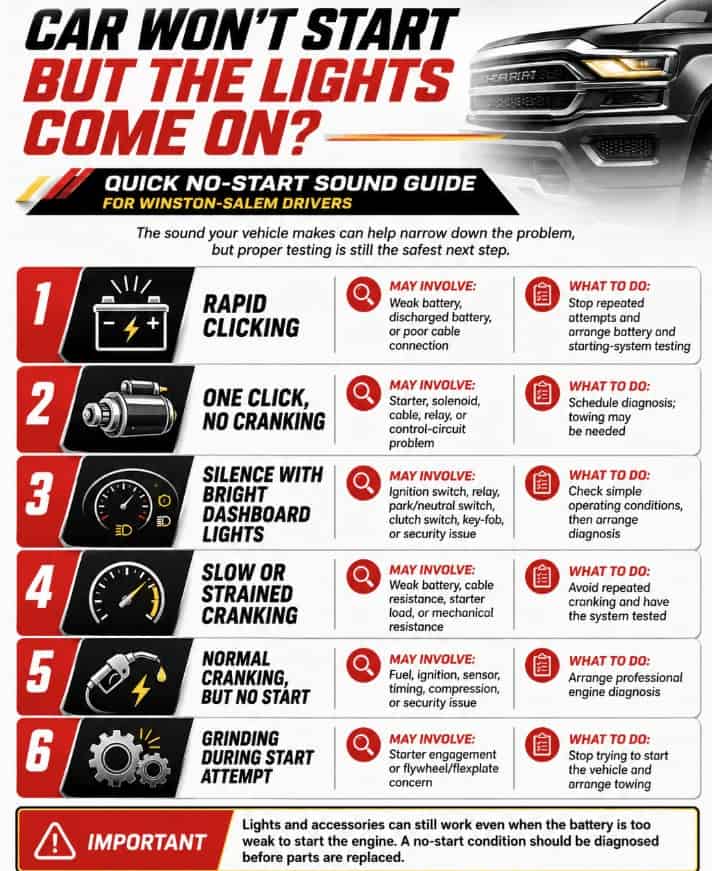
The table below helps separate the most common no-start patterns. These are diagnostic clues rather than confirmed diagnoses.
| What Happens | What It May Involve | Recommended Response |
|---|---|---|
| Rapid clicking and dimming lights | Weak battery, discharged battery or poor cable connection | Stop repeated attempts and arrange battery and starting-system testing |
| One click but no cranking | Starter, solenoid, cable, relay or control-circuit problem | Schedule diagnosis; towing may be needed |
| Silence with bright dashboard lights | Ignition switch, relay, park/neutral switch, clutch switch, key-fob or security issue | Check simple operating conditions, then arrange diagnosis |
| Slow or strained cranking | Weak battery, cable resistance, starter load or mechanical resistance | Avoid repeated cranking and have the system tested |
| Normal cranking without starting | Fuel, ignition, sensor, timing, compression or security issue | Arrange professional engine diagnosis |
| Grinding during a start attempt | Starter engagement or flywheel/flexplate concern | Stop trying to start the vehicle and arrange towing |
| Starts after a jump but later dies | Discharged battery, charging-system issue or poor connection | Have the battery and charging system tested |
| Starts only after several attempts | Developing battery, starter, relay, key, sensor or connection problem | Schedule service before the condition becomes permanent |
Can the Battery Be Bad if the Lights Still Work?
Yes. A battery can retain enough energy to power lights and accessories while failing to provide the larger amount of current required by the starter.
Possible battery-related clues include:
- Rapid clicking
- Slow cranking
- Headlights that become much dimmer during a start attempt
- A recent need for jump-starts
- Corrosion around the battery terminals
- Loose battery connections
- Intermittent electrical power
- A battery that repeatedly loses charge
A voltage reading by itself does not always establish whether the battery can perform under load. Professional evaluation may include:
- Visual inspection of the battery and cables
- State-of-charge testing
- Battery load or conductance testing
- Starting-voltage measurement
- Cable voltage-drop testing
- Starter-current evaluation
- Charging-system testing
- Parasitic-draw testing when the battery repeatedly becomes discharged
Interstate Batteries also advises drivers not to assume that a no-start vehicle automatically needs a new battery. A new battery can temporarily mask an underlying charging, electrical or starting-system problem. Read Interstate Batteries’ explanation of why a vehicle may not start even when the battery appears good.
Is It the Battery, Starter or Alternator?
These components perform different jobs, but their symptoms can overlap.
Battery
The battery supplies electrical energy before the engine is running.
Possible battery patterns include:
- Rapid clicking
- Slow cranking
- Dimming lights during cranking
- Needing a jump-start
- Electrical power that fades quickly
Starter
The starter converts battery power into the mechanical force needed to turn the engine.
Possible starter-related patterns include:
- One solid click
- Intermittent no-crank
- Silence despite working accessories
- Grinding during engagement
- Starting only after several attempts
A damaged cable, poor ground, relay fault or weak battery can imitate a starter failure. The starter should therefore be tested before replacement is recommended.
Alternator
The alternator supplies electrical power while the engine is running and helps recharge the battery.
The alternator does not perform the initial cranking. However, a charging-system failure can leave the battery too discharged to start the vehicle later.
Possible charging-system clues include:
- The battery warning light appearing while driving
- Headlights that fluctuate with engine speed
- A recently replaced battery becoming discharged again
- Electrical accessories behaving unpredictably
- A vehicle that starts after a jump but later loses power
- The engine stalling after electrical warning signs
The correct test may need to evaluate the battery, starting circuit and charging system together.
Call Carolina Auto Service at 336-765-8599 or request an appointment online. Repairs and diagnostics are completed at the Winston-Salem shop.
Why Does the Car Make Rapid Clicking Sounds?
Repeated clicking often means the starter solenoid is attempting to engage, but the available voltage drops too low to keep it engaged.
Possible causes include:
- A discharged battery
- A battery that cannot perform under load
- Loose battery terminals
- Corroded connections
- A damaged battery cable
- A poor engine or chassis ground
- Excessive resistance in the starter circuit
Rapid clicking should not automatically be treated as proof that the battery itself has failed. A poor connection may produce a similar result.
Repeatedly turning the key is unlikely to solve the cause. It may further discharge the battery and make later testing more difficult.
What Does One Solid Click Mean?
One click may mean that the starter solenoid received a start command but the starter did not turn the engine.
Potential causes include:
- A failing starter motor
- A starter solenoid fault
- Insufficient current from the battery
- Excessive resistance in a cable
- A damaged ground connection
- A starter relay or control-circuit fault
- Mechanical resistance preventing the engine from turning
The next step should be testing, not automatically replacing the starter.
What If There Is Complete Silence?
If the dashboard remains illuminated but the vehicle makes no sound during the start attempt, the problem may involve the command or authorization side of the system.
Possible causes include:
- The transmission is not recognized as being in Park or Neutral
- A manual-transmission clutch switch is not operating
- The brake-pedal switch is not authorizing a push-button start
- The key fob is not being detected
- The immobilizer is preventing startup
- The ignition switch or start button has failed
- A starter fuse or relay has failed
- Wiring or module communication has been interrupted
Before arranging service, make sure an automatic transmission is firmly in Park. Some vehicles may also start in Neutral when a transmission range switch is not correctly recognizing Park. Follow the vehicle owner’s manual rather than forcing the shifter or repeatedly cycling the ignition.
For a push-button-start vehicle, look for messages such as:
- Key not detected
- Press brake to start
- Shift to Park
- Steering lock active
- Immobilizer active
- Service starting system
A spare key or replacement key-fob battery may help when key detection is the issue, but a security warning can also require professional diagnosis.
What If the Engine Cranks but Never Starts?
If the engine turns at a normal speed, the battery and starter may be completing their basic roles. The no-start condition may instead involve fuel, ignition, timing, compression or electronic control.
Possible areas include:
- Fuel pump or fuel-pressure control
- Fuel injectors
- Ignition coils or spark control
- Crankshaft position sensor
- Camshaft position sensor
- Engine timing
- Airflow or intake sensing
- Immobilizer authorization
- Engine compression
- Wiring or module power supply
A scan tool may identify diagnostic trouble codes, but a code does not always name the failed component. It typically identifies a circuit, operating condition or system where the vehicle detected a problem.
Carolina Auto Service provides engine diagnostics and engine repair in Winston-Salem when a vehicle cranks but does not start, stalls, runs roughly or develops another engine-related concern.
Can You Safely Try a Jump-Start?
A jump-start may be appropriate when a discharged 12-volt battery is suspected, but the procedure must follow the instructions for the exact vehicle.
Connection points and procedures vary. Some vehicles use designated remote jump terminals rather than direct battery access. Hybrid and electric vehicles can also have vehicle-specific requirements.
Ford directs owners to the vehicle-specific owner’s manual for the correct jump-start procedure and connection sequence. Review Ford’s official jump-start guidance or the manual supplied by your vehicle manufacturer.
Before attempting a jump-start:
- Read the vehicle owner’s manual.
- Confirm that the batteries and equipment use the correct voltage.
- Do not jump a visibly swollen, leaking, frozen or damaged battery.
- Keep sparks and flames away from the battery.
- Use only the manufacturer-designated connection points.
- Do not improvise around high-voltage hybrid or electric components.
- Stop if you do not understand the required procedure.
A manufacturer technical bulletin available through NHTSA warns that using an incorrect booster or charger voltage can create a risk of vehicle damage, fire or explosion. See the NHTSA-hosted jump-start voltage bulletin.
If the vehicle starts after a jump, that does not prove that the battery is the only problem. The battery may have been discharged by an alternator fault, electrical draw, loose connection or another condition.
Should You Keep Driving After the Vehicle Starts?
That depends on why the vehicle initially failed.
A vehicle that starts after several attempts may not restart after it is turned off. A vehicle that required a jump may have a weak battery, poor connection, charging-system problem or electrical draw.
Schedule Service Soon If:
- The vehicle required a jump
- Cranking was noticeably slow
- Clicking occurred before it started
- The battery or charging warning light is illuminated
- The lights fluctuate while driving
- The problem has happened more than once
- You do not trust the vehicle to restart
Stop Driving and Arrange Towing If:
- The vehicle loses electrical power while moving
- The engine stalls and will not restart
- You smell burning wiring
- You see smoke
- Cables or battery connections become hot
- A serious charging-system warning appears with abnormal operation
- The steering, braking or another safety system is affected
Carolina Auto Service’s roadside-assistance information explains the towing, jump-start and related roadside benefits that may apply after qualifying service through the TECH-NET program. Coverage terms and eligibility should be confirmed for the specific customer and repair.
When Should You Stop Trying to Start the Car?
- Smoke
- A burning smell
- Hot or melting cables
- A swollen or leaking battery
- Grinding from the starter area
- A strong fuel smell
- Severe electrical flickering
- Rapid clicking that becomes weaker
- A heavy mechanical impact
- A warning telling you not to restart
- A hybrid or high-voltage warning
Repeated cranking can drain the battery, overheat the starter and complicate diagnosis.
If the car is stopped in an unsafe location, prioritize personal safety and contact appropriate roadside or towing assistance.
How Is a No-Start Condition Diagnosed?
A diagnostic-first process helps separate a failed component from several other problems that can create the same symptom.
-
Document the driver’s concern.
The technician reviews what happened, what sounds were heard, whether the vehicle was hot or cold, whether a jump was attempted and whether the problem is intermittent. -
Perform a preliminary inspection.
The battery, terminals, cables, grounds, fuses and visible starting-system components may be inspected. -
Separate no-crank from crank-no-start.
This determines whether testing should initially focus on the starting circuit or engine operation. -
Test battery condition and voltage behavior.
The battery may be checked for state of charge and performance under load. -
Test the starting circuit.
Depending on the symptom, this may include cable voltage-drop measurements, relay control, starter-current draw and command-signal testing. -
Test fuel, ignition and sensor operation when the engine cranks.
Scan data, fuel pressure, ignition activity, sensor signals and mechanical condition may be evaluated. -
Confirm the cause.
The technician determines whether the observed failure explains the customer’s complaint. -
Explain the recommended repair.
Findings and repair options are discussed before authorized work begins. -
Verify the result.
The vehicle is started repeatedly, affected systems are rechecked and a road test may be performed when appropriate.
This process matters because replacing a battery will not repair a failing starter circuit, and replacing a starter will not repair a security, fuel or engine-sensor problem.
What Information Should You Give the Repair Shop?
Specific details can help a technician reproduce an intermittent problem.
Tell the shop:
- Whether the engine turns over
- Whether you hear rapid clicks, one click, grinding or silence
- Whether the dashboard lights dim during the attempt
- Whether a jump-start works
- Whether the issue happens when the engine is hot or cold
- Whether the vehicle recently received a new battery
- Whether a battery or charging warning light appeared
- Whether the key-fob or security light behaved abnormally
- Whether the vehicle starts in Neutral but not Park
- Whether the engine stalled before the no-start
- Whether electrical accessories were left on
- Whether the condition began after another repair
A brief video showing the dashboard and sound may also help when the problem occurs only intermittently. Record only when it is safe to do so.
What Affects the Cost of a No-Start Repair?
The symptom alone is not enough to produce a reliable price.
Cost may depend on:
- Vehicle year, make and model
- Battery design and required registration or programming
- Starter location and accessibility
- Cable and ground condition
- Diagnostic time
- Electrical-circuit complexity
- Fuel or ignition testing needs
- Security-system programming
- Hybrid-system design
- Parts availability
- The confirmed failed component
- Additional damage discovered during testing
A corroded connection and a failed starter can produce similar symptoms while requiring very different repairs. Proper testing helps prevent unnecessary part replacement.
How Long Does No-Start Diagnosis or Repair Take?
The timeline depends on the cause.
A straightforward battery or connection problem may be identified differently from an intermittent wiring fault, security-system issue, inaccessible starter or crank-no-start engine condition.
Timing can also be affected by:
- Whether the symptom is currently present
- Vehicle design
- Required testing
- Access to the affected component
- Parts availability
- Programming needs
- Customer authorization
- Additional problems discovered during diagnosis
The shop should confirm the likely schedule after inspecting and testing the vehicle rather than promising a universal completion time.
Can You Reduce the Risk of Another No-Start?
Not every failure can be predicted, but several practices may reduce the risk of being stranded:
- Have slow cranking checked before the vehicle stops starting entirely.
- Investigate repeated jump-starts.
- Keep battery connections secure and free from excessive corrosion.
- Address battery and charging warning lights.
- Follow the vehicle manufacturer’s maintenance schedule.
- Mention intermittent starting delays during routine service.
- Avoid leaving lights and accessories operating with the engine off.
- Have unexplained overnight battery drain diagnosed.
- Replace a weak key-fob battery when detection warnings begin.
- Use the correct battery type and specification for the vehicle.
Winston-Salem summer heat can accelerate battery deterioration, while colder mornings may expose a battery that has already lost capacity. Battery condition should be evaluated based on test results rather than age alone.
Schedule No-Start Diagnostics in Winston-Salem, NC
When your car will not start but its lights work, avoid assuming that it only needs a battery or starter. Similar symptoms can involve multiple electrical, mechanical, fuel, ignition and security systems.
The shop’s posted operating hours are Monday through Friday from 7:30 a.m. to 5:30 p.m. After-hours vehicle drop-off is available, but the repair shop itself should not be described as operating 24/7.
Call 336-765-8599 or schedule your diagnostic appointment online.
Frequently Asked Questions
Can the Battery Be Dead if the Dashboard Lights Still Work?
Yes. Dashboard lights require much less electrical current than the starter. A weak or discharged battery may operate lights and accessories but lose voltage when the starter attempts to crank the engine. Battery performance, connection condition and starting-system voltage should be tested before a replacement is recommended.
Why Does My Car Click but Not Start?
Rapid clicking often involves low available battery power or a high-resistance electrical connection. One solid click may involve the starter, solenoid, battery cables, relay or ground. Because these symptoms overlap, the battery and entire starting circuit should be tested before replacing a component.
Does a Successful Jump-Start Prove the Battery Is Bad?
No. A jump-start only establishes that additional electrical power helped the vehicle start. The underlying issue may be a discharged battery, weak battery, poor connection, charging-system fault or electrical draw. The battery, cables and charging system should still be evaluated.
Why Does the Engine Crank Normally but Not Start?
If the engine cranks normally, the starter is turning it. The problem may instead involve fuel pressure, ignition, engine sensors, security authorization, timing, compression or control electronics. A technician may need scan data and component-specific tests to identify the actual cause.
Should I Replace the Starter if I Hear One Click?
Not without testing. One click can occur with a failed starter, but it can also result from insufficient battery current, a damaged cable, high circuit resistance, poor grounding or a relay problem. Testing should verify that the starter receives the correct voltage and command before replacement.
Can a Bad Alternator Cause a No-Start?
Yes, indirectly. The alternator supplies electrical power and recharges the battery while the engine runs. If the charging system is not working correctly, the battery can become too discharged to start the engine later. Battery and alternator testing may both be necessary.
Should I Keep Trying if the Vehicle Will Not Start?
Avoid repeated attempts if you hear grinding, smell burning, see smoke, notice hot cables or experience rapidly weakening clicks. Repeated cranking can drain the battery and overheat the starter. Arrange professional assistance or towing when the vehicle cannot be started safely.
Where Can I Get a No-Start Problem Diagnosed in Winston-Salem?
Carolina Auto Service performs in-shop automotive diagnostics at 160 Hanes Mall Circle in Winston-Salem. Call 336-765-8599 and explain whether the vehicle clicks, cranks, remains silent or required a jump-start. The shop can discuss scheduling and how to transport the vehicle for diagnosis.
Sources
- Carolina Auto Service – Auto Repair Services in Winston-Salem
- Carolina Auto Service – Engine Repair in Winston-Salem
- Carolina Auto Service – Roadside Assistance Information
- AAA Automotive – 14 Reasons Why Your Car Won’t Start
- Interstate Batteries – Why a Car May Not Start Even When the Battery Seems Good
- Ford Motor Company – Official Vehicle Jump-Start Guidance
- National Highway Traffic Safety Administration – Jump-Starting Voltage Safety Bulletin