
How to Choose an Auto Repair Shop in Winston-Salem
If your search is “choose auto repair shop” because of a warning light, noise, vibration, leak, overheating concern, brake issue, shifting problem, A/C trouble, or routine maintenance, compare the shop’s process before you compare promises. A good conversation should cover diagnosis, communication, a written estimate, customer approval, technician qualifications, hours, drop-off details, and warranty terms. A symptom or code is a clue, not a diagnosis, so the right shop should explain what still needs inspection or testing before recommending a repair.
Quick Answer: Choose a shop that explains how it will diagnose the concern, provides a written repair estimate, contacts you before additional authorized work, and clearly explains qualifications and warranty terms. Ask whether recommendations come from testing, your manufacturer maintenance schedule, an observed condition, or preventive advice. Compare documentation and communication instead of relying only on an advertised low price, a ranking claim, or a guess about one failed part.
What does “choose auto repair shop” mean in practice?
The most useful way to compare repair shops is to look at how each shop handles uncertainty. If the check engine light is on, the brakes sound different, the vehicle is overheating, or a vibration appears only at certain speeds, the shop should not jump straight to a part without first understanding the conditions. Ask what the inspection is meant to confirm, what possible causes are being considered, and how you will hear the findings.
The FTC’s Auto Repair Basics guidance advises drivers to ask for recommendations from people they trust, look for a repair shop before they need one, shop around by phone and online, compare warranty policies, and make sure the shop will honor the vehicle’s warranty. That guidance supports a practical approach: compare how shops communicate, document, and stand behind qualifying work.
For a local driver, the choice often starts with a real concern: a warning light before work, a leak in the driveway, a grinding noise, warm air from the vents, a van due for maintenance, or a fleet vehicle that cannot afford repeated guesswork. Those situations call for an independent repair shop that can explain the difference between confirmed repairs, maintenance recommendations, and items that need more testing.
Carolina Auto Service is an in-shop repair facility near Hanes Mall, and its current site describes a process built around inspection, explanation of findings, an upfront estimate, and customer approval before authorized repairs begin. That is not a claim that every concern has the same answer. It is a process for moving from a symptom to a documented recommendation.
What should a repair shop do before recommending a repair?
A repair recommendation should start with your description of the problem. Tell the shop when the concern began, whether it is constant or intermittent, whether the vehicle was cold or fully warmed up, whether it happens at idle or at road speed, and whether it changes while braking, turning, accelerating, shifting, or running the A/C. Those details can help guide testing without turning your description into a diagnosis.
A dashboard light, stored trouble code, noise, smell, leak, or maintenance reminder may indicate several possible issues. A code can point the shop toward a system or circuit, but it does not prove that one part has failed. A puddle, a vibration, or a brake noise can also have more than one cause. The shop should be willing to explain what it will inspect or test and what findings would confirm or rule out likely causes.
Useful repair shop questions at this stage include:
- What information do you need from me before diagnosis begins?
- Is the first authorization for inspection, testing, repair, or all of those?
- What systems will be checked based on this symptom?
- What findings would confirm the recommendation?
- What remains uncertain until the vehicle is inspected in person?
- Will you separate urgent concerns from maintenance that can be planned later?
This is where diagnosis before assumptions matters. For example, a vehicle that runs rough with a warning light needs testing before anyone can say whether the concern is ignition, fuel, air, emissions, mechanical, sensor-related, wiring-related, or something else. A vehicle that overheats may need cooling-system testing before a shop can separate a coolant leak, airflow issue, thermostat concern, fan issue, water-pump concern, or other possible cause.
When comparing shops, listen for plain explanations rather than certainty too early. “We will test it and explain what we find” is different from “it is definitely this part” before inspection. The first answer respects the fact that the vehicle has to be evaluated; the second may be a guess.
Repair shop questions that show whether communication is clear
Clear communication is not just being friendly at the counter. It means the shop can explain the concern, the findings, the recommendation, the estimate, and the approval process in a way you can follow. Good repair shop questions help you learn whether a shop is organized before your vehicle is already apart.
Ask these repair shop questions when comparing options:
- What did the inspection or testing show?
- Which recommendation is urgent, and which can be scheduled?
- Which recommendation follows the manufacturer maintenance schedule?
- Which recommendation is based on observed wear, leakage, measurement, or test results?
- What happens if testing does not confirm the suspected cause?
- Will I receive findings, an estimate, or recommendations in writing?
- Who will contact me if the scope changes?
- How do you document a declined recommendation?
These repair shop questions are helpful for everyday cars, SUVs, light trucks, vans, hybrids, and business vehicles. They are especially useful when the concern is intermittent. If a noise happens only on cold starts, a vibration appears only under acceleration, or an A/C concern changes with outside temperature, the shop may need your notes to reproduce the condition.
Communication should also include what the shop does not yet know. If a first test points to one system but further inspection is needed, the shop should explain that step instead of presenting uncertainty as a finished answer. That kind of conversation helps you decide whether to approve more testing, approve a repair, or pause and ask more questions.
| What you notice | What to tell the shop | Why it matters |
|---|---|---|
| Warning light or message | Which light, whether it is flashing or steady, and when it appeared | A warning light is a clue that helps guide diagnosis, not a final answer |
| Noise or vibration | Speed, road condition, braking, turning, acceleration, and whether it is constant | Conditions can help narrow the system that needs inspection |
| Leak, smell, smoke, or heat | Color, location, timing, temperature gauge behavior, and any warning lights | Some symptoms may require stopping instead of continuing to drive |
| Maintenance reminder | Mileage, service history, owner’s manual information, and prior recommendations | Maintenance should be compared with the manufacturer schedule and vehicle history |
What a written repair estimate should include
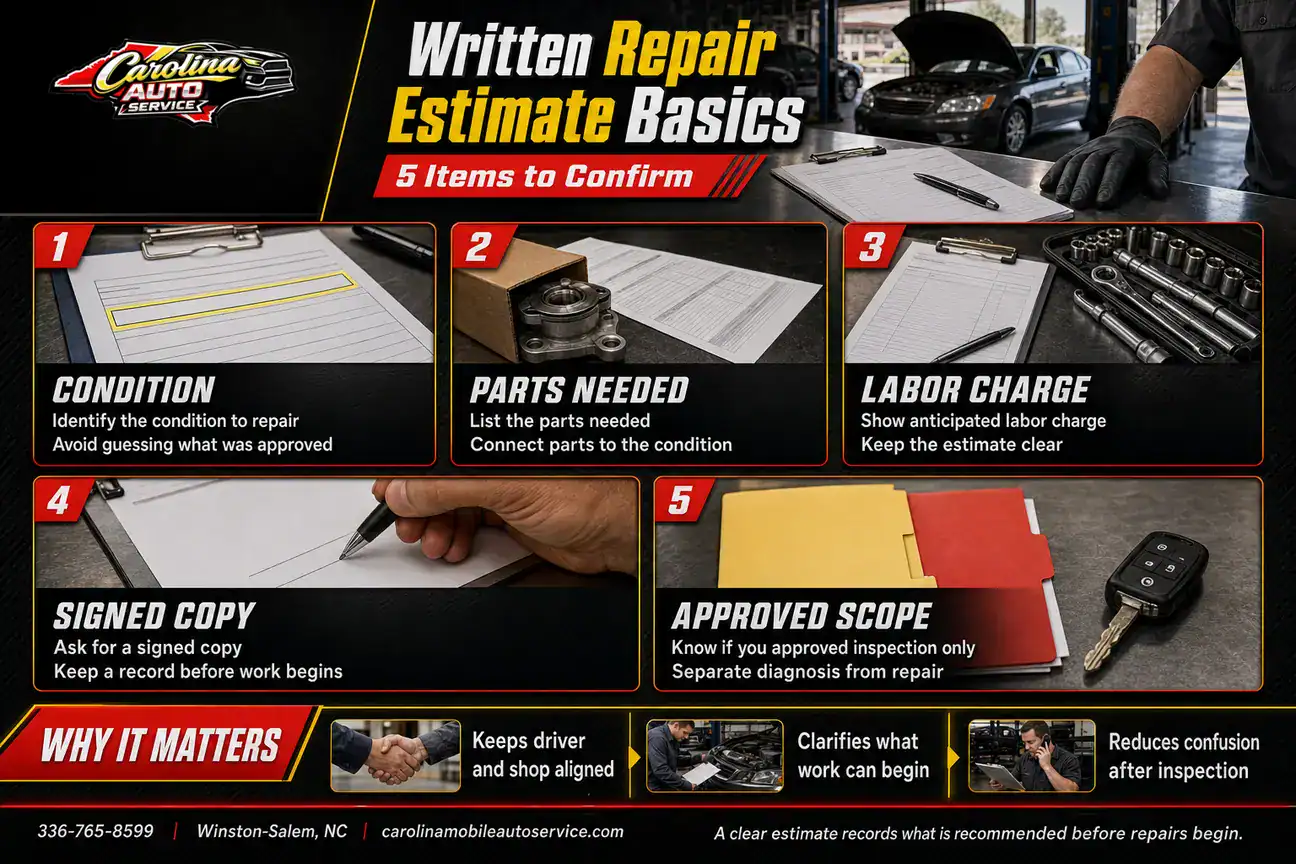
A written repair estimate gives you a record of what is being recommended before work begins. The FTC says that if you decide to get the work done, you should ask for a written estimate, and that the estimate should identify the condition to be repaired, the parts needed, and the anticipated labor charge. The same guidance advises drivers to get a signed copy.
When comparing shops, a written repair estimate should help you understand what is being authorized. It should not leave you guessing whether you approved inspection only, diagnosis plus repair, or every possible item the shop might find later. The clearer the document is, the easier it is for both you and the shop to stay aligned.
Helpful questions about a written repair estimate include:
- Does the estimate separate diagnosis from repair?
- Does it identify the condition being repaired?
- Does it list parts, labor, and other charges clearly enough to understand?
- Does it distinguish required repair from maintenance recommendations?
- Does it note anything that remains uncertain until further testing or disassembly?
- Will the shop contact me before work exceeds the authorized scope?
- Will I receive a revised written repair estimate if the recommendation changes?
Drivers can also review North Carolina’s written-estimate statute directly when they want to understand state-specific repair-estimate language. For a blog article like this, the safer takeaway is practical: ask what document you will receive, what it authorizes, and how approval will be handled if the scope changes.
A written repair estimate is also useful if you are comparing an independent repair shop with another option. It lets you compare the scope of work rather than just comparing totals. Two estimates can look different because one includes diagnosis, one assumes a part without testing, one includes related parts or fluids, or one separates urgent repair from maintenance.
How an independent repair shop should explain maintenance recommendations
Maintenance recommendations should begin with your vehicle, not a universal interval. The owner’s manual and manufacturer maintenance schedule are the starting points because service needs vary by make, model, engine, hybrid system, mileage, age, use pattern, and prior maintenance. A commuter car, a light truck, a van, a hybrid, and a business vehicle may not all need the same conversation.
The FuelEconomy.gov maintenance guidance directs drivers to keep vehicles properly tuned and follow the maintenance schedule in the owner’s manual. That supports a simple rule when comparing shops: ask whether a recommendation comes from the manufacturer schedule, from an observed condition, from test results, or from preventive advice.
An independent repair shop should be able to separate those categories. Scheduled maintenance may be based on mileage, time, operating conditions, or manufacturer guidance. Condition-based maintenance may come from inspection findings such as fluid condition, visible wear, leakage, or measurements. Repair may be recommended because testing confirmed a fault. Preventive advice may be reasonable, but it should be labeled as advice rather than presented as a confirmed failure.
Use these repair shop questions when the topic is maintenance:
- Is this recommendation in my owner’s manual or manufacturer maintenance schedule?
- Is it based on mileage, time, condition, or test results?
- What did you inspect that supports the recommendation?
- Is this urgent, upcoming, or optional preventive maintenance?
- How does my driving pattern affect the recommendation?
- What happens if I schedule this later?
An independent repair shop should also be willing to look at service history. If a timing belt, fluid service, oil change, cooling-system service, or other maintenance item was done recently, the recommendation may need to account for that record. If records are missing, the shop should say so rather than assume a service has or has not been done.
For business vehicles, maintenance planning has another layer. Downtime matters, but guessing can create repeated visits. A shop that handles fleet maintenance should still explain what is scheduled maintenance, what is inspection-based, and what has been confirmed by testing. The same principle applies: maintenance recommendations should be tied to evidence, schedule, and vehicle use.
What should you ask about technician qualifications?
Technician qualifications matter, but they should be discussed carefully and honestly. Ask what qualifications, training, or experience are relevant to your vehicle and concern. A hybrid warning, brake concern, drivability issue, A/C problem, transmission symptom, or cooling-system problem may call for different diagnostic steps.
Carolina Auto Service’s site uses the phrase ASE-certified technicians. That wording is specific enough to be helpful without overstating individual credentials, naming unverified certifications, or claiming that every person holds the same certification. When comparing any shop, the practical question is not just “Are you qualified?” but “What experience or diagnostic process applies to this vehicle and symptom?”
For hybrids, ask how high-voltage concerns are handled. Do not attempt high-voltage diagnosis or repair yourself. If a serious hybrid electrical warning appears, treat it as a safety concern and arrange proper help rather than opening covers, probing wiring, or following online shortcuts. A repair shop should be able to explain the safe path without giving you unsafe do-it-yourself instructions.
It is also fair to ask whether the shop commonly works with your type of vehicle. Carolina Auto Service’s current information states that its in-shop work includes domestic, import, and hybrid cars, SUVs, light trucks, vans, and fleet vehicles. That does not mean every possible repair is available for every vehicle; it means you can ask whether your concern fits the shop’s confirmed services before booking.
How approval policies protect the customer
An inspection or diagnostic visit is not the same thing as authorizing every repair the shop might find. Approval policies matter because the scope can change after testing, disassembly, or closer inspection. A clear shop should explain what you are authorizing first and when it will contact you again.
Before you leave the vehicle, ask:
- Am I authorizing inspection, diagnosis, repair, or a specific amount of work?
- Will you contact me before additional work is performed?
- How will you explain findings if the suspected cause is not confirmed?
- Will I receive the approved estimate and final invoice?
- How will declined recommendations be documented?
- If more than one issue is found, how will you prioritize safety, drivability, and maintenance?
A repair shop that communicates well should not treat approval as a formality. The approval conversation is where you learn what the shop found, what it recommends, what it costs, what is urgent, and what can wait. It also gives you a chance to ask whether a written repair estimate needs to be revised before the work continues.
At Carolina Auto Service, the client-confirmed process includes inspection, explanation of findings, an upfront estimate, and customer approval before authorized repairs begin. That process is useful for drivers who want an independent repair shop to explain the evidence before repairs are approved.
What should you compare about hours, drop-off, and appointments?
Logistics can affect your choice almost as much as the repair itself. Ask each shop about weekday hours, how appointment requests are confirmed, how vehicle drop-off works, and whether any transportation option depends on scheduling or service area. Clear logistics help prevent a repair visit from becoming confusing before diagnosis even starts.
Carolina Auto Service is located at 160 Hanes Mall Circle in Winston-Salem, NC 27103. Current shop hours are Monday-Friday, 7:30 a.m.-5:30 p.m.; closed Saturday and Sunday. Vehicle drop-off outside business hours is available, but that does not mean the shop is open or performing repairs around the clock. Appointment requests are not confirmed until the shop contacts the customer or confirms a time.
If you are comparing shops from Winston-Salem or Forsyth County, ask how the shop wants you to leave the key, what information to include with the vehicle, and who will call with findings. If a shuttle is discussed, ask whether it is available for your appointment based on scheduling and service-area requirements.
When you are ready to discuss a concern, you can request an appointment and describe the symptom, when it happens, the vehicle information, mileage, and warning lights. You can also call 336-765-8599 during weekday business hours; the shop confirms the appointment time.
What to ask about an auto repair warranty
An auto repair warranty should be compared before work is approved, not after a problem appears. The FTC’s warranty guidance explains that warranty terms can differ, so drivers should understand what is covered and get coverage details in writing. The FTC also notes in its repair guidance that there is no “standard warranty” on repairs.
Helpful auto repair warranty questions include:
- What parts and labor are covered?
- What time and mileage limits apply?
- Which repairs qualify?
- What exclusions or maintenance requirements apply?
- Where can warranty work be performed?
- Are there claim procedures, documentation requirements, or reimbursement steps?
- What happens if the symptom returns but the cause is different?
Carolina Auto Service states a nationwide limited 24-month/24,000-mile parts and labor warranty, whichever comes first, on qualifying repairs. Ask about terms, qualifying repairs, exclusions, and procedures before approving work. You can review the warranty on qualifying repairs for more details, but do not assume every repair, maintenance item, or situation is covered.
An auto repair warranty is not a substitute for diagnosis. A warranty tells you how qualifying repairs are handled after the work is done; it does not prove which repair is needed today. That is why the estimate, testing, approval, and warranty conversation should all fit together.
How to prepare before you book service
Preparation helps the shop spend less time guessing about the symptom and more time testing the right systems. You do not need to diagnose the vehicle yourself. You only need to bring the facts you noticed.
Before calling or requesting service, write down:
- The exact symptom, sound, smell, light, leak, vibration, or performance change
- When it happens: cold start, idle, highway speed, braking, turning, shifting, or A/C use
- Whether it is constant, intermittent, getting worse, or recently changed
- Any dashboard warning lights or messages
- The vehicle’s year, make, model, mileage, and relevant powertrain information
- Recent repair or maintenance history
- Whether the concern affects braking, steering, temperature, fuel smell, smoke, oil pressure, or hybrid electrical warnings
If you have a code from a scan tool or parts-store printout, bring it, but treat it as information rather than a diagnosis. A code can help guide testing, but inspection confirms what the vehicle needs. The same is true of photos of leaks, warning lights, or messages: useful evidence, not final proof.
When should you stop driving instead of comparing shops?
Some symptoms call for safety first, not more comparison shopping. Do not keep driving just to reach a repair shop if the vehicle has reduced braking, suspected brake failure, loss of steering control, severe overheating, steam, major coolant loss, a low oil-pressure warning, fuel smell, suspected fuel leak, smoke, signs of an electrical or mechanical fire, a flashing warning light with severe drivability symptoms, or a serious hybrid high-voltage warning.
In those situations, stop in a safe place and arrange towing or roadside assistance. Do not open a hot radiator cap, do not work under a vehicle supported only by a jack, do not handle refrigerant, and do not attempt hybrid high-voltage work. No article can state that a vehicle is safe to drive without an in-person inspection.
If a roadside assistance program may apply to qualifying service, ask about terms separately. That type of program is not the same as shop-operated towing or roadside repair.
Questions to ask before choosing an auto repair shop
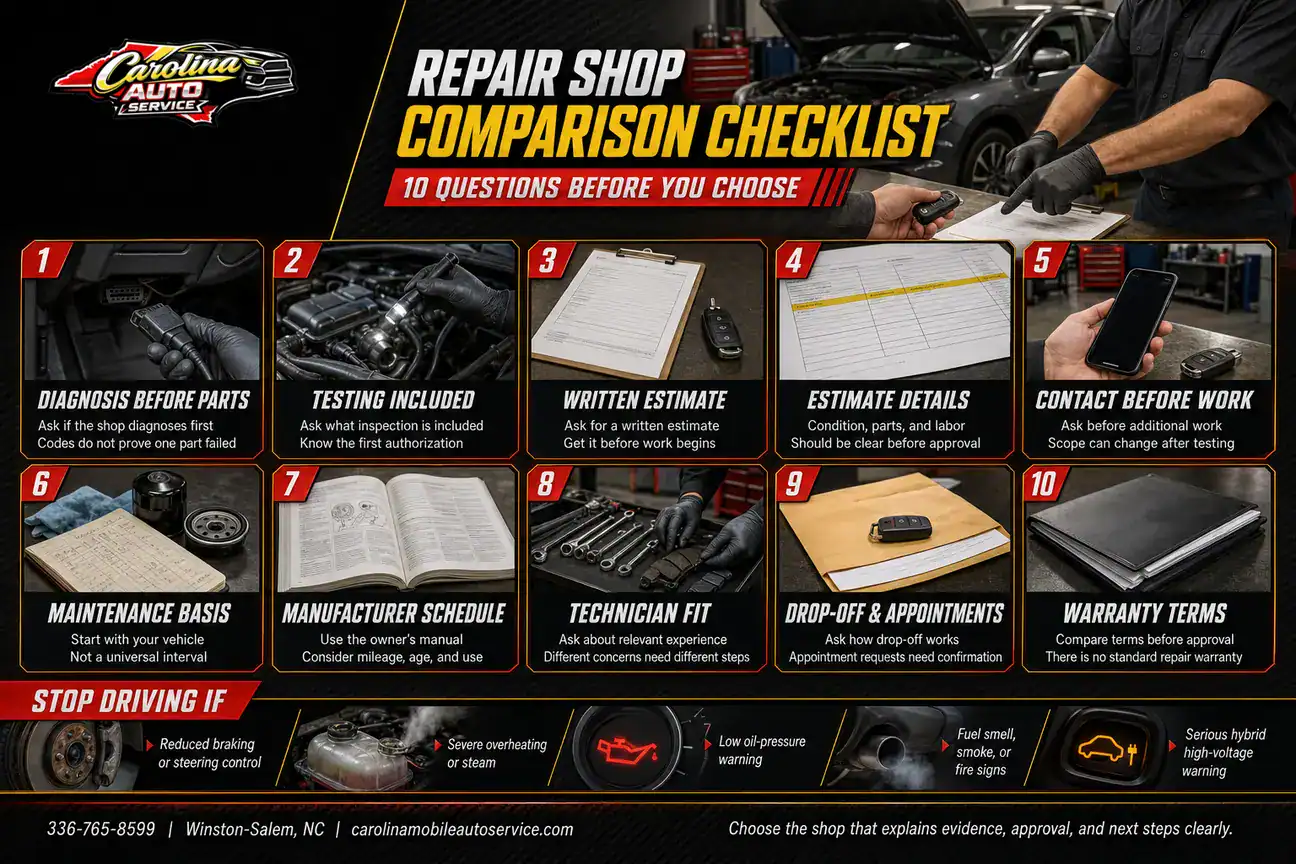
Use this checklist when comparing shops. You can copy it into a note before calling, or use it when reviewing an estimate.
- Do you diagnose before recommending a part?
- What testing or inspection is included in the first authorization?
- Will I receive a written repair estimate?
- Does the estimate identify the condition, parts, and anticipated labor?
- Will you contact me before additional work is performed?
- How are maintenance recommendations determined?
- Are recommendations based on the manufacturer maintenance schedule, inspection findings, or preventive advice?
- What technician qualifications are relevant to this vehicle or repair?
- What hours, drop-off options, and appointment-confirmation steps apply?
- What auto repair warranty applies to this specific repair?
- Which repairs qualify, and what exclusions or procedures apply?
- Will I receive the final invoice and documentation of declined recommendations?
These repair shop questions are useful because they keep the conversation focused on evidence. A clear shop should be able to explain what it knows, what it needs to test, what the written repair estimate covers, and how approval works before repairs begin.
How Carolina Auto Service fits this comparison
Carolina Auto Service is an independent repair shop with an in-shop facility near Hanes Mall. Its confirmed services include diagnostics, brake service, engine repair and diagnostics, cooling-system repair, transmission repair, drivetrain repair, hybrid service, A/C repair, oil changes, timing belts, water pumps, and fleet maintenance. You can review our repair services to see whether your concern fits the shop’s confirmed offerings.
The shop’s current information emphasizes diagnosis before assumptions, explanation of findings, an upfront estimate, and customer approval before authorized repairs begin. The site also states that the shop has ASE-certified technicians. Those are process and qualification facts, not ranking claims. Carolina Auto Service should not be described as the cheapest, the best, dealer-authorized, or available for every possible repair.
If you want to learn more about the shop before booking, you can read about Carolina Auto Service or check shop hours and directions. If you request an appointment, include the symptom, when it occurs, any warning lights, your mileage, and recent service history so the conversation starts with useful information.
Final thoughts before you decide
For a search like “choose auto repair shop,” the useful answer is to compare the process: how the shop listens, how it diagnoses, how it documents findings, how it builds a written repair estimate, how it gets approval, and how it explains any auto repair warranty. The goal is not to find the loudest promise. The goal is to find a shop that can move from symptom to evidence to recommendation without skipping the important steps.
For everyday drivers, commuters, high-mileage owners, hybrid owners, and business vehicles, the same rule applies: ask better questions before authorizing work. If the shop can explain what it knows, what it still needs to inspect, what the estimate covers, and what qualifies under warranty terms, you can make a more informed decision.
General educational information, not a diagnosis. Only an in-person inspection can confirm what a vehicle needs.
Frequently Asked Questions
What should I ask before choosing an auto repair shop?
Ask how the shop will diagnose the concern, what the written estimate includes, when customer approval is required, which technician qualifications apply, and what warranty terms cover the proposed repair. Also ask whether recommendations are based on testing, the manufacturer maintenance schedule, inspection findings, or preventive advice.
Should a repair shop provide a written estimate?
Consumer guidance advises drivers to ask for a written estimate before authorizing repair work. A useful estimate should identify the condition being repaired, parts needed, and anticipated labor charge, and it should make the approval process clear if the scope changes.
Is a dashboard warning light a diagnosis?
No. A warning light or trouble code is a clue that may be associated with several possible causes. Inspection and testing are needed to confirm what the vehicle needs before a repair recommendation is treated as confirmed.
How can I tell whether a maintenance recommendation is necessary?
Ask whether the recommendation comes from the manufacturer maintenance schedule, an observed condition, test results, or preventive advice. Compare it with the owner’s manual and maintenance history rather than applying one universal interval to every vehicle.
What should I ask about an auto repair warranty?
Ask what parts and labor are covered, the time and mileage limits, which repairs qualify, exclusions, claim procedures, and whether any special steps are required. Warranty terms differ, so get the details in writing before approving work.
Does Carolina Auto Service require approval before repairs?
Carolina Auto Service’s current information states that the shop provides inspection findings and an estimate and obtains customer approval before authorized repairs begin. Ask how approval and additional-work communication will apply to your specific visit.
Does Carolina Auto Service work on hybrid vehicles?
Hybrid service is a confirmed service category at Carolina Auto Service. Drivers with serious hybrid high-voltage warnings should stop in a safe place and arrange proper help rather than attempting high-voltage diagnosis or repair themselves.