
Forsyth County inspection: Essential 90-Day Safe NC Guide
Quick Answer: For a typical vehicle registered in Forsyth County, a Forsyth County inspection generally means an annual North Carolina safety inspection plus an emissions inspection performed during the same visit, unless an exemption applies. The state inspection is tied to registration renewal and may be completed no more than 90 days before the license plate and registration expire. If the inspection requirements are not completed, registration renewal is blocked until those requirements are satisfied. If your check engine light is on before renewal, use current NCDMV guidance, use a licensed inspection station for the official inspection, and have the warning light diagnosed before returning for inspection.
If you are trying to renew a vehicle registration, the most important first step is to check the renewal date, the county where the vehicle is registered, and the current North Carolina Division of Motor Vehicles guidance. Inspection rules can change, and exemptions depend on details such as model year, mileage, fuel type, plate classification, and registration status. NCDMV’s Vehicle Emissions & Safety Inspections overview is a good starting point before renewal.
How do official Forsyth County inspection rules apply?
A vehicle registered in Forsyth County is generally treated differently from a vehicle registered in a county that does not require emissions testing. NCDMV lists Forsyth County among the emissions counties, so many vehicles registered there need both the safety portion and the emissions portion of the annual inspection. The emissions portion is usually performed at the same time as the safety inspection, not as a separate annual appointment.
That said, “generally” matters. The exact answer can change if the vehicle is newer, older, diesel-operated, registered as a farm vehicle, registered with an antique plate, or otherwise fits a state-listed category. If your vehicle is close to an exemption line, check current NCDMV information before assuming the inspection requirement.
Carolina Auto Service’s confirmed role is repair and diagnostics, including warning-light diagnosis. Carolina Auto Service is not confirmed here as an NC safety or emissions inspection provider. For the official state inspection, use a licensed inspection station and current NCDMV guidance.
What state inspections are meant to do
North Carolina inspection rules are connected to registration, not to a repair shop’s opinion about whether a vehicle “seems fine.” A safety inspection evaluates listed safety-related systems and components. An emissions inspection evaluates emissions-related onboard diagnostic information for vehicles that are subject to the program. A repair diagnosis is different: it looks for the cause of a symptom, warning light, code, noise, leak, or drivability concern.
That distinction matters because a warning light is a clue, not a diagnosis. A code may point toward a system that needs testing, but it does not prove which part has failed. Replacing a guessed part, clearing codes, or disconnecting a battery is not a reliable way to solve an inspection concern and can make diagnostic information harder to interpret.
The state’s inspection result is official only when performed by a licensed inspection station. NCDMV explains safety and emissions requirements on its current inspection pages, including the NCDMV vehicle safety inspection page and the NCDMV emissions inspections page. Carolina Auto Service can help with diagnosis and repair concerns; for the official inspection location, use NCDMV’s Vehicle Inspection Stations locator.
Source-access and update context: state inspection pages are the authority for renewal rules, but the rules, county lists, exemptions, and waiver procedures may change. Before you plan around a deadline, check the current NCDMV and NC DEQ pages rather than relying on memory from a previous renewal.
NC emissions inspection and Forsyth County status
Forsyth County is listed by NCDMV as one of North Carolina’s emissions counties. That means a vehicle registered there generally must pass an emissions inspection in addition to the annual safety inspection unless an exemption applies. The NCDMV emissions inspections page identifies Forsyth County among the counties where the emissions requirement applies and explains broad exemption and waiver concepts.
An NC emissions inspection uses the vehicle’s onboard diagnostic information. On many modern vehicles, the onboard system monitors emissions-related performance and readiness. If a vehicle has an emissions-related concern, the inspection result may point the owner toward diagnosis and repair, but the failed result still does not identify the exact repair by itself.
Drivers sometimes assume the emissions program is the same in every county. It is not. County registration location matters, and requirements may change. If you recently moved, changed the registration address, purchased a vehicle, transferred plates, or inherited a vehicle, use current state guidance instead of relying on what applied to a different county or an earlier year.
The North Carolina Department of Environmental Quality also maintains information on the state inspection and maintenance program through the NC DEQ Inspection and Maintenance Program page. For drivers, the practical takeaway is simple: confirm the current county requirement before renewal, and do not assume that a past inspection pattern applies to a newly registered vehicle.
If someone tells you an NC emissions inspection is only about a tailpipe test, check current state guidance. For many vehicles, onboard diagnostic information and readiness status are central to the emissions portion. That is why a warning light, recently cleared code, or incomplete readiness monitor can matter before renewal.
Safety inspection requirements before registration renewal
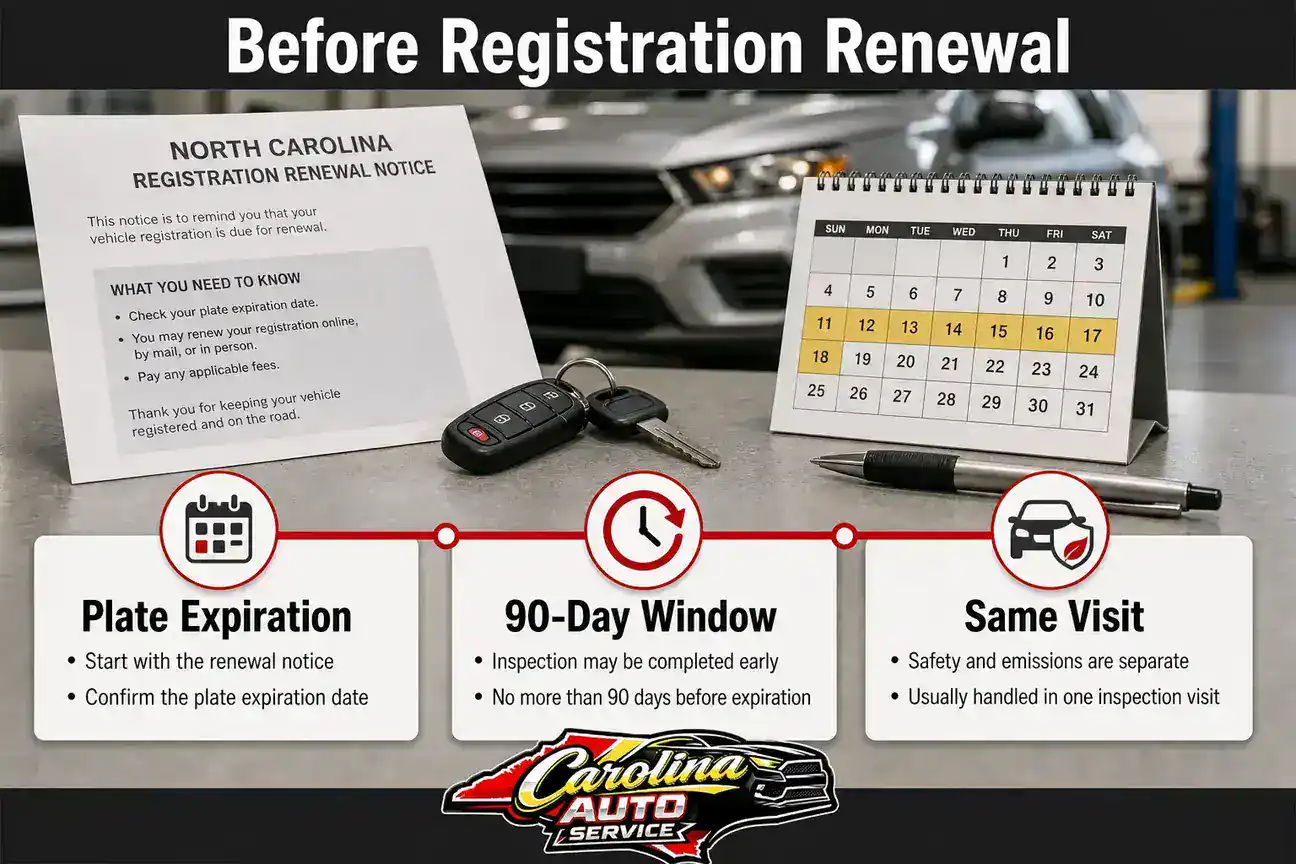
North Carolina requires a registered motor vehicle to pass the annual safety inspection before registration renewal. NCDMV states that the inspection may be completed no more than 90 days before the license plate and registration expire. The NCDMV vehicle safety inspection page is the primary source for safety inspection requirements, timing, listed components, and broad safety-exemption language.
Safety inspection requirements are separate from the emissions test. In a county subject to emissions inspection, the two are normally handled during the same inspection visit, but they evaluate different things. A vehicle may have a concern that affects one part, both parts, or neither part of the state inspection. Only the official inspection result can determine the pass or fail outcome.
For day-to-day drivers, the 90-day window is important. Waiting until the last days before renewal can leave less time for diagnosis, repairs, parts availability, and reinspection if the vehicle does not pass. That does not mean every vehicle needs repair before inspection. It means a known warning light, braking symptom, steering symptom, overheating concern, or obvious equipment problem is better addressed before the deadline becomes urgent.
Because safety inspection requirements involve listed safety items, do not treat a serious brake, steering, lighting, tire, wiper, or exhaust concern as paperwork only. The registration deadline matters, but the immediate question is whether the symptom suggests a risk that should be handled before more driving.
What does the safety portion check?
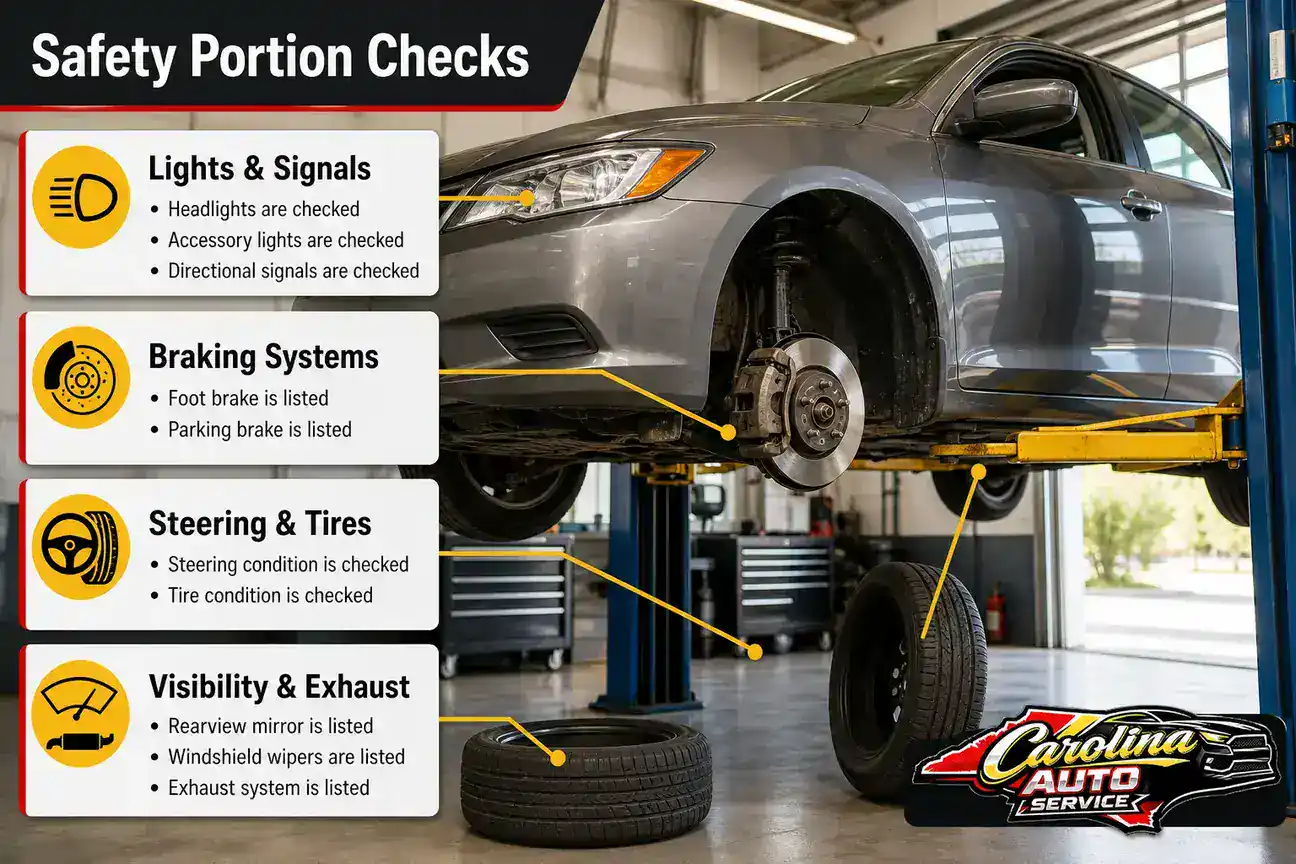
NCDMV identifies safety-inspection areas that include lighting, signals, brakes, steering, tires, horn, rearview mirror, windshield wipers, exhaust system, and emission-control components. Those categories are broader than many drivers expect. A vehicle can run well and still have a safety item that needs attention before it passes.
Here is a plain-language look at the kinds of items involved in the safety portion:
- Lights and signals: Headlights, accessory lights, and directional signals are checked as part of visibility and communication with other drivers.
- Braking systems: The foot brake and parking brake are listed safety-inspection items.
- Steering and tires: Steering condition and tire condition are part of the safety review.
- Driver visibility and warning equipment: Horn, mirror, and windshield wipers are among the listed items.
- Exhaust and emissions-control components: These items are included in the safety-inspection list even though they may also relate to emissions concerns.
A noise, vibration, warning light, leak, or drivability issue can be associated with a system that should be checked, but it does not automatically determine the inspection result. For example, a steering complaint, a braking concern, or overheating may need repair attention regardless of whether the vehicle is currently inside the registration-renewal window.
Carolina Auto Service’s auto repair services can help with repair and diagnostic concerns at the shop. If the issue involves the official inspection result, rely on the licensed inspection station’s paperwork and current state guidance for the next step.
Which vehicles may be exempt from part of the inspection?
Exemptions are where drivers often get tripped up. A vehicle can be exempt from emissions inspection but still need safety inspection. Another vehicle can be exempt from annual safety inspection because of age. Antique plate status can matter. The details should be confirmed through current NCDMV guidance because a broad category is not the same as a final decision for a specific vehicle.
Use this table as a starting point, not as a final ruling:
| Broad category | Potential inspection effect | Important qualification |
|---|---|---|
| Some light-duty vehicles less than three years old or with fewer than 70,000 miles | Emissions exemption may apply | NCDMV qualifies this category with “some,” so verify the exact vehicle status |
| Vehicles 20 years old or older | Emissions exemption may apply | Safety inspection may still apply unless another exemption fits |
| Diesel-operated vehicles | Emissions exemption may apply | Fuel type and registration details still matter |
| Vehicles registered as farm vehicles | Emissions exemption may apply | Plate and registration classification should be confirmed |
| Vehicles more than 30 years old | Annual safety inspection exemption may apply | Confirm current state wording and vehicle classification |
| Vehicles 30 years old or older with an antique automobile license plate | Both annual safety and emissions exemptions may apply | Antique plate status is part of the state-listed category |
For a Winston-Salem driver renewing a daily-use vehicle, the common question is usually whether the car needs both parts. In many cases, the answer is yes for vehicles registered in Forsyth County. But the table shows why it is worth checking before making plans based only on the vehicle’s age or mileage.
An exemption can also change how you think about an NC emissions inspection. If the vehicle is exempt from emissions but not from safety, the driver still needs to pay attention to safety inspection requirements and any symptoms that could affect the safety portion.
Inspection waiver NC: what can a waiver do?
The phrase inspection waiver NC can be confusing because a waiver is not the same thing as an exemption. An exemption means the vehicle is not required to complete a particular inspection portion because it falls into a state-listed category. A waiver is a conditional path that may apply after a vehicle fails the emissions analysis and meets the state’s repair, documentation, safety, and reinspection conditions.
NCDMV describes the waiver process as conditional. A vehicle may be eligible for an emissions repair waiver when it passes the safety inspection, fails the emissions analysis, has at least $200 in documented emissions-related repairs performed to correct the cause of the failure, is reinspected, again passes safety, and again fails the onboard diagnostic analysis. The owner must then bring the vehicle and supporting documentation to the N.C. State Highway Patrol Investigative Services Unit for the state documentation and waiver-review step.
The most important limit is clear: a waiver cannot be issued for the failure of a safety item. All safety items must pass. If the vehicle has a failed brake, steering, lighting, tire, wiper, mirror, exhaust, or other listed safety item, the inspection waiver NC process is not a shortcut around the safety problem.
Drivers should also avoid assuming a waiver will be granted. The state uses conditional language, and documentation matters. If you are dealing with an emissions failure and wondering about inspection waiver NC, read the current NCDMV emissions page and ask the official inspection station or state contact about the current process.
A practical way to think about inspection waiver NC questions is this: first separate the safety result from the emissions result, then keep paperwork from the inspection station and any repair documentation. The waiver path is for a qualifying emissions situation, not for avoiding safety inspection requirements.
Inspection failure: what happens next?
An inspection failure does not automatically tell you the repair. It tells you the vehicle did not meet the inspection requirement that was tested. The next step depends on whether the failure involved a safety item, the emissions analysis, or both.
For a safety inspection failure, the failed safety item must be corrected and the vehicle must obtain the required passing result. A waiver cannot be used for a failed safety item. If the failed item is also a serious driving symptom, such as reduced braking or steering loss, treat it as a safety concern first and a registration concern second.
For an emissions inspection failure, diagnosis may be needed to determine why the onboard diagnostic system is reporting a problem or why readiness information is not acceptable. Possible categories can include emissions-control faults, fuel or air measurement concerns, ignition or misfire-related concerns, sensor or data issues, or another condition that affects the onboard diagnostic system. Those are categories, not conclusions. Testing confirms the cause.
If the vehicle does not complete required inspection by the due date, registration renewal is blocked until the inspection requirements are satisfied. That is why a warning light close to renewal should not be ignored until the last minute. Allowing time for diagnosis, repair authorization, repair completion, and reinspection can reduce last-minute pressure.
A failed result can be frustrating, but it is better to treat it as information. Ask what failed, keep the paperwork, note whether the problem was safety or emissions, and avoid clearing diagnostic information before a technician has had a chance to evaluate the vehicle.
Inspection failure paperwork is especially useful when you seek diagnostic help. It can show whether the concern was tied to the NC emissions inspection, safety inspection requirements, or both. That context helps the diagnostic process stay focused without turning the failed result into a guessed repair.
Can a check engine light affect the emissions result?
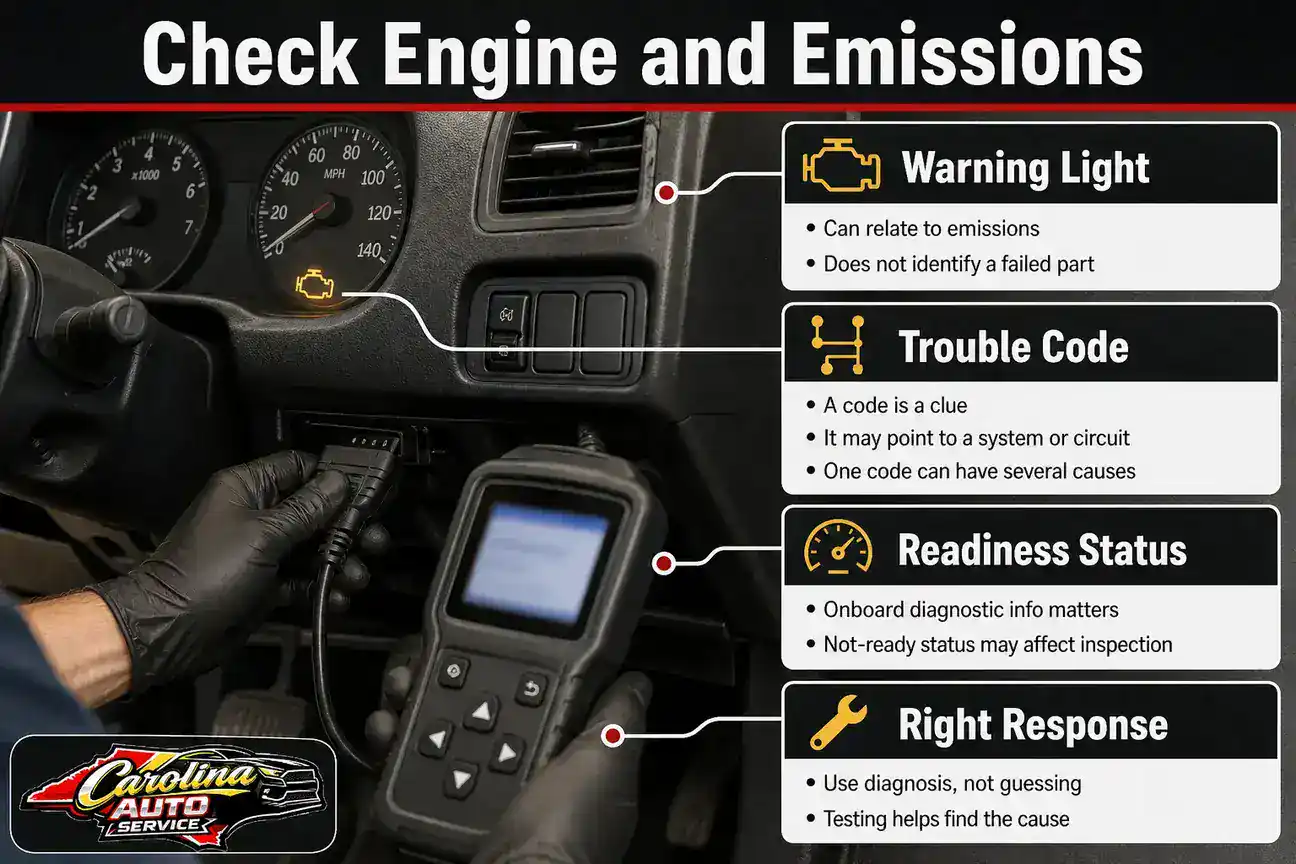
A check engine light can be associated with an emissions-related concern, but it does not identify a failed component by itself. A trouble code is a clue. It may point toward a circuit, system, performance range, or operating condition that needs testing. The same code can sometimes have more than one possible cause.
For an NC emissions inspection, onboard diagnostic information matters. If the vehicle’s computer is reporting an emissions-related fault or if the readiness status is not where it needs to be for inspection, the vehicle may not pass the emissions portion. However, the right response is diagnosis, not guessing.
Common diagnostic categories can include:
- Emissions-control system concerns
- Fuel and air measurement concerns
- Ignition, rough-running, or misfire-related concerns
- Sensor, wiring, or data communication concerns
- Readiness-monitor concerns after codes were recently cleared or power was interrupted
Carolina Auto Service provides check-engine-light diagnostics in the shop. Diagnosis can help identify the condition that caused the light before the vehicle returns to an official inspection station. It cannot guarantee an inspection result, and the diagnostic visit is not the same as the official state inspection.
If the engine is running rough, misfiring, stalling, or showing drivability symptoms along with the light, engine diagnostics may be part of finding the cause. Again, the light and code are starting points. Testing is what separates a clue from a repair recommendation.
A driver who recently cleared a code may also face readiness concerns during an NC emissions inspection. Readiness status is part of the onboard diagnostic picture, so clearing information without understanding the original concern can create more uncertainty before renewal.
What should you do before your renewal window closes?
The best preparation is simple and practical. Start with the registration renewal notice and confirm the plate expiration date. Then check whether the vehicle is registered in an emissions county and whether any broad exemption category may apply. If you are unsure, use current NCDMV information instead of relying on memory from a prior year.
If the check engine light is on, do not wait until the final days of the renewal period to think about it. Diagnosis may reveal a condition that needs repair before reinspection. Some concerns are straightforward to confirm, while others require testing under certain operating conditions. The state inspection deadline does not change how diagnosis works.
Before a diagnostic appointment, write down:
- When the warning light first appeared
- Whether the light is steady or flashing
- Any recent fuel fill-up, repair, jump-start, battery replacement, or code clearing
- Whether the vehicle runs rough, hesitates, stalls, overheats, smells unusual, or shifts differently
- Whether the concern happens cold, hot, at idle, while accelerating, or at highway speed
If you need diagnostic help with a warning light before returning to a licensed inspection station, you can request an appointment with Carolina Auto Service or call 336-765-8599. Share the symptom, when it happens, and any warning lights. Appointment requests are not confirmed until the shop contacts you or confirms a time.
When should you stop driving instead of heading to an inspection station?
Some vehicle problems should not be treated as “just an inspection issue.” Stop in a safe place and arrange towing or roadside assistance if you experience reduced braking, steering loss, overheating, low oil pressure, fuel smell, smoke, a flashing warning light, or a serious electrical warning. Do not keep driving just to reach an inspection station or repair shop when a serious symptom is present.
A vehicle cannot be declared safe to drive without a physical inspection. If the vehicle is overheating, avoid opening a hot radiator cap. If there is a brake, steering, smoke, fuel, or electrical concern, the immediate goal is to protect people first and deal with inspection timing after the vehicle is secure.
For overheating or coolant-loss concerns, cooling-system repair may be part of the later diagnosis, but do not drive on while the temperature warning is active or steam is present. Carolina Auto Service does not operate towing or roadside repair.
How can local drivers separate inspection from diagnosis?
For Winston-Salem and Forsyth County drivers, the practical difference is this: a licensed inspection station performs the official North Carolina inspection, while a repair shop diagnoses and repairs the underlying vehicle concern. Do not assume a diagnostic appointment is an official state inspection. Use NCDMV’s licensed inspection-station locator for official NC inspection locations.
Carolina Auto Service is an in-shop repair facility at 160 Hanes Mall Circle in Winston-Salem, NC 27103. Its confirmed services include check-engine-light diagnostics and a range of in-shop repair and maintenance work. If your renewal is coming up and the check engine light is already on, diagnosis before assumptions can help you understand what the vehicle is reporting before you return to a licensed inspection station.
Forsyth County commuters who spend time in stop-and-go traffic near Hanes Mall and I-40 may notice symptoms before the warning light becomes the only clue. Heat, short trips, and repeated stop-and-go driving can make existing problems more noticeable, but they do not prove the cause. Note the conditions, then have the vehicle tested.
If you need shop hours, directions, or contact details, use the contact Carolina Auto Service page. The shop’s posted hours are Monday-Friday 7:30 a.m.-5:30 p.m.; the shop confirms appointment times.
What does Carolina Auto Service check during warning-light diagnosis?
When a warning light is involved, the goal is not to make assumptions from the dashboard. ASE-certified technicians at Carolina Auto Service use an evidence-based diagnostic process to understand what the vehicle is reporting and why. Depending on the symptom, that process may include retrieving codes, reviewing data, checking related systems, testing components, and confirming the concern.
The process is especially important after an emissions-related inspection failure. The failed inspection result may show that the vehicle did not meet requirements, but it does not automatically identify a single failed part. A diagnostic path helps narrow the possibilities and supports a repair recommendation based on testing.
After diagnosis, Carolina Auto Service explains findings and provides an estimate before authorized repairs begin. Qualifying repairs carry a nationwide limited 24-month/24,000-mile parts and labor warranty on qualifying repairs; ask the shop about terms. That warranty statement applies to qualifying repairs, not to the official state inspection result.
If you are planning around a renewal date, mention the inspection failure, the renewal deadline, and whether you have paperwork from the inspection station. That context can help the shop understand what happened, while still treating the failure, code, or warning light as a clue that needs confirmation.
How should you think through exemptions, waivers, and repairs?
Drivers often mix three different ideas: exemption, waiver, and repair. Keeping them separate makes the next step clearer.
An exemption means the state may not require a certain inspection portion for that vehicle category. For example, some emissions exemptions are tied to age, mileage, fuel type, or registration category. Safety exemptions have their own age-related rules. Exact eligibility depends on current state guidance and vehicle details.
A waiver is not automatic and does not erase a safety failure. The inspection waiver NC process is tied to a qualifying emissions failure, at least $200 in documented emissions-related repairs, reinspection, and state review through the N.C. State Highway Patrol Investigative Services Unit documentation step. A waiver cannot be issued for a failed safety item, so all safety inspection requirements still have to be met.
A repair is the work needed to correct a confirmed problem. A repair should be based on testing, not on the idea that a certain code always means a certain part. That is why a warning-light concern before an NC emissions inspection is best handled with diagnosis rather than guesswork.
| Situation | What it usually means | Practical next step |
|---|---|---|
| Vehicle is registered in an emissions county | Safety and emissions inspection generally apply unless exempt | Check renewal timing and current NCDMV guidance |
| Vehicle may fit an exemption | One inspection portion may not be required | Confirm exact status with current state information |
| Safety item fails | The item must pass; waiver is not available for safety failure | Correct the safety concern and obtain a passing result |
| Emissions analysis fails | Diagnosis and repair may be needed before reinspection | Keep paperwork and diagnose the underlying condition |
| Warning light is on before renewal | The vehicle may be reporting a condition that affects inspection | Schedule diagnostic testing before the deadline becomes urgent |
Final reminders before renewal
A Forsyth County inspection is part of keeping the vehicle’s registration current, but it is also a useful moment to pay attention to symptoms you may have been postponing. If the vehicle has no warning lights or symptoms, your main job is to confirm timing and use a licensed inspection station. If the vehicle has a check engine light, drivability issue, overheating concern, brake symptom, steering problem, smoke, or other warning sign, treat that concern seriously before focusing only on the registration date.
For most vehicles registered in Forsyth County, plan around both safety inspection requirements and the NC emissions inspection unless a current exemption applies. If there is an inspection failure, read the paperwork carefully and separate a safety failure from an emissions failure. If you are looking up inspection waiver NC because of an emissions result, remember that the waiver path is conditional, requires the applicable documented repair amount and state documentation step, and cannot cover a failed safety item.
Carolina Auto Service can help with in-shop diagnosis when a warning light or symptom needs testing before you return to an official licensed inspection station. General educational information, not a diagnosis. Only an in-person inspection can confirm what a vehicle needs.
Frequently Asked Questions
Does a vehicle registered in Forsyth County need both a safety and emissions inspection?
Generally, yes. Forsyth County is listed among North Carolina’s emissions counties, so vehicles registered there generally need an annual safety inspection and an emissions inspection conducted at the same time, unless an exemption applies.
How early can a North Carolina inspection be completed?
NCDMV says the inspection may be completed no more than 90 days before the license plate and registration expire. Drivers should check the current renewal notice and state guidance before planning around the deadline.
What happens if an inspection is not completed by the due date?
If the required inspection is not completed, registration renewal is blocked until the inspection requirements are satisfied. If the vehicle has a known warning light or symptom, allow time for diagnosis, repair decisions, and any needed reinspection.
Does a check engine light automatically mean the vehicle will fail?
No automatic conclusion should be made from the light alone. It may be associated with an emissions-related fault, but the light and any stored code are clues rather than a confirmed diagnosis. Testing is needed to determine the cause and the inspection result.
Can a failed emissions inspection receive a waiver?
A vehicle may qualify only if it meets the state’s conditions, including passing safety inspection, failing the emissions analysis, completing at least $200 in documented emissions-related repairs, and failing the emissions analysis again after reinspection. The owner must bring the vehicle and documentation to the N.C. State Highway Patrol Investigative Services Unit for the state waiver-review step. A waiver cannot be issued for a failed safety item.
Are older vehicles exempt from North Carolina inspections?
NCDMV lists vehicles more than 30 years old as exempt from the annual safety inspection and vehicles 20 years old or older as exempt from emissions inspection. Antique vehicles 30 years old or older with an antique plate are listed as exempt from both. Exact eligibility should be confirmed with current NCDMV guidance.
Does Carolina Auto Service perform North Carolina safety or emissions inspections?
Carolina Auto Service is confirmed for check-engine-light diagnostics and related repair concerns, not as an NC safety or emissions inspection provider in this article. For official inspection locations, use the NCDMV Vehicle Inspection Stations locator and current state guidance.