
North Carolina repair estimate: $350 Smart Repair Law Guide
The North Carolina repair estimate rules matter before you authorize diagnostic or repair work, especially when your vehicle has a warning light, noise, leak, overheating concern, brake symptom, shifting issue, or A/C problem and the cause is not yet known. This auto repair law guide is general educational information for drivers, not legal advice. Laws and official webpages can change, so verify the current North Carolina statute before publishing, relying on, or making a legal decision from any summary.
Quick Answer: North Carolina repair estimate basics
Under North Carolina General Statutes § 20-354.3, when requested repair work will cost more than $350 to the customer, the shop must prepare a written estimate before performing diagnostic work or repairs, subject to the statute’s terms. Diagnostic work, teardown, taxes, shop supplies or overhead, and incidental services can be part of the cost calculation. A customer should understand the diagnostic scope, the estimate, and the repair authorization process before work moves forward.
That short answer is useful, but real repair situations are rarely that tidy. A check engine light may need testing before anyone can estimate the repair. A brake noise may turn out to be a simple inspection concern or a more involved repair. An overheating vehicle may need diagnosis before the shop can tell whether the issue is in the cooling system, engine controls, airflow, or another area. A symptom or code is a clue, not a diagnosis, so the estimate conversation should separate testing from confirmed repair work.
When a written repair estimate is required
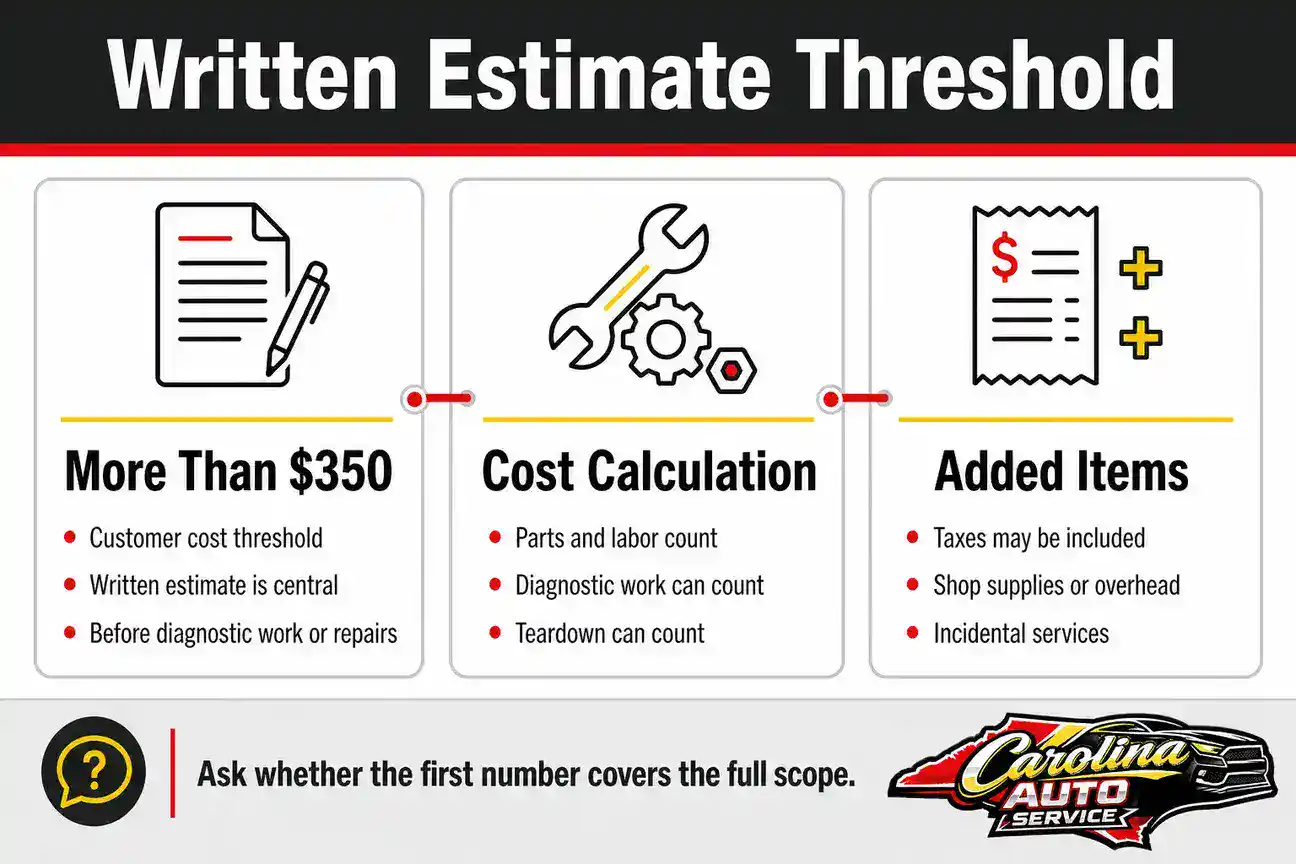
A written repair estimate is the central document in the North Carolina Motor Vehicle Repair Act discussion. The important threshold from the statute is “more than $350 to the customer.” The statute does not describe that as a parts-only threshold or a labor-only threshold. The repair cost calculation includes the necessary repair parts and labor, but it also includes necessary diagnostic work, teardown if any, taxes, repair-shop supplies or overhead, and other extra services incidental to the repair.
That is why a driver should not treat the first number mentioned as the whole story unless the scope is clear. Ask whether the figure is only for initial testing, whether it includes related supplies or taxes, and whether it covers any teardown. A written repair estimate should be specific enough for you to understand what you are approving and what has not yet been approved.
The phrase “to the customer” also matters in everyday conversation. If a repair is being considered under a warranty, service contract, fleet account, or other arrangement, the question of who is responsible for which charges can affect how the estimate is discussed. This article does not decide those legal questions; it simply points out why the document should identify what the customer is being asked to authorize.
The Federal Trade Commission’s auto repair basics guidance advises consumers that, if they decide to get repair work done, they should ask for a written estimate identifying the condition to be repaired, the parts needed, and the anticipated labor charge, and they should get a signed copy. That advice is consumer guidance, not a replacement for state law, but it lines up with a practical habit: do not leave the estimate conversation vague.
What a clear estimate conversation should cover
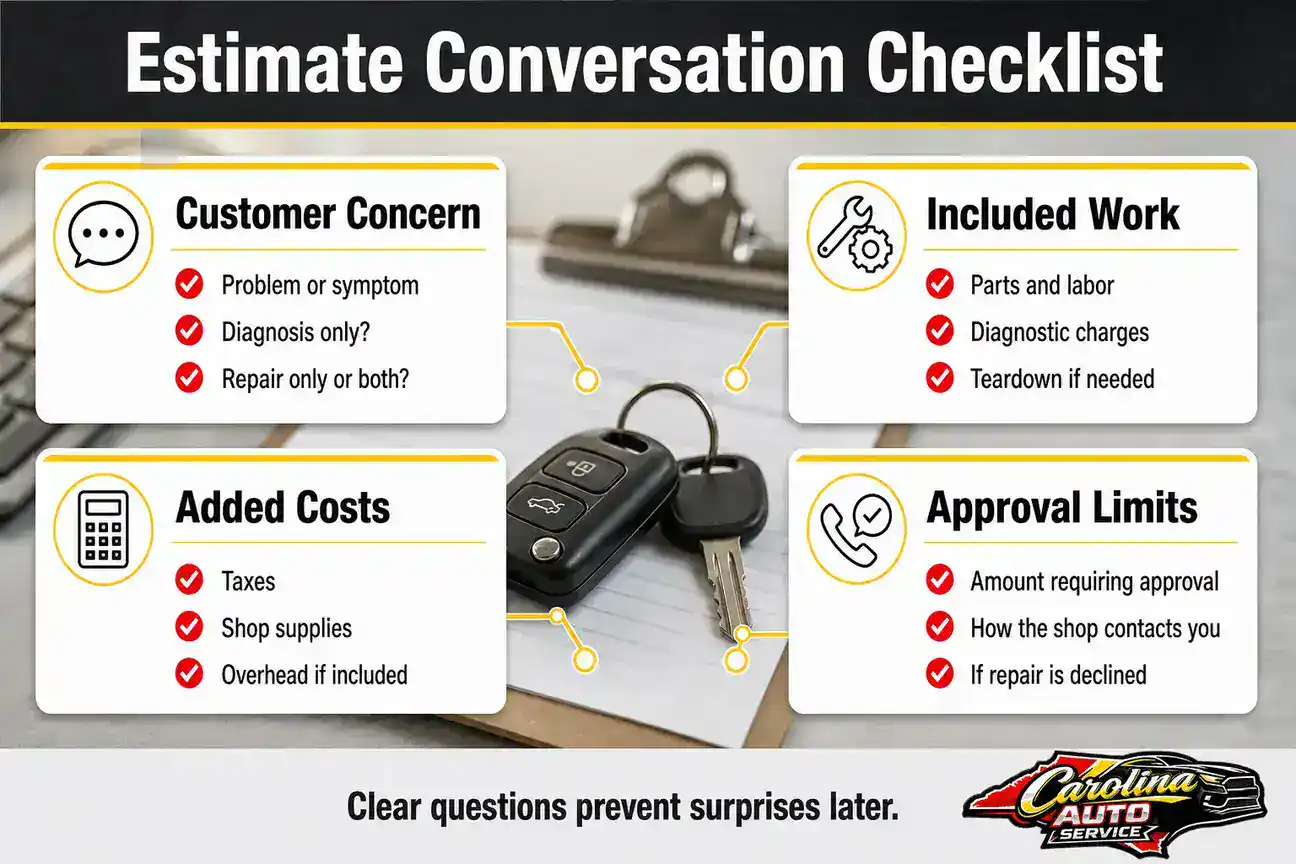
Before signing or otherwise approving work, ask the shop to clarify these points in plain language:
- What problem, symptom, or customer concern is being addressed?
- Is the current authorization for diagnosis only, repair only, or both?
- What parts and labor are included, if the repair is already known?
- Are diagnostic charges, teardown, taxes, shop supplies, or overhead included in the estimate?
- What amount or additional work requires renewed approval?
- How will the shop contact you if the estimate changes?
- What happens if you decline the repair after testing or teardown?
For a Winston-Salem driver, this may come up when a vehicle is dropped off for a warning light before work, after work, or during a commute near Hanes Mall or I-40. The local setting does not change the statute, but it does affect the practical question: what do you need to know before leaving the vehicle and authorizing testing?
Why diagnostic charges belong in the conversation
Diagnostic charges deserve a separate discussion because many customers arrive before the repair is known. A scan tool may retrieve a code, but a code alone does not prove that a specific part has failed. The same applies to a noise, vibration, leak, A/C concern, rough running condition, or intermittent no-start complaint. Testing helps narrow the possibilities before a repair recommendation is made.
For example, a check engine light can be associated with many systems. A brake noise can be related to wear, hardware, road debris, or another condition. A cooling concern can involve coolant level, airflow, pressure, electrical controls, or other possibilities. Until inspection and testing confirm the cause, it is better to talk about clues than conclusions.
The statute’s cost calculation matters here because necessary diagnostic work can count toward the repair-cost threshold. That does not mean every diagnostic visit automatically turns into a large repair. It means customers should ask what the initial diagnostic charges cover and whether the shop expects to ask for additional approval before moving beyond that scope.
For warning-light concerns, Carolina Auto Service’s check-engine-light diagnostics page is the relevant service path. The key idea is diagnosis before assumptions. The shop may need to inspect, test, and interpret the symptom before any estimate for repair can be meaningful.
Testing is not the same as replacing parts
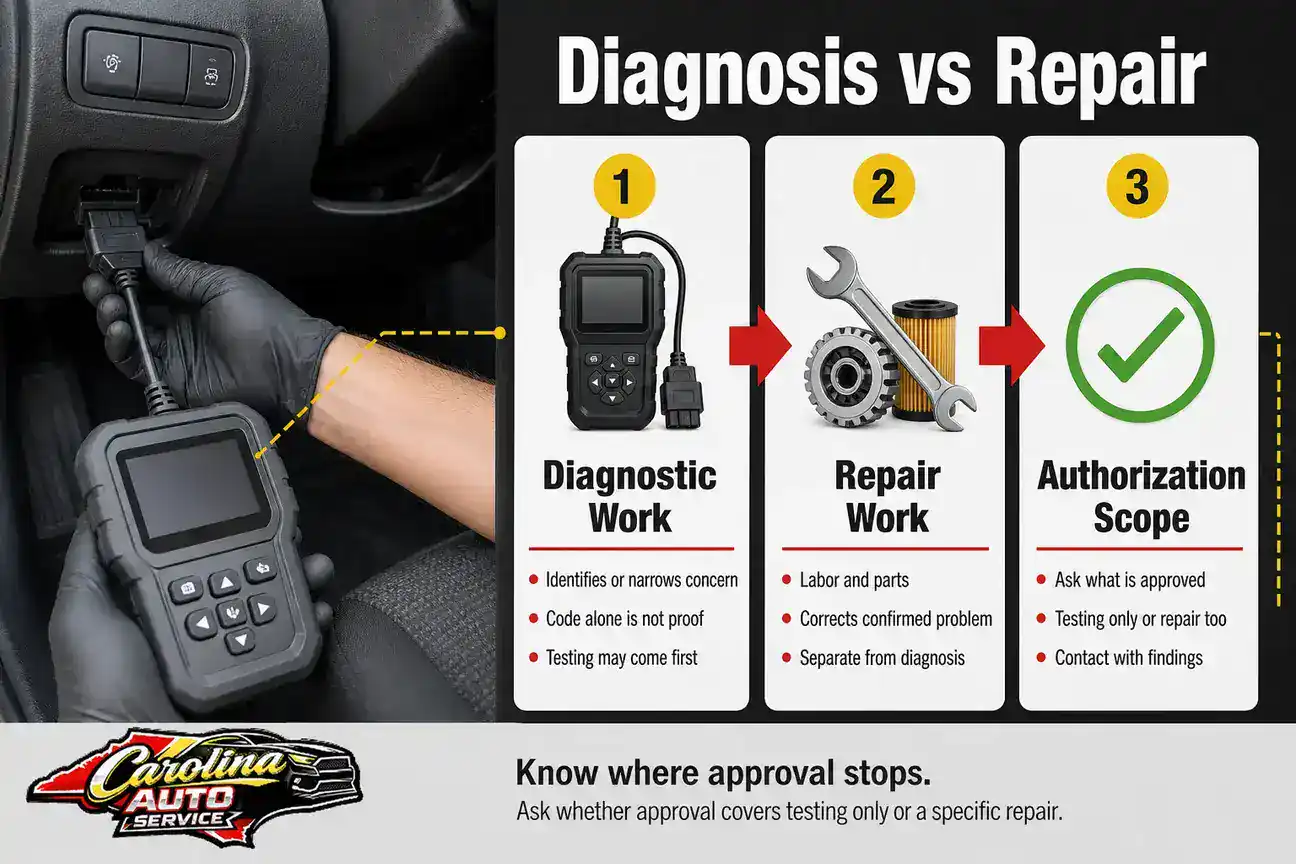
Customers sometimes ask, “If I pay for diagnosis, does that mean the repair is included?” The answer depends on what was authorized. Diagnostic charges usually refer to the work needed to identify or narrow the concern. Repair work means labor and parts intended to correct the confirmed problem. Those are related, but they are not the same thing.
Ask whether the initial repair authorization covers only testing or includes a specific repair. If it includes testing only, ask how you will be contacted with findings. If it includes a specific repair, ask what happens if testing shows a different concern than expected. Clear communication at the front counter prevents surprises later.
How auto repair law handles unknown problems and changes
Auto repair law has to account for the real-world problem of incomplete information. Sometimes a shop cannot prepare an accurate final repair estimate until diagnostic work is complete. Section 20-354.3 describes partial-waiver situations, including situations where the customer leaves the vehicle while the shop is closed, the shop reasonably believes an accurate repair estimate cannot be made until diagnostic work is complete, or the customer permits the vehicle to be delivered to the shop.
Those provisions should be read carefully in the current statute. They should not be treated as permission for unlimited work or open-ended spending. A practical customer approach is simple: before authorizing diagnosis, ask what testing is being authorized, what the diagnostic charges are, whether teardown could be needed, and when the shop will stop to ask for approval.
If the problem is unknown, the first estimate may be an estimate for diagnosis rather than a final estimate for the repair. After the necessary diagnostic work is complete, the shop should be able to explain what was found, what remains uncertain, and what the recommended next step is. Then the customer can decide whether to give repair authorization for the recommended work.
Questions for an unknown warning light, sound, or leak
When the vehicle’s symptom is unclear, use questions like these before signing or approving work:
- What is the current diagnostic concern listed on the repair order?
- What testing is included in the initial diagnostic scope?
- Are the diagnostic charges a separate line item or part of the estimate?
- Could teardown be required to find the cause?
- If teardown is needed, will you ask for approval first?
- If I decline the repair, could there be teardown, reassembly, or related charges?
- Will I receive a written repair estimate before repair work begins?
- How will repair authorization be documented?
Those questions are not confrontational. They help both sides define the job. A shop cannot always know the final answer before inspection, but the customer can still ask for the diagnostic scope and approval process in advance.
How repair authorization should be understood
Repair authorization is the customer’s permission for the shop to perform the work described. In a careful process, authorization should not be a vague “fix whatever you find.” It should identify the concern, the work being approved, the estimate or diagnostic scope, and the point where the shop must contact the customer before continuing.
Ask whether the authorization is written, electronic, verbal, or otherwise documented. This article does not give a legal opinion about which format applies in every situation. The practical point is that you should know what you approved and the shop should know where approval stops.
The FTC says an estimate should state that the shop will contact the customer for approval before doing work exceeding a specified amount of time or money. That is a useful habit even when the final diagnosis is not yet known. It gives the customer a stopping point and gives the shop a clear boundary.
For business vehicles, approval may also depend on who is allowed to approve work. A fleet manager may want a purchase order, a driver may be allowed to approve diagnosis only, or a business owner may need to approve repairs over a certain amount. Carolina Auto Service provides fleet maintenance for local business vehicles at the shop, so fleet customers should define authorization roles before work begins.
Written, verbal, and electronic approval questions
Do not assume the authorization method is obvious. Ask these questions:
- Will I sign the estimate or approve electronically?
- If you call me, how will that approval be recorded?
- Can I set a dollar limit or work-scope limit before you contact me again?
- Who is allowed to approve work for a family vehicle or business vehicle?
- Will I receive a copy of the estimate and approval record?
These questions are especially useful when another person drops off the vehicle. If a spouse, employee, friend, or tow provider delivers the vehicle, clarify who can approve diagnostic work and who can approve repair work. A misunderstanding at drop-off can lead to confusion later.
What can happen when an estimate changes
An estimate is not always the final invoice. Sometimes inspection reveals a related condition that was not visible at first. Sometimes teardown shows damage that could not be seen from the outside. Sometimes a symptom has more than one contributing cause. The important question is not whether an estimate can ever change; it is how the change is communicated and approved.
North Carolina General Statutes § 20-354.5, within the Motor Vehicle Repair Act, addresses charges in excess of the repair estimate and cancellation-related situations. Because detailed legal requirements can change, review the current statute before relying on any summary. As a customer, ask the shop what amount or work scope requires renewed repair authorization.
When a customer cancels or declines to proceed after diagnosis or teardown, there may still be authorized costs. The North Carolina Motor Vehicle Repair Act article is the broader statutory source for this topic. Do not assume that declining a repair always eliminates every charge, and do not assume that every charge is allowed without disclosure. Ask before teardown begins.
A practical approval statement might sound like this: “Please diagnose the overheating concern up to the approved diagnostic amount. Contact me before repairs, teardown, reassembly charges, or any work beyond that amount.” The exact wording should match the shop’s documents and the current law, but the idea is to make approval clear.
Estimate-change table for common repair situations
| Situation | What it may mean | Question to ask before authorizing |
|---|---|---|
| Warning light with stored codes | The code is a clue that may require testing before a repair is known. | What diagnostic testing is included before a repair estimate is prepared? |
| Noise that requires disassembly to inspect | Teardown may be needed before the shop can see the condition. | Will you ask for approval before teardown, and could reassembly charges apply? |
| Leak with uncertain source | The visible drip may not identify the failed seal, hose, gasket, or component. | What testing is included, and will the estimate change if more than one leak is found? |
| A/C concern | Temperature, pressure, electrical, and refrigerant-related checks may be needed. | What is included in diagnosis, and will repair work require separate approval? |
| Fleet vehicle brought in by a driver | The driver may not be the person authorized to approve work. | Who must approve diagnosis, repairs, and any changes to the estimate? |
What the estimate should say about storage
Storage charges are another detail customers often overlook. Section 20-354.3 says the written estimate must include a statement indicating the daily storage charge after the customer has been notified that the repair is complete. Do not assume a grace period, a storage rate, or a notification method unless it appears in the shop’s policy or written documents.
A useful question is: “When and how will you notify me that the vehicle is ready?” Another is: “What daily storage charge appears on the estimate after completion notice?” These questions matter for commuters, families sharing a vehicle, and fleet managers who may need to coordinate pickup.
The storage discussion should not be awkward. It is simply part of understanding the estimate. If you know how completion notice works, you can plan pickup and avoid confusion. If you cannot pick up promptly, communicate early and ask what policy applies.
Replaced parts and documentation
The statute also addresses a statement allowing the customer to indicate whether replaced parts should be saved for inspection or return. This can be useful when you are comparing recommendations, documenting a major repair, or simply trying to understand what was replaced.
Not every part can always be returned in every circumstance, and this article does not decide those legal details. The customer-friendly question is: “Can I indicate on the estimate whether I want replaced parts saved for inspection or return?” If the answer depends on the type of part, core return, contamination, or other condition, ask the shop to explain before work begins.
What to ask before authorizing diagnosis
Before you approve diagnosis, slow the conversation down enough to separate the known symptom from the unknown cause. A customer may know the brake pedal feels different, the engine is overheating, the transmission is shifting oddly, or the A/C is not cooling. That does not mean the customer or the shop can name a failed part without testing.
Use the following checklist before giving repair authorization or diagnostic approval:
- What symptom or concern will be written on the repair order?
- What is the diagnostic charge?
- What testing is included in the diagnostic scope?
- Could diagnosis require teardown?
- Will I be contacted before teardown or repairs?
- Could I owe diagnostic, teardown, reassembly, or related charges if I decline the repair?
- Will I receive a written repair estimate after diagnosis?
- What amount or additional work requires renewed approval?
- How will approval be documented?
- Can replaced parts be saved for inspection or return?
- What storage-charge statement appears on the estimate?
- How will I be notified that the vehicle is ready?
That checklist also helps the shop. Clear symptoms can lead to better testing decisions. “It makes a grinding noise” is helpful; “it grinds from the left front when braking after highway driving” is more useful. “The check engine light is on” is helpful; “the light flashes under acceleration” is more urgent and should be reported clearly.
Safety symptoms that should change your plan
Estimate rights are important, but safety comes first. If you have reduced braking, steering loss, overheating, low oil pressure, fuel smell, smoke, flashing warning lights, or a hybrid high-voltage warning, stop in a safe place and arrange towing or roadside assistance. Do not keep driving just to reach a shop or obtain an estimate.
Do not open a hot radiator cap, bypass safety systems, handle refrigerant, work on hybrid high-voltage components, or work under a vehicle supported only by a jack. Those situations can be dangerous. A safer plan is to document what happened, where it happened, warning lights, smells, noises, and whether the symptom changed with speed, braking, turning, A/C use, or engine temperature.
For non-emergency symptoms, it is reasonable to gather details before an appointment. For serious safety symptoms, the next step is to get the vehicle moved safely without driving it farther. If a roadside assistance program may apply to qualifying service, review the applicable terms and ask about the warranty on qualifying repairs rather than assuming coverage or limits.
How Carolina Auto Service approaches inspection and approval
Carolina Auto Service is an in-shop auto repair facility at 160 Hanes Mall Circle in Winston-Salem. Its stated process is inspection, explanation of findings, estimate, and customer approval before authorized repairs begin. That process is not legal advice and should not be described as a guarantee of legal compliance; it is the shop’s customer-facing approach to diagnosis before assumptions.
The shop’s ASE-certified technicians diagnose, maintain, and repair domestic, import, and hybrid cars, SUVs, light trucks, vans, and fleet vehicles in the shop. You can learn more about Carolina Auto Service, or review its auto repair services if you are trying to match a symptom to the right service category.
For a customer, the practical benefit of this process is structure. First, the concern is inspected. Then findings are explained. Then an estimate is presented. Then the customer approves authorized repairs before the work proceeds. If the vehicle problem is still unknown at drop-off, ask which part of that process applies to diagnosis and which part applies to repair work.
Carolina Auto Service offers a nationwide limited 24-month/24,000-mile parts and labor warranty on qualifying repairs. Ask Carolina Auto Service about warranty terms, what qualifies, and how the warranty applies to the specific repair being considered.
What Forsyth County drivers should do next
If you are in Forsyth County and your vehicle has a warning light, noise, vibration, leak, overheating issue, braking concern, shifting symptom, or A/C problem, write down what happens before you call. Note whether the symptom occurs cold or hot, at idle or speed, while braking or turning, with the A/C on, after rain, after fueling, or after recent service.
If the concern is not an emergency, you can request an appointment and describe the symptom, when it happens, any warning lights, and whether you want diagnosis only or a repair estimate after diagnosis. Appointment requests are not confirmed until the shop contacts you or confirms a time. You can also contact Carolina Auto Service for shop hours and directions.
If you bring maintenance records, previous estimates, warranty paperwork, or fleet approval instructions, those documents can help clarify the estimate conversation. They do not replace inspection, but they may help the shop understand recent work, recurring symptoms, or authorization limits.
Putting the estimate conversation together
The safest way to think about the North Carolina repair estimate topic is in layers. First, ask whether the expected customer cost triggers a written repair estimate. Second, ask whether diagnostic charges, teardown, taxes, supplies, overhead, or incidental services are included. Third, define the repair authorization boundary before work begins. Fourth, ask how estimate changes, storage charges, and replaced parts will be handled.
This is also a good place to remember that auto repair law summaries are not a substitute for current legal text. The official statute is the controlling source, and the details can change. If a dispute or legal question exists, consult the current statute and appropriate legal guidance.
For everyday repair decisions, though, the practical path is straightforward: ask for clarity before work begins, separate diagnosis from repair, and make sure approval is documented. General educational information, not a diagnosis. Only an in-person inspection can confirm what a vehicle needs.
Frequently Asked Questions
Is a written repair estimate required in North Carolina?
When requested repair work will cost more than $350 to the customer, North Carolina law requires a written repair estimate before diagnostic work or repair, subject to the statute’s exceptions and partial-waiver provisions. Because laws can change, check the current statute before relying on any summary.
Does the $350 threshold include diagnostic charges?
Yes, the statutory cost calculation includes necessary diagnostic work and teardown, along with parts, labor, taxes, repair-shop supplies or overhead, and incidental services. Ask the shop whether the initial approval is for diagnosis only, repair only, or both.
What if the shop cannot identify the problem yet?
Ask for the diagnostic charge, the testing scope, and the approval process for any later repair. An unknown problem may require diagnosis before a final repair estimate can be prepared, but that does not mean the customer should give open-ended approval.
Can a repair shop charge for teardown if I decline the repair?
Potentially, depending on what was disclosed and authorized. Ask before teardown begins whether diagnosis, teardown, parts affected by teardown, or reassembly charges could apply if you decide not to proceed with the recommended repair.
Can the estimate change after the vehicle is disassembled?
It can, especially if the condition was not visible before disassembly. Ask how the shop communicates newly discovered conditions, what amount or additional work requires renewed approval, and whether work pauses until you authorize the change.
Does the estimate have to disclose storage charges?
The written estimate must include a statement indicating the daily storage charge after the customer has been notified that the repair is complete. Ask when completion notice occurs, how it is delivered, and when storage charges begin under the shop’s policy.
Should I get a copy of the estimate and authorization?
Yes. A copy helps you confirm the condition being addressed, the work or diagnostic scope being approved, the anticipated charges, and the point at which the shop must contact you before going further.