
Open Car Recall: Essential Safe Next Moves by VIN
If your VIN lookup shows an open car recall, treat it as a recall status that needs follow-up, not as a complete diagnosis of the vehicle. In general, “open” means the recall remedy has not been recorded as completed for that VIN. Your next step is to read the manufacturer’s instructions, then contact the vehicle manufacturer’s dealership for the recall remedy. Do not assume the result explains a check-engine light, noise, leak, overheating concern, brake symptom, shifting problem, or A/C issue. Those may need separate inspection and testing.
General educational information, not a diagnosis. Only an in-person inspection can confirm what a vehicle needs.
Quick Answer: What should you do after finding an open car recall?
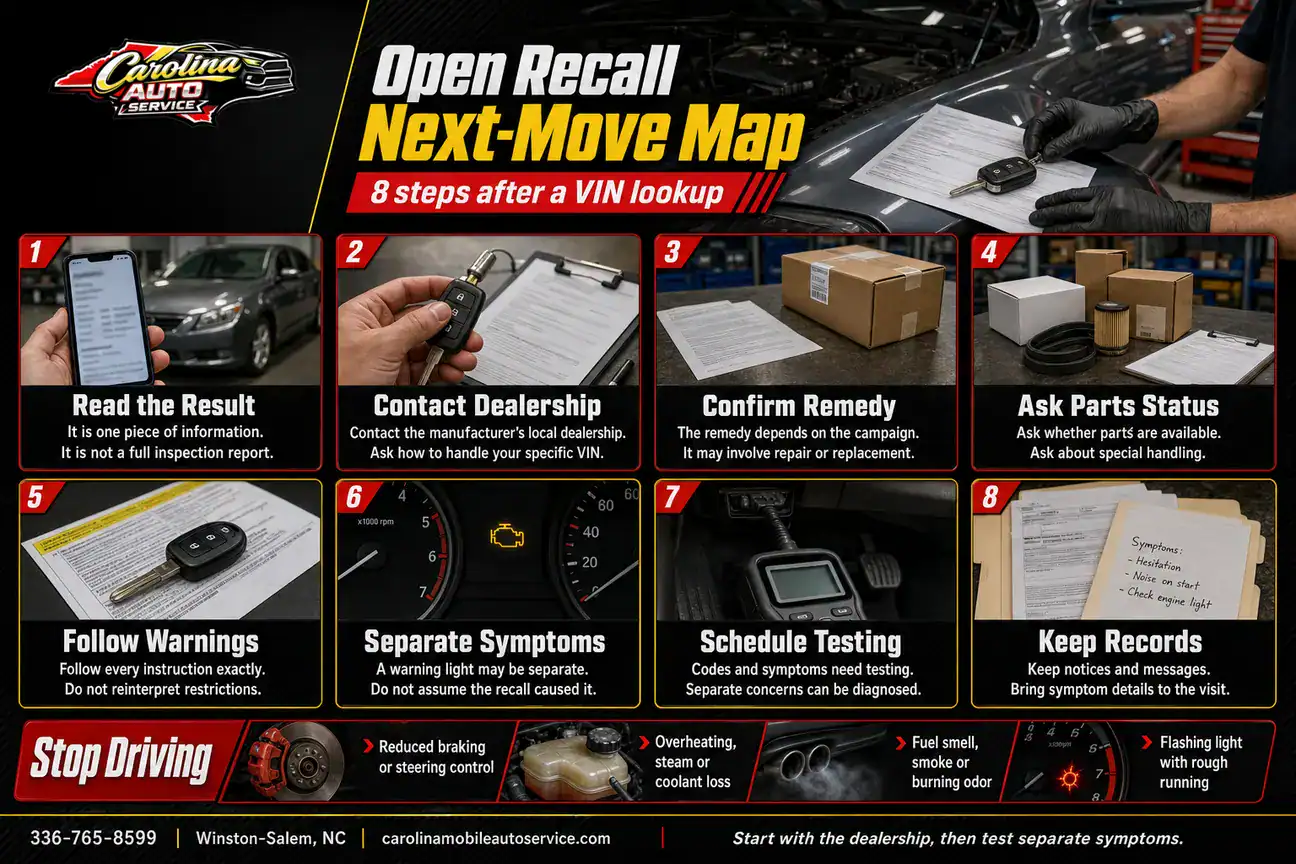
Contact the vehicle manufacturer’s local dealership and ask how to handle the recall remedy for your specific VIN. The NHTSA recalls page explains that manufacturers are required to address recalled problems through a repair, replacement, refund, or, in rare cases, repurchase, but the exact remedy depends on the campaign.
Follow every manufacturer instruction exactly, including any “do not drive,” “park outside,” or other operating restriction. Do not reinterpret those directions on your own. If the vehicle also has a warning light or symptom, treat that as a separate clue unless the manufacturer or dealership confirms it is part of the recall.
Carolina Auto Service can diagnose separate symptoms and maintenance needs at its in-shop facility, but the manufacturer’s recall remedy should be handled through the appropriate dealership. If there is a check-engine-light diagnostics concern that appears separate from the recall, that is a different conversation from completing the recall campaign.
What does an open car recall result actually mean?
An open result generally means the vehicle is tied to a safety recall and the remedy has not been recorded as completed for that VIN. It does not, by itself, prove the vehicle is safe to drive. It also does not tell you that every current symptom is caused by the recall. The recall record is one piece of information, not a full inspection report.
A recall is issued for a specific safety defect or noncompliance condition. The manufacturer’s notice or dealership can explain which vehicles are included, what remedy applies, whether parts are available, and whether any interim precautions apply. The remedy may be different from ordinary repair work because it follows the manufacturer’s recall campaign process.
The most important step is to separate three different questions:
- Recall status: Has the manufacturer’s recall remedy been recorded for this VIN?
- Manufacturer instructions: Does the notice include any recall warning instructions, such as “do not drive” or “park outside”?
- Current vehicle symptoms: Is the vehicle showing a warning light, noise, vibration, leak, overheating, braking concern, shifting issue, or another condition that still needs diagnosis?
That separation keeps you from making two common mistakes: ignoring a serious recall notice or assuming a recall result explains every problem with the vehicle.
Open, completed safety recall, or no open result: how should you read the status?
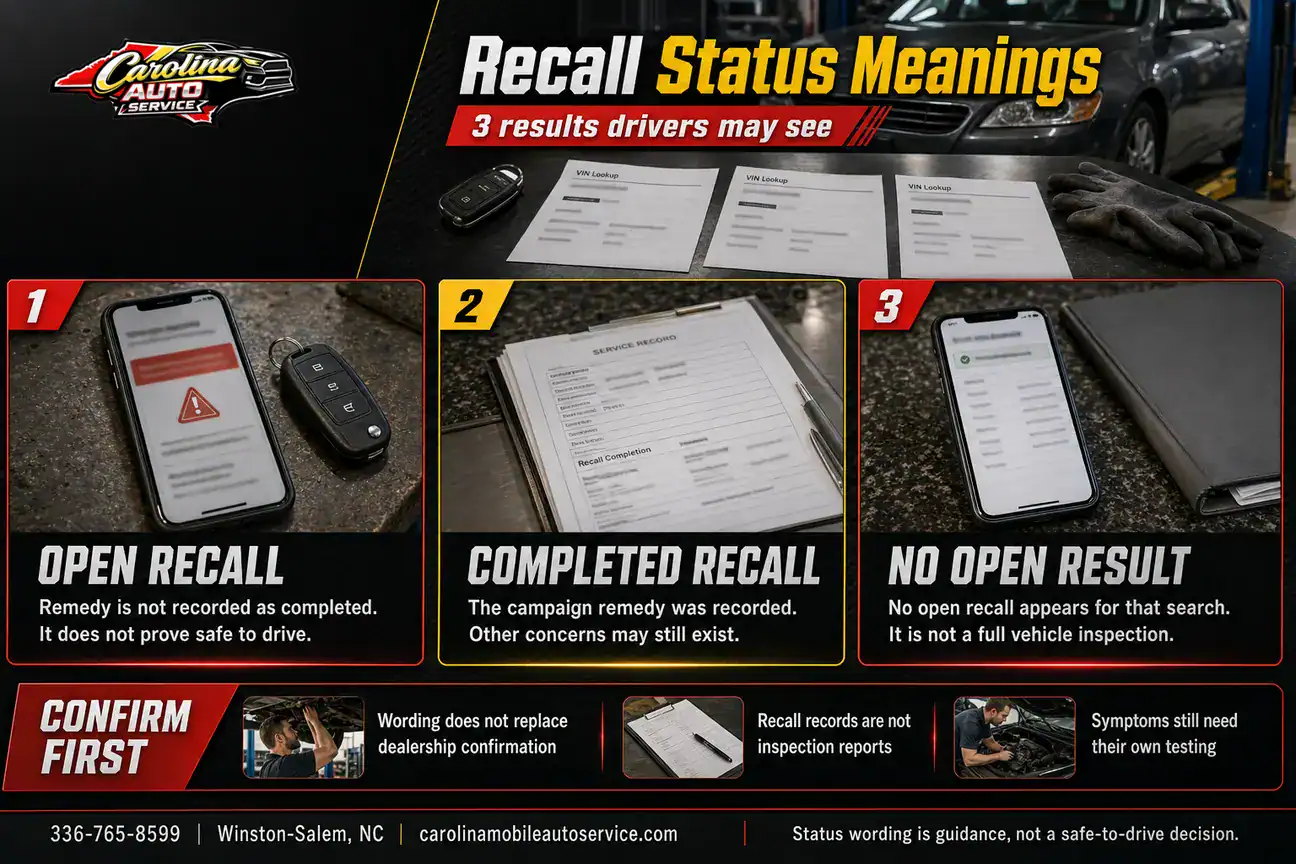
Drivers often see different wording when they check a VIN. The terms can sound simple, but they do not replace confirmation from the manufacturer or dealership. Use the table below as a practical guide.
| Result | What it generally indicates | What it does not establish |
|---|---|---|
| Open recall | The recall remedy has not been recorded as completed for that VIN. | It does not prove that every symptom comes from the recall, and it does not establish that the vehicle is safe to drive. |
| Completed safety recall | The specified recall remedy has been recorded as completed for that campaign. | It does not mean the vehicle has no unrelated mechanical, electrical, maintenance, or safety concerns. |
| No matching open recall | No open campaign was returned for that lookup. | It does not mean the vehicle has no diagnostic problem, warning light, maintenance need, or drivability concern. |
A completed safety recall should be treated as a campaign record, not as a clean bill of health for the entire vehicle. If your check-engine light, brake warning, temperature gauge, harsh shift, vibration, or A/C concern continues, that symptom still deserves separate attention.
If you believe a recall was already handled but the lookup still shows open, ask the dealership or manufacturer to confirm the record. Documentation can matter, especially if you recently bought a used vehicle or had the recall performed before the manufacturer’s system updated.
Recall warning instructions: what if the notice says “do not drive” or “park outside”?
Recall warning instructions take priority. If the manufacturer says “do not drive,” do not drive the vehicle just to reach a repair shop or dealership. If the notice says “park outside,” follow that direction and ask the manufacturer or dealership how to handle the vehicle safely. Do not soften, ignore, or reinterpret a warning because the vehicle “seems fine.”
NHTSA tells owners to follow interim safety guidance and contact the local dealership to fix the recalled part. Its recall resources also identify certain urgent recall conditions, including do-not-drive or fire-risk concerns, so read the complete manufacturer notice and any warnings displayed with the VIN result on the NHTSA recall lookup resource.
When you contact the dealership, ask clear questions:
- Is the remedy available for this VIN now?
- Are parts available, or is there a waiting period?
- Does the manufacturer say not to drive the vehicle?
- Does the manufacturer say to park the vehicle outside or away from structures?
- Should the vehicle be transported instead of driven?
- Is there an interim measure until the remedy is available?
- What documentation should you keep?
If a serious symptom appears while you are driving, stop in a safe place and arrange towing or roadside assistance. Do not continue driving just to reach the shop. Serious symptoms include reduced braking, loss of steering control, overheating, smoke, fuel odor or visible fuel leakage, a low oil-pressure warning, or a flashing warning light accompanied by rough running or loss of power.
This is not a determination that a specific vehicle is unsafe. It is safety-first guidance for situations where the manufacturer’s recall warning instructions or the vehicle’s symptoms indicate that routine driving may create risk.
Recall repair dealership: who handles the manufacturer remedy?
The recall remedy should be handled by the vehicle manufacturer’s dealership. The recall repair dealership can confirm the campaign details, remedy availability, parts status, and any special handling instructions. That dealership is the place to ask whether the vehicle should be driven, parked, towed, or held until parts are available.
NHTSA explains that manufacturers must fix recalled problems through the required remedy process, and its owner guidance points drivers to the manufacturer’s dealership for recall work. That is different from normal maintenance or independent diagnosis. A recall repair dealership handles the recall campaign because the remedy is connected to the manufacturer’s recall obligations.
Carolina Auto Service should not be treated as the recall repair dealership, and the shop should not be described as completing, closing, clearing, or performing a manufacturer’s recall remedy. Carolina Auto Service is an independent in-shop repair facility for diagnosing and repairing separate vehicle concerns, not a substitute for the manufacturer’s dealership in a recall campaign.
That distinction matters when a driver has two things happening at once. You might have an open recall and also have a check-engine light, brake noise, coolant loss, harsh shifting, or an A/C problem. The recall repair dealership should handle the recall remedy. A separate symptom can be diagnosed independently when it is not part of the manufacturer’s recall process.
Recall and check engine: why might the light be a separate issue?
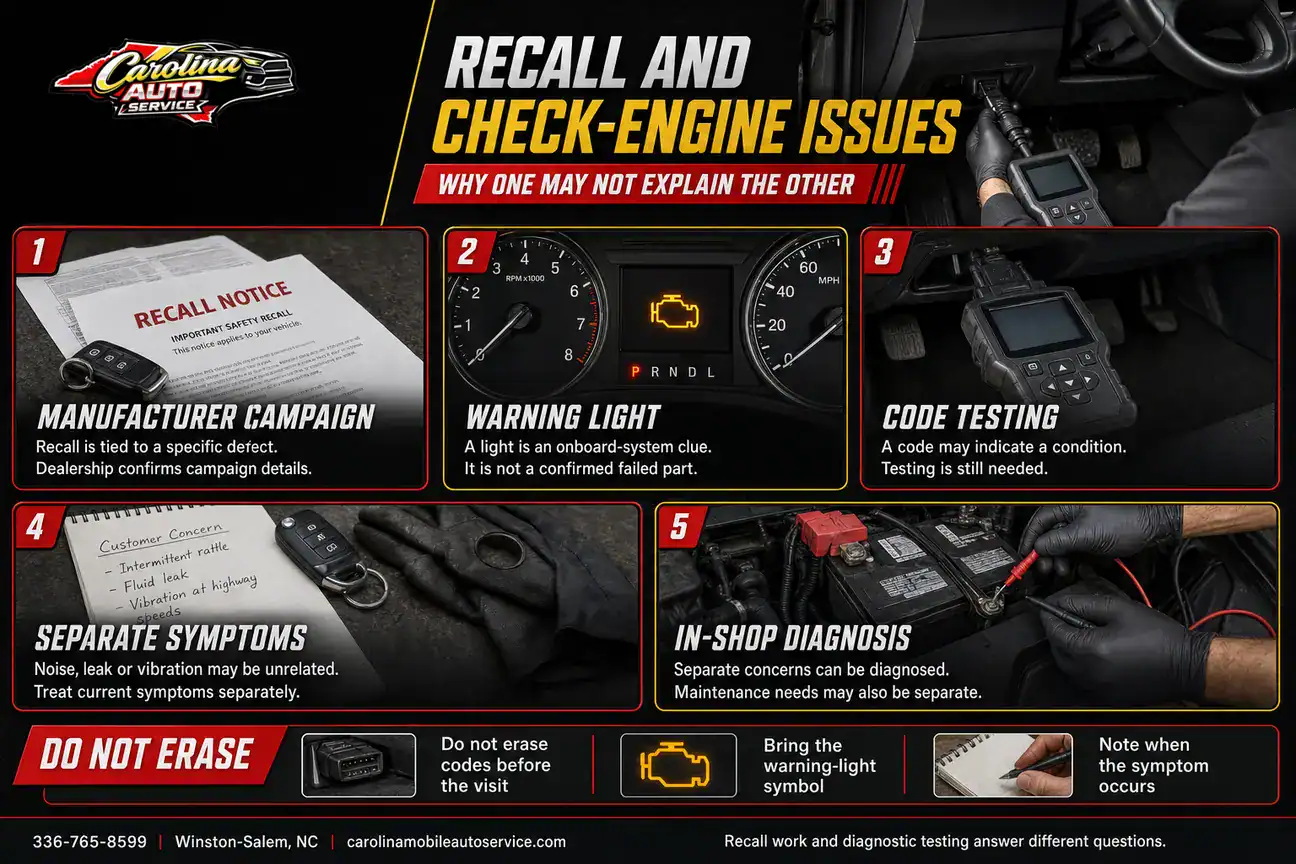
A recall and check engine concern can happen at the same time without being the same problem. A recall is a manufacturer campaign tied to a specific defect or noncompliance condition. A check-engine light is a diagnostic clue from the vehicle’s onboard system. A code or warning light may indicate a condition that needs testing, but it is not a confirmed failed part by itself.
The phrase recall and check engine often comes up when a driver hopes the VIN result explains the dashboard light. Sometimes the recall notice may involve a system related to a symptom, but that connection should be confirmed by the manufacturer or dealership. Other times, the light may be tied to a separate engine, emissions, fuel, ignition, sensor, wiring, or control-system condition. Inspection and testing are what narrow that down.
For example, a steady light may be associated with many different conditions, while a flashing light accompanied by rough running or loss of power is more urgent. Either way, the light is a clue. It should not be treated as proof that a specific part has failed or that the recall remedy will solve it.
If a recall and check engine issue appear together, keep both tracks clear:
- Contact the recall repair dealership for the manufacturer campaign.
- Follow recall warning instructions exactly.
- Record whether the light is steady or flashing.
- Note when the symptom occurs: cold start, idle, acceleration, highway speed, braking, turning, or A/C operation.
- Do not erase codes or disconnect the battery to “reset” the issue before diagnosis.
When the concern is separate from the recall, Carolina Auto Service can perform diagnosis at the shop. The goal is diagnosis before assumptions: read the clues, test the affected systems, explain the findings, and provide clear repair recommendations and an estimate before authorized work begins.
Could the recall be unrelated to another symptom?
Yes. A VIN recall result does not diagnose every mechanical, electrical, maintenance, or drivability concern on the vehicle. A noise, vibration, leak, overheating condition, brake symptom, shifting issue, or A/C complaint may be unrelated to the recall even when the recall is open.
Here is a practical way to separate the possibilities:
- Recall: A manufacturer campaign for a defined safety defect or noncompliance condition.
- Diagnostic symptom: A current warning light, noise, smell, vibration, leak, temperature change, or drivability issue that requires inspection and testing.
- Maintenance need: Service due according to your vehicle’s owner’s manual and manufacturer maintenance schedule.
Braking symptoms are a good example. Reduced braking, grinding, or a pedal that does not respond normally should not be written off as “probably the recall.” Those concerns may be associated with brake wear, hydraulic issues, electronic controls, or other conditions that require inspection. If the vehicle can be handled safely and the manufacturer has not issued a do-not-drive instruction, a separate brake service inspection may be appropriate. If braking is reduced, stop in a safe place and arrange assistance instead of driving on.
Overheating is another example. A recall result does not confirm the cause of a rising temperature gauge, steam, coolant loss, or warning light. Those symptoms may be associated with cooling-system leaks, airflow problems, fan operation, thermostat concerns, or other conditions. Do not open a hot radiator cap. If the vehicle is overheating, stop safely and arrange help. For separate cooling concerns that can be inspected at the shop, Carolina Auto Service offers radiator repair and cooling-system repair.
Shifting problems can also be separate. Harsh shifts, slipping, delayed engagement, or warning messages can be associated with transmission controls, fluid condition, internal wear, driveline concerns, or electronic faults. The recall record alone does not confirm the cause. A separate transmission diagnostics visit can help identify what testing is needed.
Hybrid owners should be especially careful not to treat a warning message as a DIY problem. A hybrid high-voltage warning or related fault should not be handled without proper training and equipment. For non-recall hybrid maintenance and diagnostic concerns, Carolina Auto Service provides in-shop hybrid service. Do not attempt high-voltage work yourself.
What records help when a completed safety recall still leaves a symptom?
Keep paperwork from the dealership, recall notice, VIN lookup, and any follow-up messages from the manufacturer. A completed safety recall may show that a specific campaign remedy was recorded, but it does not prove the vehicle has no remaining diagnostic concern. A symptom that continues after recall completion still needs to be described clearly and tested on its own.
Good records also help avoid confusion between warranty questions, service contracts, maintenance, and a manufacturer recall remedy. The FTC guidance on auto warranties and service contracts explains that warranty and service-contract coverage can depend on terms and conditions. That is separate from Carolina Auto Service’s own warranty language for qualifying repairs.
For ordinary repair decisions, the FTC auto repair basics guidance encourages consumers to understand estimates, authorizations, and repair-shop communication. That fits the same practical habit: keep notes, ask what is being authorized, and separate confirmed findings from guesses.
If Carolina Auto Service recommends a repair after inspection, the shop explains findings and provides an estimate before authorized repairs begin. A nationwide limited 24-month/24,000-mile parts and labor warranty applies on qualifying repairs; ask about terms.
When should you stop driving instead of arranging a routine appointment?
Do not use a recall lookup to make an independent safe-to-drive decision. Follow the manufacturer’s instructions first. Separately, certain symptoms call for stopping in a safe place and arranging towing or roadside assistance rather than trying to drive to a shop.
Stop driving and arrange assistance if you notice:
- Reduced braking or a brake pedal that does not respond normally.
- Loss of steering control.
- Overheating, steam, or a rising temperature gauge with signs of coolant loss.
- A low oil-pressure warning.
- Fuel smell or visible fuel leakage.
- Smoke or a strong burning odor.
- A flashing warning light with rough running, shaking, or loss of power.
- Any manufacturer-issued do-not-drive instruction.
- Any manufacturer-issued park-outside instruction that changes how the vehicle should be stored.
Do not drive on merely to reach the shop. If roadside help may apply after qualifying service, Carolina Auto Service’s site has information about a roadside assistance program, but roadside help is a third-party program and not a shop-operated towing or roadside repair service. Ask about current terms if that benefit becomes relevant.
What can Carolina Auto Service diagnose after a recall lookup?
Carolina Auto Service can help with separate symptoms and maintenance needs in the shop. That can include a warning light that remains after a completed safety recall, a recall and check engine concern that appears unrelated, or a drivability issue that needs testing apart from the manufacturer campaign.
Confirmed in-shop diagnostic and repair areas include:
- Check-engine-light diagnostics and other warning-light concerns.
- Engine diagnostics and repair.
- Brake inspection and repair.
- Cooling-system and radiator repair.
- Transmission diagnosis and repair.
- Drivetrain inspection and repair.
- Hybrid maintenance and diagnostics.
- Automotive A/C diagnosis and repair.
- Routine maintenance based on the vehicle’s owner’s manual and manufacturer schedule.
For broader non-recall concerns, the shop’s auto repair services page gives an overview of the types of in-shop work Carolina Auto Service provides. The key is to keep the manufacturer recall remedy separate from ordinary diagnosis and repair. A recall repair dealership handles the campaign; Carolina Auto Service can evaluate separate symptoms and explain what testing shows.
ASE-certified technicians diagnose domestic, import and hybrid cars, SUVs, light trucks, vans and fleet vehicles in the shop. When a repair is recommended, the shop explains findings and provides an estimate before authorized repairs begin. A nationwide limited 24-month/24,000-mile parts and labor warranty applies on qualifying repairs; ask about terms.
What information should you bring to the dealership or repair shop?
Good notes help both the dealership and an independent repair shop. For the recall repair dealership, bring the VIN result and any manufacturer notice. For a separate diagnosis, bring symptom details. Do not try to erase codes or disconnect the battery before the visit, because that can remove information that may help with testing.
Write down:
- The VIN lookup result and recall campaign number, if shown.
- The manufacturer notice, email, letter, or dealership message.
- The exact recall warning instructions, if any.
- Whether the result says open or completed safety recall.
- The exact dashboard warning-light wording or symbol.
- Whether a warning light is steady or flashing.
- When the symptom occurs: cold start, idle, acceleration, braking, turning, highway speed, or A/C operation.
- Any noise, vibration, odor, smoke, leak, temperature change, or loss of power.
- Whether the symptom began before or after the recall notice.
- Recent maintenance or repairs.
- Whether the vehicle is a personal vehicle, business vehicle, hybrid, SUV, truck, van, or fleet unit.
For business vehicles, keeping recall and maintenance records organized is especially useful. A fleet manager can coordinate the manufacturer campaign with the recall repair dealership while arranging separate in-shop diagnosis or maintenance when the concern is not the recall remedy.
Winston-Salem drivers: separating recall action from shop diagnosis
For Winston-Salem and Forsyth County drivers, the practical path is often two-track. First, call the vehicle manufacturer’s dealership about the recall remedy and any recall warning instructions. Second, if the vehicle has a separate warning light or symptom and the manufacturer has not instructed you not to drive, schedule diagnosis for the separate concern.
Carolina Auto Service is an in-shop repair facility at 160 Hanes Mall Circle in Winston-Salem, NC 27103, near Hanes Mall. The shop can diagnose separate symptoms for everyday drivers, commuters, high-mileage vehicles, hybrids, and local business vehicles. It should not be presented as the recall repair dealership and does not replace the manufacturer’s dealership for recall remedies.
If your vehicle has a separate check-engine light, noise, vibration, leak, overheating concern, brake symptom, shifting issue, or A/C concern, you can request an appointment and describe when the symptom happens, whether any lights are flashing, and what the VIN recall result said. The shop confirms the appointment time. You may also call 336-765-8599 during shop hours, Monday-Friday 7:30 a.m.-5:30 p.m. For the address, hours, and directions, see shop hours and directions.
How can you decide your next move without mixing up the issues?
After finding an open car recall, do not jump straight to parts, prices, or assumptions. Start with the manufacturer’s instructions. Ask the recall repair dealership what the remedy is, whether parts are available, whether there are recall warning instructions, and whether the vehicle should be driven, parked outside, or transported.
Then look at the vehicle’s current behavior separately. If there is a completed safety recall but the check-engine light remains on, the completed campaign does not rule out a separate issue. If there is a recall and check engine concern at the same time, keep the recall remedy with the dealership and the separate diagnostic question with a qualified repair shop.
If symptoms are urgent, stop in a safe place and arrange assistance. If symptoms are not urgent and the manufacturer has not restricted driving, Carolina Auto Service can help evaluate separate concerns through in-shop diagnosis. That approach keeps the recall process clear, protects safety, and avoids turning a VIN result into a guess.
Frequently Asked Questions
What does an open recall mean by VIN?
An open recall generally means the vehicle is associated with a recall whose remedy has not been recorded as completed for that VIN. Contact the vehicle manufacturer’s dealership and follow the manufacturer’s instructions.
Is an open recall the same as a check-engine-light diagnosis?
No. A recall is a manufacturer campaign concerning a specified defect or noncompliance condition. A check-engine light is a symptom or diagnostic clue that may have a separate cause and requires testing.
Can Carolina Auto Service perform my recall repair?
Recall remedies should be handled through the vehicle manufacturer’s dealership. Carolina Auto Service can diagnose separate symptoms and maintenance needs in its shop, but should not be presented as performing the recall remedy.
Can I drive with an open recall?
This should not be answered yes or no for a specific vehicle without the manufacturer’s campaign guidance and appropriate inspection. Follow the manufacturer’s instructions, especially any “do not drive” or “park outside” warning.
What if the recall shows as completed but the warning light is still on?
A completed recall does not rule out an unrelated problem. A continuing warning light should be diagnosed separately, particularly if it is flashing or accompanied by rough running, loss of power, overheating, smoke, or another serious symptom.
Are recall repairs free?
NHTSA says recall repairs are free at the vehicle manufacturer’s dealership. That does not imply unrelated diagnosis, maintenance, towing, or other repairs are free.
What should I do if the dealership says the recall repair is unavailable?
Ask whether the remedy or parts are pending, whether the manufacturer has issued interim instructions, and whether the vehicle should remain parked or be transported. Keep the recall notice and document the dealership’s instructions.