
Why Is the TPMS Light Still Flashing After Adding Air
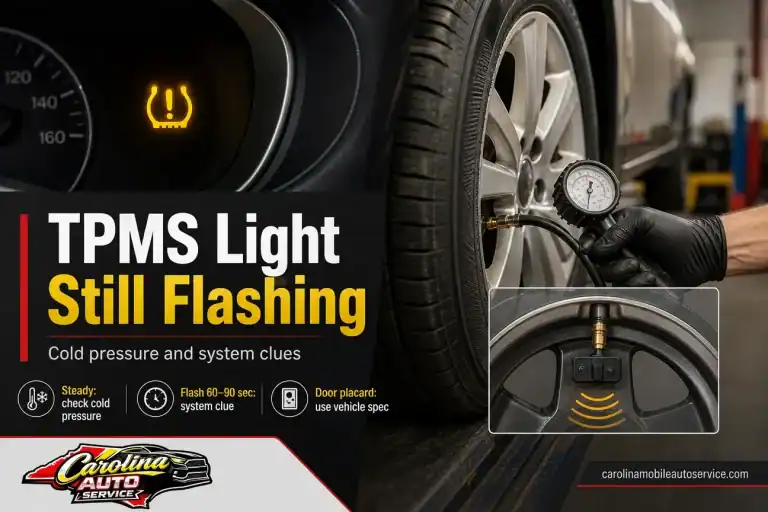
When you see a TPMS light flashing after you have already added air, the vehicle may be telling you something different from a simple low-pressure warning. A steady tire pressure light usually points first to tire pressure, but a light that flashes for about a minute and then stays on can be associated with a TPMS system fault. The right next step is not to guess at a bad part. Check the tires cold, look for visible damage, follow the vehicle-specific instructions in the owner’s manual, and arrange proper testing if the warning pattern continues.
Quick Answer
A steady tire pressure warning usually means one or more tires may be significantly underinflated and should be checked as soon as possible. A flashing warning that then stays on may indicate a possible system malfunction rather than air pressure alone. Check pressures cold using the driver-door placard or owner’s manual, not the tire sidewall maximum. If there is serious tire damage, severe pressure loss, vibration, or a handling change, stop in a safe place and arrange qualified assistance.
What a steady tire pressure warning usually means first
A steady tire pressure warning is the vehicle’s way of getting your attention before a tire problem becomes harder to control. The National Highway Traffic Safety Administration explains that when the TPMS symbol illuminates, it means at least one tire is significantly underinflated, and NHTSA tire-safety guidance says drivers should inspect tires and check tire pressure as soon as possible. That does not identify which tire is low, why it lost pressure, or whether another condition is also present.
A steady light can remain on after air is added for several reasons. One tire may still be below the recommended cold pressure. The pressure may have been checked while the tires were warm. A tire may be losing air through a puncture, valve area, wheel sealing surface, or another condition. Some vehicles also require a model-specific reset, calibration, relearn, or drive condition before the warning clears.
The important point is that the warning light is a clue, not a diagnosis. Adding air may correct low pressure, but it does not prove the tire has no damage or that the system is working normally. If the light stays on or returns, keep notes instead of guessing. That information helps narrow down whether the issue looks pressure-related, damage-related, or system-related.
Check every applicable tire, not just the one that looks low. Some vehicles monitor a full-size spare and some do not; that detail belongs in the owner’s manual. Appearance alone is not enough because a tire can look normal and still be below the recommended pressure. A tire can also look acceptable from one side while having tread or sidewall damage elsewhere.
Why the TPMS light flashing after adding air points to a different clue
A flashing TPMS light deserves a different kind of attention than a steady light. NHTSA explains that a system malfunction may be indicated by a TPMS symbol flashing for 60 to 90 seconds and then remaining illuminated. NHTSA also notes that the flashing sequence followed by continuous illumination can repeat at each startup until the malfunction is corrected.
That pattern does not prove a specific part has failed. It may be associated with a sensor that is not transmitting correctly, a valve-area issue, a receiver or control-module communication problem, a relearn issue after tire or wheel work, or another TPMS system fault detected by the vehicle. Testing is needed before naming a failed sensor, module, receiver, or wiring condition.
A flashing warning can also be confusing because the tire may have been low at first and then the system may still report a separate issue. For example, a driver may add air, see the warning continue, and assume the tire is still low. That may be true, but the flashing-then-steady pattern changes the question. At that point, the system itself may need inspection in addition to a pressure check.
If your vehicle shows a warning message in words, write it down exactly. Some dashboards say “low tire,” while others may say “TPMS,” “tire pressure monitor,” “service tire monitor,” or similar wording. Exact wording varies by make, model, year, trim, and TPMS design. Your owner’s manual is the first place to confirm what your vehicle’s specific message means.
Dashboard pattern decoder for TPMS after adding air
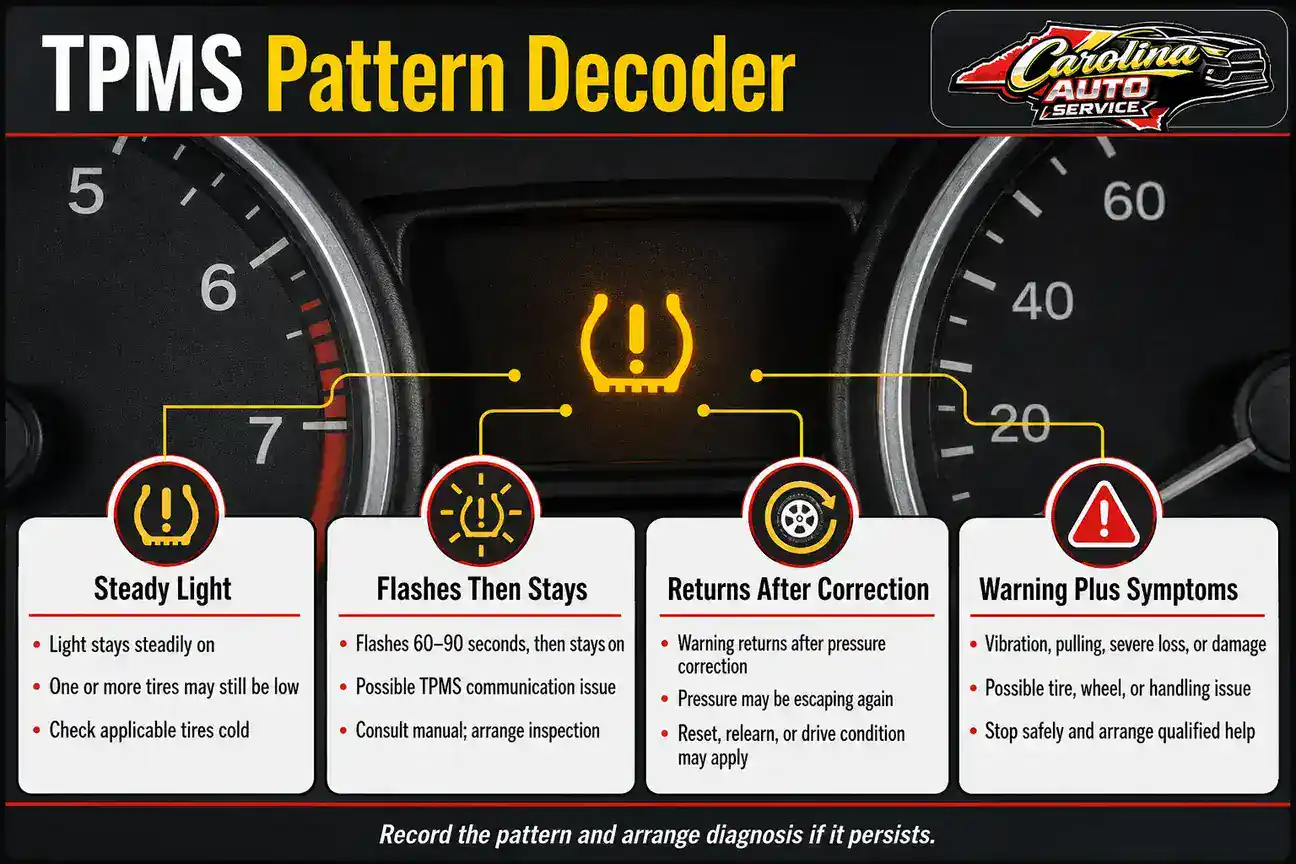
| Dashboard behavior | What it may indicate | What to do next |
|---|---|---|
| Light stays steadily on | One or more tires may still be underinflated, or pressure may be falling again | Check all applicable tires cold and look for visible damage |
| Light flashes for about 60 to 90 seconds, then stays on | A possible TPMS system fault or communication issue | Consult the owner’s manual and arrange qualified system inspection |
| Light returns after pressure correction | Pressure may be escaping, or the vehicle may need a reset, relearn, or drive condition | Record when it returns and arrange diagnosis if it persists |
| Light appears with vibration, pulling, severe pressure loss, or visible damage | A possible tire, wheel, or handling safety concern | Stop safely and arrange qualified assistance |
How to check cold pressure before assuming a TPMS system fault
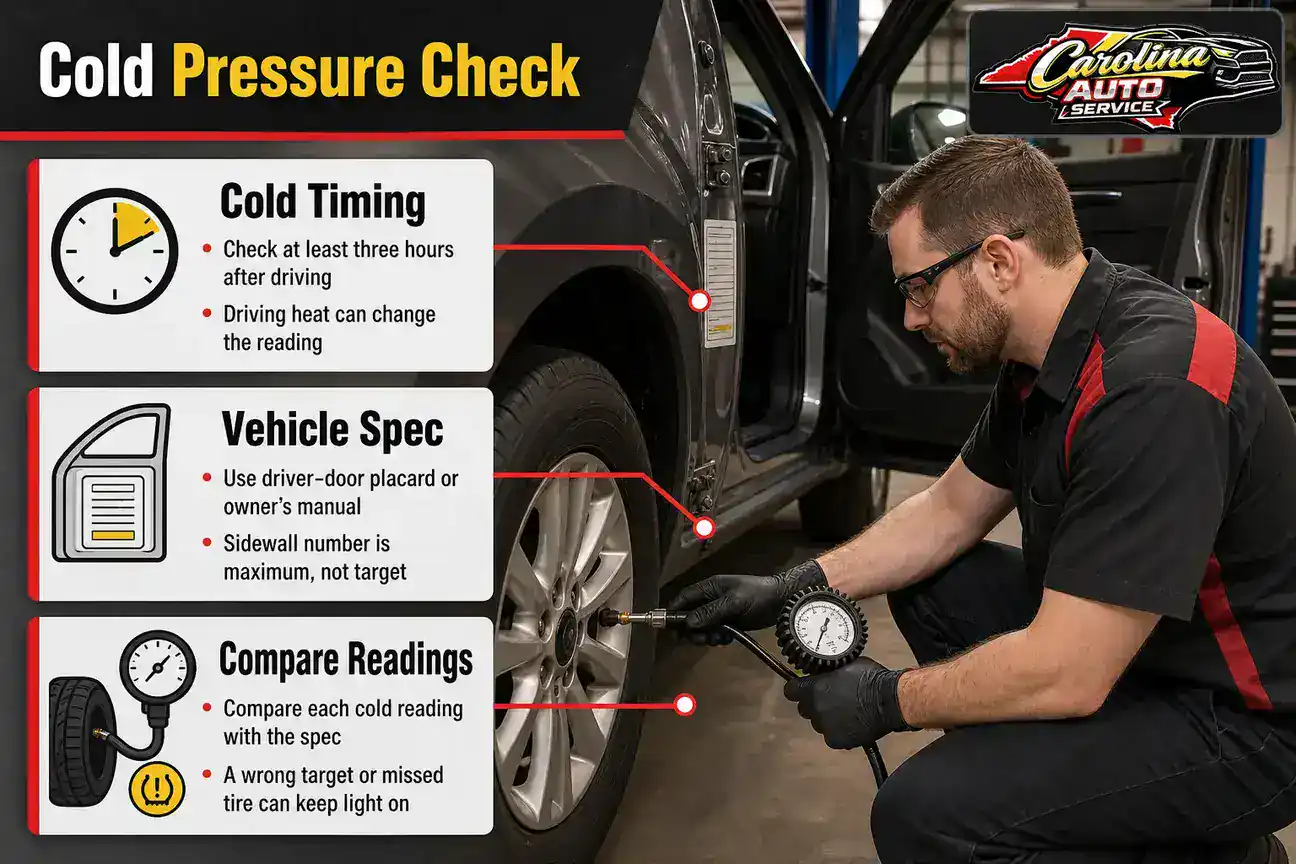
Before assuming a TPMS system fault, recheck the basics in the way the vehicle manufacturer expects. Tire pressure changes with temperature and driving heat. NHTSA’s road-trip tire guidance says to check tire pressure when cold, at least three hours after driving, for an accurate reading. That cold-pressure detail matters because a warm tire can show a pressure reading that does not match what the placard is asking for.
Use the recommended cold pressure listed on the driver-door placard or in the owner’s manual. Do not use the maximum pressure molded into the tire sidewall as the target. NHTSA specifically warns that the sidewall number is the maximum pressure the tire can hold, not the vehicle’s recommended pressure. The correct number is vehicle-specific, and front and rear tires may not always share the same specification.
When checking pressure, measure each applicable tire with a dependable gauge and write down the readings. If one tire is much lower than the others, that clue matters. If all tires match the placard and the warning continues, that clue matters too. If the pressure drops again after air is added, the situation should be treated as an active symptom, not as a light that simply needs clearing.
Do not let a pressure reading create false confidence. Correct pressure is important, but it does not rule out internal tire damage, bead-area leakage, a valve-area condition, or a TPMS problem. It also does not allow anyone to declare the vehicle safe to drive without an in-person inspection. Pressure readings are part of the picture, not the whole picture.
Visible damage that can keep a tire pressure warning coming back
A recurring tire pressure warning after air is added often leads drivers to look for a nail or screw. That is a reasonable thing to notice, but it is not the only visible clue. NHTSA advises drivers to inspect tread and sidewalls for cuts, punctures, bulges, scrapes, cracks, or bumps. Those categories are useful because some tire problems are not obvious at first glance.
Look for a tire that appears visibly low or collapsed, a nail or screw in the tread, a bulge in the sidewall, cracking, a cut, an uneven shape, or a tire that looks different from the others. Also notice whether the warning came on after hitting a pothole, scraping a curb, driving through construction debris, or traveling on a rough shoulder. A small-looking mark can still be associated with a larger concern that needs a qualified look.
If you see a bulge, exposed cord, major cut, severe pressure loss, or a tire that will not hold air, do not keep driving just to reach a shop. Stop in a safe location and arrange qualified assistance. The same advice applies if the vehicle shakes, pulls, feels unstable, or handles differently after the warning appears. A dashboard light plus a handling change should be treated more seriously than a light by itself.
A visual check cannot prove that a tire is properly inflated or undamaged inside. It also cannot prove that the warning system is operating correctly. That is why the best notes combine what you see, what the gauge reads cold, and how the dashboard behaves at startup and while driving.
4 safe reasons TPMS after adding air may not clear
If you are trying to understand TPMS after adding air, think in terms of four broad possibilities rather than one guaranteed answer. These are not diagnoses. They are starting points that help you decide what to observe and what to tell a repair facility.
1. The pressure is still not at the vehicle’s cold specification
The most basic possibility is that one or more tires still does not match the recommended cold pressure. This can happen when the pressure was adjusted after driving, when the wrong target pressure was used, or when one tire was missed. It can also happen if the tire pressure warning was triggered by more than one tire and only the most obvious tire was filled.
Use the owner’s manual or door placard and compare each cold reading with the vehicle’s specification. If the warning clears only temporarily, write down how much pressure was lost and over what period of time. That information helps separate a one-time pressure correction from a condition that is actively returning.
2. Air may be escaping again
A tire can lose air slowly enough that it does not look flat at first. Possible clues include a recurring warning after air is added, one tire consistently reading lower than the rest, or a visible object in the tread. Air loss can be associated with a puncture, valve area, wheel sealing surface, or other condition. It should not be reduced to one assumed part without inspection.
If the pressure drops quickly or the tire looks low again soon after filling, do not keep topping it off and driving as though the issue is resolved. Severe pressure loss can affect handling and tire condition. Stop safely if the vehicle feels unstable, vibrates, pulls, or shows visible tire damage.
3. The vehicle may need a specific reset or relearn
Some vehicles clear a warning after correct pressure is restored and the right drive conditions are met. Others may require a reset button, menu procedure, calibration, scan-tool relearn, or sensor identification process. That is why a universal reset sequence is not a good answer. It may be wrong for your vehicle, or it may hide the fact that the tire is still losing pressure.
The owner’s manual should be your first source for the vehicle-specific procedure. It may explain whether the vehicle uses a direct or indirect TPMS, whether there is a reset menu, and what conditions must be met before the system updates. If the flashing TPMS light pattern continues, treat that as a continuing clue rather than assuming the reset was incomplete.
4. A TPMS system fault may need testing
A possible TPMS system fault can involve communication between the wheel-area sensor and the vehicle, stored system information, sensor identification, or another part of the monitoring system. The exact cause varies by vehicle design. A scan result or warning pattern may point the diagnostic process in a direction, but it still needs confirmation.
At Carolina Auto Service, warning lights are approached with diagnosis before assumptions. The shop’s check-engine-light diagnostics page covers broader warning-light diagnostics; it should not be read as a promise that every tire or TPMS-related repair is a confirmed service. The practical takeaway is that a warning light or code is a clue, and inspection and testing determine what the vehicle needs.
When to stop driving instead of trying another reset
Do not continue driving merely because you added air or because the light went out for a short time. Stop in a safe location and arrange towing or roadside assistance if there is serious tire damage, severe pressure loss, a strong vibration, sudden pulling, a major handling change, smoke, overheating, reduced braking, steering difficulty, or another urgent warning light. Do not drive on just to reach the shop when the vehicle may be unstable or difficult to control.
A tire pressure warning without obvious handling symptoms still deserves attention, but the response depends on what you observe. If there is no visible damage and the vehicle is not shaking, pulling, or losing pressure rapidly, consult the owner’s manual, recheck cold pressure, and arrange diagnosis if the warning persists. That is different from declaring the vehicle safe. No article or phone description can confirm safety without seeing the vehicle.
If the vehicle is a hybrid and a high-voltage warning appears along with any tire or handling concern, do not attempt high-voltage checks. Hybrid warning lights and high-voltage systems are not DIY areas. Carolina Auto Service provides hybrid service in the shop, and vehicle-specific procedures should be handled through qualified diagnosis.
Why the owner’s manual matters for a flashing TPMS light
The owner’s manual matters because TPMS details are not universal. Two vehicles can show a similar dashboard symbol while using different monitoring designs and different reset procedures. The manual can identify the recommended cold pressure, the warning symbols and messages, whether the system monitors a spare tire, and the correct steps after pressure is corrected.
A vehicle-specific procedure may also depend on conditions such as ignition mode, menu settings, drive cycle, tire rotation, sensor replacement, or recent wheel work. That is why a generic internet reset sequence can be misleading. If the manual says the warning should clear under certain conditions and it does not, that is useful information for diagnosis.
Owner’s manuals are especially important when a warning appears after recent tire, wheel, battery, or electrical work. A sensor identification or relearn issue may be possible, but it should not be assumed. The timing of the warning helps, yet timing alone does not confirm the cause.
For a TPMS system fault, a repair facility may need to compare the warning behavior with manufacturer information. The vehicle may store information that helps separate a pressure issue from a system issue. Even then, the result should be explained as findings from testing, not a guess based only on the light.
What in-shop diagnostics can and cannot determine
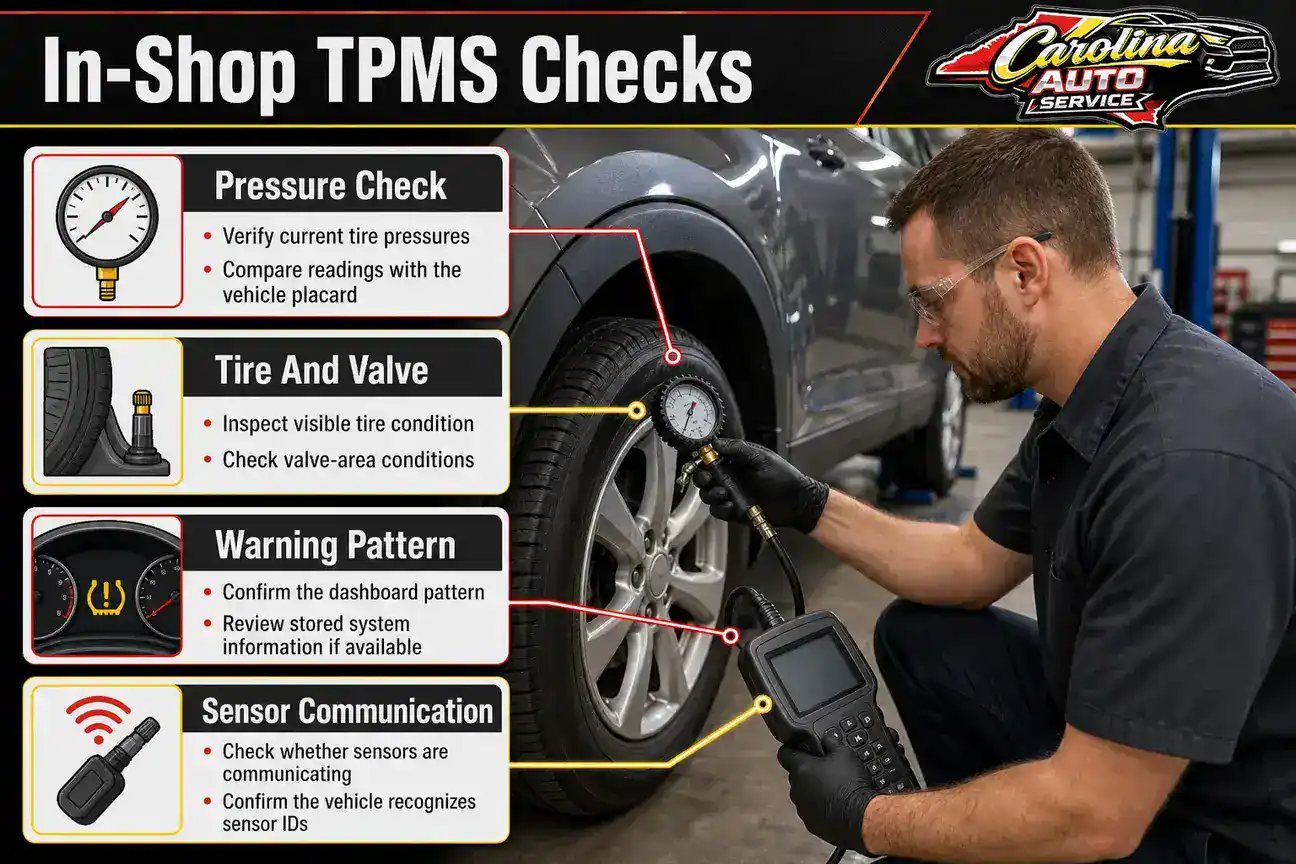
In-shop diagnostics can bring order to a confusing dashboard warning. A technician may verify current tire pressures, compare them with the vehicle placard, look at visible tire and valve-area conditions, confirm the dashboard pattern, and review stored system information if available. Testing may also check whether sensors are communicating, whether the vehicle recognizes sensor IDs, and whether the warning appears pressure-related, sensor-related, communication-related, or in need of further testing.
Diagnostics cannot honestly begin with “it is definitely the sensor” or “it only needs a reset” before the vehicle is checked. A flashing TPMS light is a useful clue, but it still needs context: cold pressure readings, visible tire condition, timing, recent work, and the exact message. That is the difference between diagnosis and parts guessing.
Carolina Auto Service’s ASE-certified technicians diagnose warning lights and other symptoms at the Hanes Mall Circle shop. For issues that fall outside a confirmed service, the shop can explain findings and next steps without presenting unconfirmed services such as tire sales, wheel alignment, tire repair, or state inspections as offerings. If authorized repairs are recommended, Carolina Auto Service provides clear repair recommendations and an estimate before work is approved.
If a qualifying repair is performed, ask about the nationwide limited 24-month/24,000-mile parts and labor warranty on qualifying repairs and the terms that apply. A roadside-assistance program may apply to qualifying service; see the roadside assistance program and warranty on qualifying repairs pages for program terms.
What to note before requesting an appointment
Good notes can shorten the path from symptom to explanation. Before requesting an appointment, write down the make, model, year, approximate mileage, and whether the light is steady or flashes before becoming steady. Note how long the flashing lasts, whether it happens at startup or while driving, and whether it repeats every time the vehicle is started.
Record each cold pressure reading and the recommended pressure listed on the placard or owner’s manual. Write down whether air was added, how much was added, and whether the warning returned. If one tire keeps dropping compared with the others, that is important. If all pressures look correct and the warning still follows the flashing-then-steady pattern, that is also important.
Also note any visible cut, puncture, bulge, crack, scrape, bump, object in the tread, vibration, pulling, noise, or handling change. Include recent tire, wheel, battery, or electrical work, even if it seems unrelated. Dashboard warning lights often make more sense when timing and recent work are considered together.
If the vehicle does not have urgent stop-driving symptoms, you can request an appointment with Carolina Auto Service and describe the warning pattern, cold pressure readings, and any symptoms. The shop confirms the appointment time. You can also call 336-765-8599 during business hours for guidance on what information to have ready.
Local notes for Winston-Salem drivers
Drivers in Winston-Salem and Forsyth County see plenty of conditions that make tire-pressure notes useful: stop-and-go traffic near Hanes Mall and I-40, seasonal temperature swings, potholes, and regular commuting. Those conditions do not diagnose the problem, but they can help explain when the warning appears and whether it follows a pattern.
Carolina Auto Service provides in-shop auto repair and diagnostics at 160 Hanes Mall Circle in Winston-Salem. If you are coming from nearby communities such as Clemmons or Lewisville, request an appointment and describe whether the light is steady, whether it flashes first, and what the cold tire pressures show. For hours, directions, and contact details, visit contact Carolina Auto Service.
Bottom line on TPMS light flashing after adding air
A TPMS light flashing after air is added should not be treated as a simple nuisance light. A steady warning usually sends you back to pressure and visible tire condition first. A flashing-then-steady warning can point toward a possible TPMS system fault that needs vehicle-specific diagnosis. Either way, the owner’s manual, cold pressure readings, visible condition, and dashboard pattern are the best starting clues.
Do not assume one universal reset will fix every vehicle. Do not assume a tire is fine because it looks normal. Do not assume a part has failed because the light flashes. Treat the warning as information, document what you observe, and arrange proper testing when the light persists or returns.
General educational information, not a diagnosis. Only an in-person inspection can confirm what a vehicle needs.
Frequently Asked Questions
Is a flashing TPMS light the same as a low-pressure warning?
No. A steady warning commonly points first to significant underinflation. A warning that flashes for about a minute and then stays on may indicate a possible monitoring-system malfunction, so pressure and system operation both need attention.
Why is the TPMS light still on after adding air?
The tire may still be below the vehicle’s recommended cold pressure, pressure may be escaping again, the reading may have been taken when the tires were warm, or the vehicle may need a model-specific reset or relearn. Testing is needed to determine the cause.
How long should tires be cold before checking pressure?
For an accurate cold-pressure reading, wait at least three hours after driving. Then compare each tire with the vehicle’s door placard or owner’s manual, not the maximum pressure printed on the tire sidewall.
Can a tire look normal and still trigger the TPMS light?
Yes. Appearance alone does not confirm pressure or rule out a slow leak, internal damage, a valve-area condition, or a monitoring-system issue. Use a pressure gauge and follow the owner’s manual.
Should I use the tire sidewall number when adding air?
No. The sidewall number is the tire’s maximum pressure, not the vehicle’s recommended pressure. Use the cold inflation pressure listed on the driver-door placard or in the owner’s manual.
Can the TPMS light reset itself after adding air?
Some vehicles may clear the warning after the correct pressure is restored and the required conditions are met. Others may require a reset, calibration, drive cycle, relearn, or scan-tool procedure. The owner’s manual gives the vehicle-specific instructions.
Can I keep driving with a flashing TPMS light?
The vehicle cannot be declared safe to drive without inspection. Stop safely and arrange qualified assistance if there is serious tire damage, severe pressure loss, vibration, pulling, or a handling change. If those signs are absent, consult the owner’s manual and arrange diagnosis rather than assuming the warning is resolved.